If running out of stored hydraulic pressure is the only problem they had, that's good. That's easy to fix, although it means some weight penalty.
What SpaceX did was a low-cost test. They were paid for a shipment to the ISS, which was successful. The test of the booster recovery system didn't cost them a launch. They didn't expend a booster just for this.
Indeed. They attempted to recycle a garbage rocket after it had been used already.
This crash into the ocean thing. That happens on literally every single other rocket launch in history, it's not abnormal, it's just not usually filmed or even thought about much.
which makes me curious, how many boosters are crashed into the ocean and what are the rules regarding them? From toxins to salvage. I know we have dumped far worse into the ocean, its littered with munitions for instance.
First stage rockets likely break into pieces upon hitting the water and sink to the ocean floor. Higher stages burn up in the atmosphere.
Debris from a successful launch are usually not worth worrying about. Failed launches, on the other hand, could contain unburned propellants, hypergolic fuels, radioactive or toxic payloads, and may come down as a blazing fireball on top of something that otherwise would have expected no more than a speck of metal oxides.
I recall seeing a video of a solid rocket booster that destroyed several cars in a parking lot with flaming chunks of partially burned propellant.
Range safety cannot reasonably be expected to protect everywhere that a rocket could possibly reach. In the worst case scenario, it must intentionally destroy the vehicle if it may stray outside the protected area such that the debris remain within it.
If you work on a launch complex, make sure you have good insurance.
> That's easy to fix, although it means some weight penalty.
It's probable that they use RP-1 as the hydraulic fuel and then dump it after use into the main RP-1 tank. In this case, assuming they don't need more high-pressure fluid than they need braking fuel, there is no weight penalty.
The news on a radio station in my area commented on this, saying something like:
"...just like you recycle your milk bottles, cardboard etc. a company has tried to /recycle/ a rocket and it blew up...haha"
It made me sad since I knew it was SpaceEx, understood the complexity of what they're attempting and they reduced it to comparing it to throwing an empty beer bottle in a bucket.
I am relieved to see that SpaceEx is viewing it largely as a success/excellent learning experience; in my opinion they are by far the most exciting thing in science/technology at the moment.
One of the annoying aspects of coverage of SpaceX's attempts, although fortunately it's fairly rare, is the desire to make fun of "eggheads" when they "fail" because it makes people feel superior.
Nevertheless, this work is one of the most important things going on in human civilization right now. That may seem like a bit of hyperbole, but go back and look at things like the invention of the transistor or the internet. Nobody perceived fully how impactful either of those things would be though they've transformed the lives of billions and spawned trillions of dollars in economic activity. If reusing rockets becomes feasible, and there's every reason to believe it will be, then it will lower the costs of spaceflight by one to two orders of magnitude right off the bat. And that will vastly accelerate our investment, colonization, and exploration of space and kickstart a positive feedback loop of growth in activities in space (from infrastructure like GPS and commsats to human presence) spurring investment in improving space and launch systems which then increases activity levels (due to increasing capabilities and lower costs) which then spurs improvements, and so on. Ultimately culminating in mankind becoming not just a multi-planet species but a space faring civilization no longer confined to either the Earth or even this Solar System. And all of that will have grown from the tiny kernel of spaceflight activities in the present, with SpaceX's activities being particularly relevant for that future.
>Although the rocket's landing did not go according to plan, the other half of the launch mission was a success.
Describing the first stage landing as "half" the mission is disingenuous. The mission was the ISS resupply, and even if the first stage landed properly if the resupply failed it would have meant a 100% mission failure.
I agree with you, and I find it fascinating that in May 2012 everyone celebrated SpaceX successfully docking with the ISS for the first time. [1]
It's only been 2.5 years, and they'd only docked to the ISS a total of 5 times before this mission, and yet everyone now takes the mission and successful docking for granted and is looking for the next great thing.
I disliked that element of the reporting too. Your use of "they" is funny, too--SpaceX and NASA would say that CRS-5 was a complete success from the point of view of the mission.
The reporter's not being disingenuous, she's just...not using words correctly. The mission was to keep the ISS astronauts supplied and alive. The mission succeeded. The tests around rocket reuse were not part of the mission.
True, but one is transformative and the other is more mundane. The issue is that to make progress in rocketry (the mission) you have to get other people to pay for it (making it ostensibly their mission).
Not to knock the ISS in any way, it's just that any of the big players could have done this resupply run afaik.
SpaceX also does them cheaper and with a higher max cargo due to Dragon being a more advanced vehicle than most, it can also return significant cargo from the ISS.
So no, the other big players currently aren't on the same level as SpaceX when it comes to ISS missions.
The Dragon capsule is a bit less capable than one would like in that it can't actually dock. That's what makes the Soyuz necessary and NASA's whatever-they're-calling-it-this-week capsule necessary.
Technically the Dragon is "berthing", in that the space station's arm is what's actually bringing the two craft together, and any failure in that arm would render Dragon unable to connect or disconnect from the station.
"There's nothing routine about flying to the Moon." - Apollo 13 Film
This isn't a moon mission of course, but I don't know if I would ever call something reaching orbit mundane. Especially for a company with only 5 successful dockings to their name.
No, I'm complaining because they're pretending the first stage landing is "half" of the mission. It's not. The fact that it didn't work is almost meaningless, whereas a failure of the resupply mission would be a disaster.
The first stage recovery was essentially bonus points. They were trying for 120% of the contracted, revenue-generating mission goals and only got 101%.
Is there a chance someone could explain this - how does not being able to move the fins (with hydraulics) translate into a hard landing - were they just off the target landing spot because the fins couldn't be used to fine-tune the descent to within a meter of the target landing zone, and thus they 'missed' the barge by a few meters, or is something else at play?
EDIT: never mind - I've learned that they have a steering function, as well as drag inducing function, and they ran out of hydraulic fluid required to induce more drag, which would thus slow the rocket down. Leaving my comment here in case anyone else is curious.
People on /r/spacex have theorized (with the aid of comments from Musk) that running out of hydraulic fluid caused the grid fins to get stuck in an extreme position, which forced the rocket off course. Cold gas thrusters and gimbaling of the engine tried to correct this, but the end result was that the rocket had insufficient control authority to achieve a controlled landing.
How is the rocket going to achieve a controlled landing with no thrust? It seems to me that it would crash into the pad anyway. Or was it that they did have thrust, they were just unable to steer because of the lost pressure?
Yes I think you've got it right - they had thrust from the rocket motors, but they ran out of hydraulic fluid required to use the fans to induce more drag, so the rocket came down hard.
Basically, because they lost steering it came in too steep, and ended up falling onto the deck on its side because the engines couldn't compensate for that position.
If the rocket's trajectory is correct, all that is required is a final hard burn to negate all downward velocity a short distance above the barge deck.
You can do away with the pump, pipes, and power supply.
Since the main propulsion isn't going, closed hydraulics would have to have an independent power supply. Probably batteries. Instead, they replace all that with some compressed air. They can run out of compressed air, but can also run out of whatever powers the pumps in a closed system.
The hydraulic fluid is probably RP-1 and is probably dumped into the fuel tank, where it's available for later burning. Another 2-for-1.
Where do the weight savings come from? Hydraulic fluid is heavy; it seems like you could save quite a bit of weight by carrying less of it if it wasn't expendable. Not that I don't believe it, just curious.
Seems like they actually use RP-1 (rocket fuel) as the hydraulic fluid so that it is burned as fuel after it has been used. This means that the hydraulic fluid isnt "dead mass"
> Why is it acceptable to leave thousands of pounds of scrap and chemicals in the ocean?
Because in the quantities caused by spaceflight, its negligible. You should be far more concerned with the bottom trawling for seafood and plastics buildup from everyday consumers.
I still don't understand. Those waffle irons are not needed at low speed. They did grasshopper landing without them right? Or perhaps they interfere if they are present and not working correctly? Either way, why did the rocket hit "hard" as Elon said? Rocket velocity shouldn't have anything to do with the waffles right?
I've been thinking someone forgot to include the height of the GPS in some code somewhere, and this whole hydraulic issue while true, is a handy way to not publicly disclose a simple mistake. Don't wanna look like the mars probe that crashed due to unit conversion issues...
So really, how does the hydralic issue affect the impact velocity?
First, "hard" landing doesn't necessarily mean "high speed". It's a generic term for unsuccessful landing. It could be incorrect attitude landing (e.g. tilted) or anything else. In this case it looks like it was exactly that: landed tilted or with significant horizontal speed. If it was high vertical speed, we would've seen big scrapes on the platform's surface, and there's none.
Contrary to popular belief, the fins are _extremely_ effective even at low speeds. First, they have enormous surface area. Secondly, they have huge momentum around the center of mass, which is at the very bottom of the rocket when it's empty. So, even a small force generated by the fins generates huge momentum and can help position the rocket in the desired attitude.
It looks like the control system was commanding the fins to move and was expecting the attitude to change, but they didn't move anymore. Perhaps at the very end of the flight the gimbals on the engine didn't have enough authority to orient the rocket vertically and/or arrest its horizontal speed.
I think it's amazing achievement for the very first attempt. Congrats SpaceX and I'm jealous like hell for what you've been able to achieve.
> I think it's amazing achievement for the very first attempt.
People don't understand this enough. They took the stage of a rocket from supersonic speeds to a tiny barge in the ocean. Even though they didn't complete the objective, they were successful in showing that the theory holds up.
On top of what you've said I don't think enough people get the scale of this task. This is decelerating, balancing, and maneuvering a 14 story tall object, from supersonic speed at the edge of space, onto a tiny barge in the ocean. It's mind boggling when you look at the scope of what they are pulling off.
I saw this same remark during the particle experiments at the LHC. If they discovered the Higgs, then we learn that our guess was right. If they can't find any evidence of the Higgs, then we learn that we might not be right. In any case, we learn things.
I liked to apply that to the Rosetta mission as well. The happy-path goal was to land a craft on a comet. If everything went 120% better than expected, then we would get a large amount of data about the surface of comets. If things went the way they did in actuality, then we get a large amount of data about comets. In either case, we learn a hell of a lot more than we did having not done the mission, regardless of it's outcome.
Science and knowledge isn't binary. Sure, you can say you either know something or you don't, but knowing something has a range of n through infinity. "Failure" gives you the option to learn more.
>> I think it's amazing achievement for the very first attempt.
I completely agree. I was just confused by the term "hard landing" and the effectiveness of the grid fins at low speed. It didn't make complete sense to me. As for my "stupid mistake" comment, I guess running out of fluid is also as simple as it gets if that's all that went wrong, and they are owning up to that.
That said, this is only a "first attempt" at putting it all together. I had fairly high confidence in them. Remember, they hovered and landed in Texas. Their first controlled re-entry failed, the second made it to the sea with onboad camera, the third was seen hovering at low speed from a plane. They had no reason to think this wouldn't work - which is not the same as having high confidence that it will work ;-) Putting it all together often leads to interesting things...
I'm still impressed and look forward to the next one.
Oddly, if it was a 'stupid' mistake I'm pretty sure they would own up to it.
But lets look at what the these things do. During descent they provide control authority over roll, pitch, and yaw of the lower stage. Even though the center of gravity is near the bottom the rocket, the system is trying to keep it vertical. It is travelling down range and needs to go from moving sideways, to coming straight down. Earlier versions of Grasshopper used hypergolic thrusters on the sides but they were scrapped in favor of the fins system. So once you run out of hydraulic fluid, you're limited to the ability to gimbal the Merlin engines for controlling pitch and yaw.
If you watch the video you can see that the fins are used all the way to the point where it lands.
So my guess is they knew they were going to run out of hydraulic fuel and brought the rocket in "hot" (at a higher than planned approach speed) and didn't manage to get close enough before the fins stopped working.
If that really was the only thing that didn't work correctly, then we'll know on the 29th.
There weren't any 'early versions' of Grasshopper. Grasshopper was a single test vehicle (and it didn't use hypergolics, it just relied on gimbaling the single Merlin it had).
The first stage has cold-gas thrusters on board for attitude control, but has never used hypergolics, AFAIK. The only hypergolic engines SpaceX uses are the Draco and SuperDraco, which were never on any first stage cores.
You are correct, a long time ago when reading about the Draco I was under the impression they were used on the early Falcon 9 as thrusters, but according to this : http://www.spacex.com/news/2013/04/04/draco-thrusters they were only used on the upper stage and on the Dragon.
If the grid fins were stuck in an unhelpful position, then the engine would have to compensate much more significantly, reducing the trust available in the 'slowing down' vector.
It's also likely that 'hit hard' just means it crashed. Looking at the pictures of the ASDS, it's clear the rocket came down off-center. Perhaps it was at the appropriate velocity, but because it landed on top of a bunch of support equipment, it fell over and exploded.
If you can't orient your rocket correctly you're going to have a hell of a time getting it to slow down to the correct speed while also maintaining the correct position for touchdown.
I'm not sure how the waffles help with that, but I'll believe the article if they say it's used for steering/rotating.
Right, I believe the grid fins are the primary roll control method (the other being friction and secondarily tilting the ship and making a precession around center of mass). If this force was lost while the control loop was expecting it to work things can go bad I guess.
Also attitude control. The stage isn't going to be much of a glider no matter what you do with it, but at terminal velocity, it has nontrivial lift and drag, and changing those will change the trajectory.
"Needed"? The rocket has maneuverability without them, sure. Just as your car has maneuverability without power steering, and your car has braking capability without ABS. But the grid fins increase the maneuverability a great deal at low cost, which is why they are used. They make it far more likely that the rocket can successfully hit a landing spot during a re-entry. So even though they add some weight and add some cost and add some complexity to the system they still increase the chances of recovering the multi-million dollar rocket hardware, which is a big win.
And the hydraulic fluid running out affects the impact velocity because the terminal trajectory of the rocket was controlled based on the assumption of having the grid fins working. When they stopped working they put the vehicle in a situation that was no longer controllable given the remaining capabilities of the rocket. If the power steering goes out on your car in the middle of a turn that's much worse than if you didn't have power steering at all, and could result in a crash.
> They did grasshopper landing without them right?
As someone who doesn't know the slightest bit about space technology, I was a bit confused about the fact that they successfully landed another rocket. If that's the case why is the landing of Flacon 9 so significant? Is it like a bigger rocket or something?
The Grasshopper was SpaceX's testbed rocket that did the "easy" version of this - taking off straight up (to a maximum altitude of 744m) and then landing right back at its launch pad. I believe one of them also did some sideways maneuvers too.
It was a bit smaller-scale (two-thirds the height) of a Falcon first stage, and I believe also had a less complicated engine. More importantly, though, given the failure mode of this rocket, it had no mission other than taking off a bit and then landing - it wasn't integrated into a rocket that was intended to get to the edge of space, decelerate from hypersonic speeds, and then do the complicated landing.
Grasshopper and the Falcon 9R Dev were the two rockets of spaceX which landed back successfully. Those were limited altitude test flight, this one were the expended first stage of a revenue flight. This rocket went higher, and faster before separation and performing a boost back burn. Might seem as just a quantitative difference, but the different aerodynamical regimes (vacum, hypersonic, supersonic, transonic) provides a real challenge.
It's also worth noting that the engines were lit 100% during those previous tests, while they have to be relight during this one. That comes with it's own set of complications of course.
Hovering a rocket under controlled conditions and actually recovering a rocket stage that was used operationally are fairly different. It seems as though they've put most of the pieces together in terms of proving they can reuse the first stages, but they haven't actually done that operationally, and there are still many doubters (even in this very thread). Actually bringing the first stage back is one step closer to proving they can reuse the stages, which would be a tremendous step forward in spaceflight.
Similarly, Apollo 8 and Apollo 10 proved fairly conclusively that NASA could land humans on the moon, but it was actually doing so on Apollo 11 that was so incredibly important.
When they recover their first 1st-stage, I'm curious what they will do with it. Use it on a self-funded test launch, or use it on a customer's launch, or just leave it there and look at it?
Probably each of those in some order. The first few recoveries will just be for taking apart and analysing, but at some point they'll be launching them; I believe they're already asking around for a customer willing to launch something (at a heavy discount) on a second-hand rocket, but I wouldn't be surprised if the very first reuse launch was self-funded.
I'm going to disagree with most of the other replies to this.
I don't think they will keep/dismantle the first recovered stage. I'm sure they'll examine it minutely, but the whole point of this is to re-use rockets. My guess is that as long as the stage appears to be in working order they will want to actually do that as soon as possible. It's how Musk rolls.
They will likely get a call from the Smithsonian at some point. Tear it down, maybe test some parts, put it back together, and ship it to D.C. You'll be able to look at it and watch video of the launch and landing right there.
Not everything needs to be a single sentence. "The tank of hydraulic fluid ran out before landing. This tank powered the fins that steer the rocket. Therefore the rocket could no longer be steered."
Or there's the ablative: "The tank of hydraulic fluid having been emptied, the fins could no longer steer the rocket."
I'd argue that's because it's wrong; not massively wrong, but wrong. You can have a parenthesis with commata on both sides (as siblings have suggested), or you can (just) write the same sentence with no commata at all and it would make sense, but a single comma in that position is a mistake.
Where's the passive? "The tank ... ran out of fluid" isn't passive. (If it is, then "the heroes ran out of time", "the car ran out of gas", "I ran out of money" and "the airplane ran out of runway" also use passive voice, yes? What is the active equivalent?)
"hydraulic fluid that powered the fins enabling them to rotate and steer" isn't passive either. Poorly written, certainly.
I double-checked with the examples in http://www.lel.ed.ac.uk/~gpullum/passive_loathing.pdf and still didn't see a match. FWIW, that paper also comments "mistaken charges of using the passive voice are commonplace".
My apologies, I read 'to rotate' as passive but it isn't at second pass. I should have tried rewriting it as active voice and it would have become obvious when I failed.


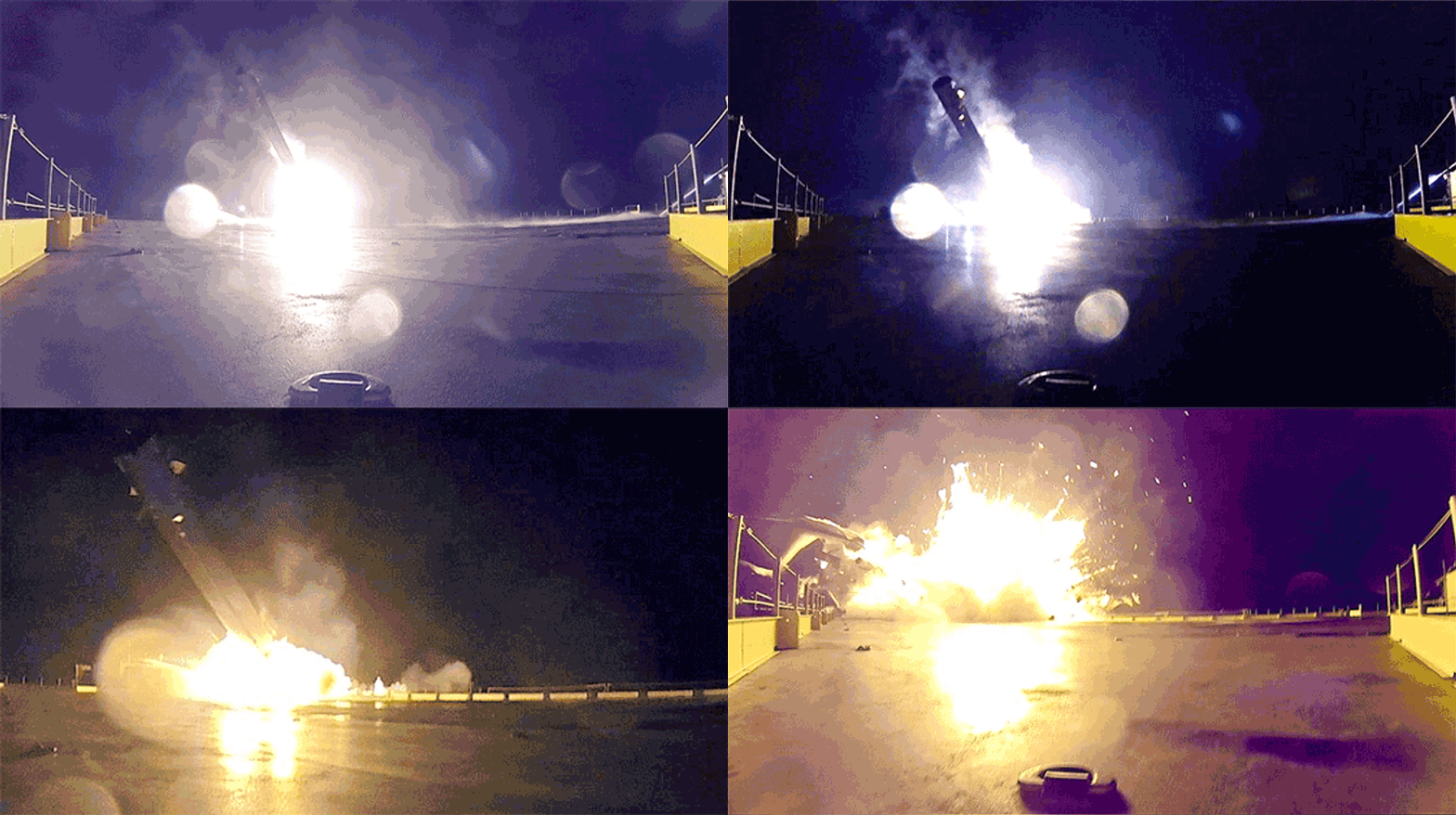

What SpaceX did was a low-cost test. They were paid for a shipment to the ISS, which was successful. The test of the booster recovery system didn't cost them a launch. They didn't expend a booster just for this.