Paul Krugman is so much better when he's being rational about economics than when he's on yet another tirade about how bad Republicans are – whether one agrees or not, it's just uninteresting. This is similar to how Richard Dawkins is utterly brilliant when he sticks to evolutionary biology but kind of insufferable when he crusades against religion.
You're entitled to your opinion on his crusades against religion. But let's bear in mind that there are those of us who consider religious irrationalism a key challenge of our age, nationally and internationally, and hence that such a crusade is important.
Yes, but he is royally screwing it up by being such a complete and utter arse about everything.
Also, you can't go and identify religion as being the biggest peril of our age when you have folk like Stalin lurking in the background of the 20th century to suggest that maybe it just might be blind adherence to dogma that is the actual issue here and that atheist political theories are just as susceptible to that particular meme as the religious when it comes to justifying blood with false utopias. I got no problem with people of a book, or not of a book, or whatever. I just have problems with the ones who take it seriously enough to kill over whose interpretation of the unknowable is correct.
And you cannot have a crusade against religious irrationality. A crusade is a religious war. It just doesn't work.
Let's also remember there are people who believe that insults and condescension are the least effective ways to help someone see they are acting irrationally, and that attacking a group of people's shared identity is the worst way to work with them on the substance of the challenges of our time.
> attacking a group of people's shared identity is the worst way to work with them on the substance of the challenges of our time
"when we insult their intelligence and mock the things they hold sacred, they fight harder against us. maybe we should try something different?"
"are you crazy? they're bad guys. they believe what they want, regardless of what empirical reality says. now let's do the exact same thing again, maybe it will work better this time."
You're right it's a poor way to change someone's mind, and certainly doesn't foster inclusion, but what of people who are still making up their mind? Mainly, I'm talking about young people who have been raised in a mostly religious context, but haven't gone head-over-heels yet.
It might be that challenging superstition in the most brutal way possible (outside of physical violence, that is), serves to promote more rational beliefs among this group.
I doubt it. I won't repost my other comment which addresses this [1] but in my opinion people like Dawkins are fanatics. And science/atheist fanatics are no better than religious fanatics. Religious fanatics drive me away from religion but Dawkins fanaticism drives me away from atheism.
I think it's calm, rational argument that has swayed me most away from religion. Just a simple thought experiment:
1. You think religions like scientology are crazy.
2. You believe in a man who was born of a virgin, died, rose from the dead, and who hundreds of millions of people eat and drink every weekend.
3. How can you call them crazy when you believe that?
Even still it's hard for me to get off the fence but simple arguments like that, which aren't arrogant and totally patronising, but lay out the facts in an honest way, are what convince people.
I think the problem with a more aggressive approach is arrogance. Most religious people probably accept they could be wrong - their belief is based on faith. But aggressive atheists argue that religious people are wrong and stupid when from a religious persons perspective the atheist has no proof they are wrong. Evolution is real and correct but isn't proof their is no God. Atheists say it's not up to them to prove their is no God, it's up to religious people to prove their is. But if you're calling someone out as wrong they will think you need to prove it. Because there is and never will be a way to disprove the existence of a God I don't think this approach works. You have to present the facts in a way that is honest but in a way that the other person hasn't thought about before.
Some of us have sympathy for his cause and still think his writings on evolution (out of a sense of "check out how amazing and exciting this stuff is!") are overwhelmingly better than his writings on religion (even if we frequently appreciate snark).
>> "The problem is, Dawkins preaches to the converted. Only atheists and creationists listen to him, and neither are likely to change their minds."
This is very true. Over the last year I've been swayed towards atheism but people like Dawkins turn me off. Despite his protests that he isn't arrogant and people just mistake his confidence for it he is a smug, arrogant git. He's right about a lot of things but it seems he and a lot of 'famous' atheists just trade in religious fanaticism for science fanaticism. His fanaticism drives me away from atheism the same way that fundamental Christian fanaticism drives me away from religion.
Krugman's article dialect borders on the offending.
The point he was making can be easily summed as the peculiarities of the macroeconomic Trilemma[1]. If Scotland honours the pound, then it must either lose monetary independence or restrict capital inflows. Every country must make this decision, whether they are in an economic union or not. Scotland's situation is interesting because effectively, a fixed exchange rate situation with Britain will mean less monetary policy mechanisms for Scotland to play with. Of course, it can always attempt to maintain economic stability with fiscal policy; it suffices here to say they have their individual purposes.
Krugman is a very well known advocate of monetary policy, especially in the 2008 recession. For this reason, it's clear he has a disposition towards favouring his own tools of choice. Of course, for being a left wing economist, it isn't difficult to see a possible reason why he favours monetary policy: it devalues currency, taking more from those who hold large cash balances.
Economists, like all other professions, should strive to be fair and balanced in their articles. Krugman's article is certainly not balanced.
> Of course, for being a left wing economist, it isn't difficult to see a possible reason why he favours monetary policy: it devalues currency, taking more from those who hold large cash balances.
This is one of those memes that just won't die: currency devaluation isn't bad for the rich. It's bad for the poor. The rich hold the vast majority of their wealth in inflation-proof assets. Their housing costs are fixed because they own houses. The poor hold what little liquid wealth they have in cash, and their housing costs are variable because they rent.
If inflation was the pro-poor policy, you could be damn sure we wouldn't have experienced it consistently for a hundred years.
This confusion springs from the idea that inflation is a pro-debtor policy. But the biggest debtors by far are rich people and institutions. Nobody lends poor people tens of thousands of dollars to buy securities on margin, or millions to build real estate developments.
The reality is more complicated. Wages tend to be sticky downwards, therefore the main way to dig a country out of a balance sheet recession is through currency devaluation, which forces a haircut through other means. It's how Canada and Germany rebounded in the 90s.
Yes, this hurts the poor and middle class, as inflation does (though it also can help - people that bought houses in the 70s effectively got a discount), but unemployment hurts more.
> This confusion springs from the idea that inflation is a pro-debtor policy.
we have made debt slightly less awful to be in, at the cost of making the entire world run on debt, and putting as many people into debt as possible.
a situation where everyone had all their needs met and didn't need to spend any money would cause the world to come falling apart at the seams. ridiculous.
No, professionals should not strive for "balance". They should strive for reason based on evidence. And when the evidence changes, their conclusions should change accordingly.
If some people say the Earth is flat and others say it's round, I don't want my geologist to say, "opinions differ on the shape of the planet".
Many influential people claimed that easy money after the 2008 collapse would cause massive devaluation of the dollar and sky high inflation and interest rates.
Krugman's models and historical evidence suggested that, contrary to popular opinion, inflation and interest rates would actually stay very low for many years, and that the dollar would maintain its value.
Six years later, the results are in. Look at the evidence and challenge your model, or you're just spouting baseless ideology.
If you'd invested with Krugman, the guy with a model who showed his work, you'd have made a lot of money. If you'd invested with the Wall Street Journal, CNBC, and the others who have an ideology without a model, you'd have lost a lot of money.
> Krugman is a very well known advocate of monetary policy, especially in the 2008 recession.
Huh? Throughout the recession and still to this day, ever since the Fed ran into the zero bound, he's been banging the drum for expansionary fiscal policy. Unconventional monetary policy (i.e. quantitative easing) is decidedly a second choice for him, given the zero bound on interest rates.
The point is that the pound's monetary policy would be set to favor England's economy while the Scots would lose any say in the matter. You make no counterargument other than name calling.
> a possible reason why he favours monetary policy: it devalues currency, taking more from those who hold large cash balances
i understand that logic, but currency devlauation ends up making things worse for pretty much everyone but the extremely wealthy.
in a deflationary economy, all you have to do in order to prepare for the future is just spend less than you earn. that's it. the savings will be more valuable in the future than it is now.
in an inflationary economy, not only must you spend less than you earn, you must now take on risk just to maintain the value of what you already have. the entire financial system exists because for most people, investing (choosing loans or investments) requires more resources and knowledge than they have on their own. you're _forced_ to play a game you don't really understand: picking companies to invest in. most people who 'get it' will tell you to just buy and hold - but all of that would be totally unnecessary if currency were deflationary or just kept its value.
of course, the extremely wealthy have much more money to invest, and can spend their whole lives managing their portfolios, because working isn't necessary for them. they benefit from the increased flow of cash into investment markets, enabling the existence of a financial industry that is necessary to service _everyone's_ 401(k) and pension fund - because "spend less then you earn" isn't enough.
Without sticking up for Krugman's article, which I'm not qualified to judge, isn't he capturing some of that "fiscal policy" level when he talks about Spanish austerity?
I think it would have made more sense for Krugman to frame this as an argument for a new Scottish currency: his point is that
* a currency union without a political union is bound to cause problems if you wait long enough
* history shows us that nobody is willing to fix the currency until it's too late
So it would be better if Scotland avoids starting on the wrong track by simply creating a currency. As he states, though, the Scottish secessionists are bound and determined to go the wrong way...
(Side note: Labor productivity is lower in Canada, but something tells me that working hours are shorter and vacations longer...)
Canada has a lot of oil and other natural resources in proportion to its population. I suspect this underwrites a lot of their high standard of living vs. labor intensiveness. I'm not sure nations that don't have that kind of cash cow can do what Canada does.
Scotland can't create a currency if they desire to join the EU. Current rules don't allow any more UK/Denmark-style currency exemptions.
It appears that Scotland's options would be:
- retain the Pound Sterling, not sure about EU membership
- Euro, with EU membership
- new currency, but without EU membership
> And it wasn’t just Spain, it was all of southern Europe and more. Even euro-area countries with sound finances, like Finland and the Netherlands, have suffered deep and prolonged slumps.
I hadn't heard of troubles in those two countries before before, though I'm sure like pretty much every country in Europe — or indeed the world — they didn't go entirely unscathed during a global financial crisis. Scotland, the UK as a whole and other western European countries aren't exactly in the depths of recession and unemployment that have been happening in Spain and Greece, for example.
Note the lack of mention of Norway (not that it's a eurozone country), which is in an incredible financial position with a $900bn fund made up primarily by saving a portion of oil revenue. While Norway has had 15 years to amass this huge fund, this is the model that Scotland would like to follow — as after independence it would have control of its north sea oil and gas revenue.
> In short, everything that has happened in Europe since 2009 or so has demonstrated that sharing a currency without sharing a government is very dangerous.
What happened was dangerous, though arguably the use of a shared currency and central bank helped countries support one another.
In any case, the most likely outcome in the case of Scottish independence is a currency union with the rest of the UK, in a similar manner to the Euro. If the Bank of England denies Scotland the use of its assets, it will also have to forgo Scotland's share of the liabilities, essentially wiping out Scotland's share of UK debt. So it's unlikely that Scotland's currency would be completely separate in any case.
All in all, while there are naturally unknown factors, there are plenty of reasons to seek independence and just in terms of economics — even excluding oil and gas revenue — an independent Scotland would appear to be in a good financial position.
The North Sea Oil paid for the 80's, the main income from it now is tax. The Norway government will still own a lot of their oil.
It will be very expensive for both the UK and Scotland if its a yes vote. I just hope it isn't because I can't see it being beneficial to either party.
The housing market in NL all but crashed and is still just about limping along. In some provinces the situation is pretty dreadful. The funny bit is that the prices haven't dropped all that much (because people are psychologically much less likely to take a loss on a property than they are to cash in on a profit, a big factor in this is that they'll end up with a remaining debt to the bank after selling the house which is definitely not always an option).
So the market simply froze with asking prices holding relatively steady and sales dropping to near zero at some point. As of late there is a bit of a recovery depending on the area you look at.
The housing crash certainly affected many parts of the US. Overall, there has been good recovery of the housing market, though some areas less robust than others.
Judging by what I see in my region (Pacific Northwest), what has been a positive factor is in-migration from other parts of the country. It leads to a question or two.
I am wondering if within Europe migration is potentially less of a contributor to economic recovery. For example, to find cheaper housing or to go where more jobs are available, there would be a reason to move to another location. But how much is such a move inhibited by language or cultural differences? Is that a significant issue?
Boundaries can be a hazard or protection or both. All kinds of unnecessary barriers can be erected between countries which can make things harder than need be. Scotland needs to be careful about getting what it wants.
Europeans are much less likely to chase the Euro than their US counterparts are going to chase the buck.
Language is one part of the issue, another is that we have a completely different look at distance. I'm living in Romania right now, I don't even know a single other Dutch person that has moved to Romania.
In the US you'd be in the company of 1000's of people from 'out of state', but you're all Americans. In Europe the chances of getting a job differ greatly depending on where you're from and where you are applying for a job.
A Romanian in NL or France would have a harder time finding employment than a local (and would get paid substantially less when they do find a job), a guy from Michigan or even Canada in San Francisco would have roughly the same chance of finding employment as a local and would earn roughly the same amount of money (that's anecdote based, not 'data' based so correct me if you feel this is inaccurate).
Part of all this is culture, part of it is stigma, xenophobia, language, perceived quality over the last decade or so of hiring people from different countries and with different backgrounds.
The US is simply much more homogeneous than Europe will ever be, even though there are large differences between say California, Colorado, Florida, New York and Wisconsin the differences between the people from those places are not all that large mentality wise and so on. You participate in a single set of elections with parties that are present everywhere.
Compare that to Spain, France, NL, Sweden, Poland, Romania and Greece to select a few examples, and the people from those countries, each with a fairly unique cultural identity. No unified elections (some of the parties don't even have parallels across a border with a next door neighbour). There is no shared history, the history books are usually written from the perspective of the country where it will be used for teaching rather than from the perspective of Europe or something a bit more objective than the local country.
I don't think the 'Federated States of Europe' will ever feel as closely knit as the USA does.
Think of the differences between the groups of states on both sides of the American civil war, now multiply by 15 or so and then take all the possible interactions between those parties. That gives you an idea of what the shared history looks like for Europeans.
> In the US you don't end up with a debt to the bank if the value is less than the loan, but thats not the case in the rest of the world
This varies between different US states (real property law is generally not federal law) and, IIRC, between first and second mortgages in some of those jurisdictions.
> In the US you don't end up with a debt to the bank if the value is less than the loan
Could you explain this a bit more. I think you are saying that in the US when you sell your house for less than the value of the loan, the banks takes the loss instead of you, which is not how I thought it worked. Does this have something to do with mortgage insurance?
> I think you are saying that in the US when you sell your house for less than the value of the loan, the banks takes the loss instead of you
This is generally the case with a voluntary sale at less than the loan value, but those are generally only possible with the consent of the lender (who has a claim on the property which must be extinguished for you to sell it.)
It is also sometimes the case in the event that the lender forecloses on the property for non-payment, and the foreclosure sale produces less than the amount owed on the loan -- but this differs between different states.
I think he means if you get foreclosed, the bank has no recourse beyond just taking your house. If you sell your house, then obviously you're responsible for the difference.
> Why would anyone sell their house for less than their mortgage when they can just walk away and not owe anything?
Credit and taxes -- a short sale is, though damaging, less so to ones creditworthiness than a foreclosure, further, the entire amount of the unpaid principal (in either the short-sale or the foreclosure/surrender case, but foreclosure sales generally return less than a short sale with positive owner involvement would) is taxable as income.
> In the US you don't end up with a debt to the bank if the value is less than the loan
That's only in certain states. Most states are "recourse states" where the bank can sue you for the difference between whatever they sold the property for and the remainder of the loan.
    > If the Bank of England denies Scotland the use of its
    > assets, it will also have to forgo Scotland's share of
    > the liabilities, essentially wiping out Scotland's share
    > of UK debt.
The Bank of England's central asset is that people believe the UK economy will produce enough to make the UK government's promises in Pounds Sterling worth something.
Salmond Shekels may not carry the same weight, perhaps quintuply so if one of the first acts of the new government is to renege on their financial commitments.
Besides: anyone who doesn't think that France, Spain, and other EU members are going to extract their pound of flesh for EU membership for Scotland - in no small part to dissuade their own autonomous regions - is living in la la land. It'll be the Euro, or being locked out of the EU. That the best response to this so far is "No no, it'll all be fine, we're already part of the EU" serves to illustrate the degree to which the independence argument is based on really really really hoping it works out OK.
> But Canada has its own currency, which means that its government can’t run out of money, that it can bail out its own banks if necessary, and more. An independent Scotland wouldn’t. And that makes a huge difference.
Works for Panama, Ecuador, and El Salvador, all of which use the dollar. Worked for plenty of successful governments on the gold standard throughout history. And it works for every state and city and other regional government. It's really pretty partisan and tendentious to suggest that governments playing games with the currency is a fundamental tenet of governance.
Just because your favored public policy techniques make use of currency manipulation doesn't mean a nation can't do without it, Mr. Krugman, even if the Scots are pretty far to the Left.
Scotland was ground zero for the industrial revolution and has had relative peace within its borders for centuries.
Those other three countries all experienced coups in living memory, and didn't seriously start industrializing until at least a century later than Scotland.
Those factors are more than enough to explain a factor of four or five difference in GDP.
Basically every government in history used commodity money for millenia. (Perhaps I should have said "using commodity money" instead of "on the gold standard". That was inexact and inaccurate.) And yes, it turns out there are problems with such systems, like recessions. Fortunately fiat money administered by a wise and knowing bureaucracy, like in the United States, renders your economy totally recession-proof!!! cough cough and if there IS a recession you can just bail out all the banks and everything will be magically better!!! cough hack gaaaaag
Anyway, the problem with commodity money (or the gold standard) is price instability when the real price of gold rises or falls because of wild swings in the supply or in national economic output. If you're Scotland and your number one trading partner is the rest of the UK and they do a half-decent job at price stability and your government holds lots of GBP, borrows in GBP, and issues bonds in GBP... well, you don't really end up having that class of problem.
My sister lives and works and Scotland on visa (we're American).
She (and others in her position) are worried that this passing may well end up with her visa not getting renewed or cancelled as they are UK viasas rather than Scottish ones.
Could be interesting times for ex-pats living in Scotland!
The plan is for Scotland to honour all current visas. Any reapplications/extensions/etc would then just go through the Scottish system thereafter rather than the UK system.
The intention is also to make immigration to Scotland easier and more forgiving, and expand the number of visas granted, not tighten up the rules.
As a Scot living in the US, I'm curious to know what's going to happen the other way around.
I'm concerned about what will happen to my British citizenship in the event of independence. It seems like Scotland would introduce its own citizenship and passport with independence, but it is unclear what would happen to existing British passport holders of Scottish descent.
If the answer is dual citizenship, I wonder how this will affect the availability of public services over time. For example, as a holder of both passports, would I be free to pick and choose which country I draw a pension from, get healthcare from, and pay tax to?
For me, there are too many unanswered questions. Currency is the tip of the iceberg.
You'll be happy to know that all European Union passports grant you access to the embassies and consulates of all other European Union countries. So if you're abroad and want access to UK embassies in the event of an independent Scotland, then that would not be a problem. Check the back page of your passport for the full terms.
You are not the only one with this concern. Despite being out of the country for a long time I would prefer to keep my British passport. I'm also annoyed that I don't get a vote on whether my nationality will change.
I am British and have a British passport. If there is a Yes votes I will have to change to a Scottish passport, which I believe will have less value, or an English passport, which is not my identity. Neither of those is a good choice.
Ex-pat Scots, whose nationality will be affected by the result, were specifically denied the vote, while English people and other nationalities, including Germans and other Europeans living in Scotland, have been allowed to vote. Complete insanity.
Let's be realistic here. I'm in the same boat, I'm Scottish and British (identity) and have a British passport (citizenship), and live in London. It's very unlikely to be an either or, and I believe the contingency right now is that in worst case, British passports will be honoured till expiry. But likeliest is dual passports. And what of my son, though, while we're on this? He's English, born here to a Scottish dad and English mum. Will he get a choice (or us on his behalf)? That exercises me more than my own passport.
On your initial question, it'll just be a straight up question of what's more important - a passport that reflects your heritage but that might have more visa requirements for a few years, or retain your existing one. If it came to it, I'd take the rUK one for now, it's not a big issue - it's like all the people I know who're from other countries and also have a UK passport.
> I am British and have a British passport. If there is a Yes votes I will have to change to a Scottish passport, which I believe will have less value, or an English passport, which is not my identity.
Er, no one has proposed that England become independent of the UK -- if Scotland leaves, you could have a Scottish passport or end up with a British passport. The United Kingdom of Great Britain and Northern Ireland -- comprised of England, Scotland, Wales, and Northern Ireland -- without Scotland will still be the United Kingdom of (most of) Great Britain and Northern Ireland -- comprised of England, Wales, and Northern Ireland.
Likely worst case scenario is the UK coffers get fat on Scottish registrations. Unless you opt to become a republic, you'll still be a British subject regardless.
    > I'm concerned about what will happen to my British
    > citizenship in the event of independence. It seems like
    > Scotland would introduce its own citizenship and
    > passport with independence, but it is unclear what would
    > happen to existing British passport holders of Scottish
    > descent.
I don't think British law acknowledges the concept of "Scottish descent". You're a British citizen, and the nationality of your parents or place of birth don't factor in to it. If you choose to surrender your British citizenship to be a member of The Social Republic of Salmond, there may be difficulties, but otherwise countries are simply not allowed to turf out their own citizens! So relax :-)
If it passes, Scotland won't actually become independent until 2016, so there's no worry there.
But in any case, there would be no reason for Scotland to make the existing UK and European standards stricter, especially for people who were already legally in the country before independence.
Interesting article. Worth noting that Stiglitz is more bullish about the economic possibilities for Scotland after independence - though I understand he's an advisor to the Scottish Government.
I'm surprised that there is so much controversy about this article - nothing Paul Krugman has written here is outside the mainstream in international economics, in fact it can be taken out of a textbook (in fact the author has written a very popular one on the subject).
The point or the article is simple - you are going to have a new set of problems to work out, please think about them, don't assume the best possible outcome. I didn't see a radical policy proposal that could possibly offend anyone. A lot of people seem to dislike the examples - but this is just nitpicking to show off.
I expect this to be a wealth transfer event and personally I am going to make some cheeky One-Cancels-the-Other Order (OCO) bids and cheeky offers on the pound and on publicly listed Scottish companies, especially financial stocks. I expect price action will likely surge upon confirmation of where this vote will go and I'm betting I'll be able to make a profit from this event. In my experience the market always overshoots upon 'risky' events and reverts back to the mean.
I would be interested to hear if anyone else sees this vote the way I do (or doesn't)?
I'm an English person that lives in Quebec, and going from what I know growing up in the UK and what I have seen here with the current polling I'm convinced not going for independence will work out worse.
The reason is markets really hate uncertainty. Given a close but non-final referendum the result isn't certainty: it's potentially decades of uncertainty. Quebec has had this for over 30 years and it's destroyed the place. (To be clear, I don't think Quebec should go independent now, but if it was going to 1980 was the time).
Independence has many unknowns, but a lot of them are of the kind where solutions mysteriously won't be available until the problem actually presents itself. For example, the Scottish EU question is a lot of bluffing on both sides, but you can't help thinking the reality will prove to be a lot less exciting. After 5-10 years it will settle down a bit, but if the status quo is preserved with the potential for another one you can watch all the businesses hedging their bets with stuff going south of the border for decades to come, while the economy in the north becomes even more dependent on the public sector, which is a recipe for trouble.
As a result I don't think anyone taking too strong a financial position based on this coming out one way or the other is particularly wise.
Right I get what you're saying but this isn't a long term trade, I'm looking to set up a sort of 'jack in the box' trade where if price leaps up or leaps down I'll catch the ride and then cash out. I expect this trade will be done in a day.
For example, I remember being in NZ when Air NZ (publicly traded national airline) was in financial trouble and their share price was tanking. As soon as I could I bought up loads of shares on the (correct) assumption that the NZ Government wouldn't let the only national carrier go bust. Sure enough the NZ Government announced a rescue package and I made some good money.
Thankfully I had the good sense to bet on Uncle Sam in 2008 and made a killing in options.
My point is that sometimes politics makes for 'wealth transfer' events in the market.
> In short, everything that has happened in Europe since 2009 or so has demonstrated that sharing a currency without sharing a government is very dangerous.
The above, I think, is the interesting content in this article. Whatever Scotland ends up doing, the larger questions of how the world of the future ought to be organized are important ones, and the above principle looks like one that is worthy of some thought.
Agreed. It seems impossible at the moment, but we should ask ourselves what the ideal situation would be and work to get there: what about a world government (democratically elected) that respects the diversity and autonomy of all nations (including Scotland, Catalonia and any others through the democratic application of the right to self-determination) with a global currency?
Independence is a tradeoff. On one side, they'll put the issue of not having currency and other downsides, on the other hand they'll put the benefits that they see fit.
Krugman's argument might be sound, I don't know, but I don't think it's the only argument.
People seem to forget this and focus on a few individual issues instead of the bigger picture. In the end nobody really knows what will happen. I feel both sides have failed at answering people's questions but that's mainly because they don't know the answers to a lot of them. The decision either way will be majorly uniformed. I think for a lot of people it will be a question of 'I don't like the way things are and this is a way to possible change that'.
And, of course, if they are independent, they'd have the ability to delink their currency from the pound later, even if that isn't their intent at the moment.
The linked article draws a bizarre comparison between Canada and Scotland, should it secede from the U.K.. First of all, Canada has nearly seven times the population and vastly more land. Second, Canada's "relatively small" economy is merely the #11 largest in the world in terms of GDP and three quarters the size of the entire U.K. (and 31% higher per capita). Third, Canada never really seceded from the U.K.. Although Canada has been independent in practice for over a century and completely independent in law since patriation in 1982, Canada's symbolic head of state is still the British monarch. Canada never had to fight or vote for independence. We just gradually wound up that way.
The relationship between Canada and the U.S. does have some superficial similarities, but Canada's status as a different country has always made relations between Canada and the U.S. substantially different than between Scotland and the U.K.. The situation Scotland finds itself is almost completely different from anything Canada as a whole has ever gone through.
The more interesting parallel is between Quebec and Scotland. Quebec's population is 50% larger than Scotland's and its land area is vastly larger, but it has held two referendums on separation from Canada and has threatened to hold others several times. Here are some lessons we've learned:
1. Baseline support for separation is Quebec is well below 50% most of the time, but separatists have chosen unusual periods when separatist sentiment is at a peak to hold referendums and campaigned hard for a victory. In these separation referendums, the advantage clearly goes to the separatists.
2. The terms for a successful separation vote have been and remain unclear. At the time of both referendums, federalists and separatists had extremely different ideas about what percentage of the vote would be necessary to actually carry out separation. Since then a "clarity act" has been passed, but all it states is that a "clear majority" is required. If it looks like Scotland might reach 50% plus one, then the U.K. and Scotland had better have a clear stance on what that will mean!
3. A separatist government was responsible for composing the referendum questions in both of Quebec's sovereignty votes. These governments can and will choose tortuous, unclear phrasing to get as many extra votes as they can.
4. Everybody has different ideas of what separation would actually entail. Would Quebec keep a portion of federal property (e.g. Military equipment)? Would they assume a proportional amount of the national debt? Would they be allowed to use Canadian currency/passports? Would English centers (e.g. Montreal) and native bands that wish to remain in Canada be permitted to separate from Quebec and remain with Canada? The list goes on and on. Federalists will make separation sound as scary and punitive as possible while separatists will make it sound as harmless as possible. The trouble is, people voting in the referendum don't really know what they're voting for except a start to the negotiations!
5. Business interests loathe political instability. Referendums and separatist governments with draconian language laws have significantly retarded Quebec's economy over the years. I would suggest that, whether they separate or not, it would be in Scotland's best interests to pass a law stating how long it must be before the next referendum on separation can be held. If this is not done, separation will remain a constant uncertainty.
6. Separation threats haven't been all bad for Quebec. Due to Canada's practice of transferring funds from wealthy provinces to poor provinces, Quebec has received substantial funding that has helped make up for it's lagging economy. Their separatist governments have also used the specter of separation to extort concession after concession out of the federal government. If Scotland votes no, it's a safe bet that the U.K. government will be pandering to Scottish interests for generations.
> Canada's status as a different country has always made relations between Canada and the U.S. substantially different than between Scotland and the U.K
That is literally the point of Krugman's article, not a reason to dismiss it.
To spell it out for you, the comparison is that an independent Scotland would have a relationship to the UK analagous to that between Canada and the US, a small northern country bordering an economically dominant southern one that is its major trading partner, and with which it has close cultural ties.
The Quebec tangent you go off on makes no sense, since the situation there is colored by a long history of struggle along religious and lingustic lines that has no parallel in the Scotland/England relationship.
It's hard to reason about the economic consequences of secession with a comparison to Quebec, because Quebec didn't secede.
The point of the article is that without its own currency, Scotland could not hope to match Canada's success as an independent member of the Commonwealth of Nations.
Especially in light of Europe's experience after the 2008 collapse, it's nuts to think you can share a currency without sharing a government.
I find it interesting to argue this referendum in comparison with the Province of Quebec (disclaimer: I'm from Quebec). Forget Canada vs Scots, both are different.
I've learn two things about referendum:
1. It gets emotional. It's ike the atom bomb of politic. What? You disagree and you'll get out of the country!? People behave differently. So... This article from the nyt looks like a scarecrow in support of a No vote. Scots do not care about our housing bubble caused by artificial low interest rates.
2. A referendum is not "unusual" or about "substantial funding". It is history in the making. Why the Scots will make a referendum, is not about federal money.
I believe in federalism, for the motives expressed by Milton Friedman. His way is to give more power to the states, and more to the cities.
A strong big spending federal gov is not ideal. Thanks housing bubble!
> a bizarre comparison between Canada and Scotland
It is especially bizarre when Ireland exists. The Republic of Ireland is right next door. It has about the same population as Scotland. One century of independence has had its ups and downs, but they’re mostly doing fine.
Krugman's comparison was not between Canada and Scotland directly, but between the pairings of (Canada + USA) and (Scotland + UK). Both instances of smaller countries geographically and culturally situated next to a larger, more powerful neighbour.
> If it looks like Scotland might reach 50% plus one, then the U.K. and Scotland had better have a clear stance on what that will mean!
I've seen several times that the government statement on the referendum is that if a (unqualified) majority is acheived, Scotland will become independent, after a period of negotiation on the specific terms, so, I don't think lack of clarity is as much of an issue here as you present it as having been for the Quebec referenda.
My very cursory reading on the subject indicate that polls have shown that Scots truly expect a major economic downturn if they secede; however they may be willing to bear that price if it will free them from a government they feel does not represent them. So, this isn't really a useful commentary on the referendum; they know the economic issues but might not care.
If we accept that nations (that is, communities of people with a feeling of belonging to the same group that share history, culture, language, traditions, etc.) exist, then we must accept that they should be considered equal in the same way people are considered equal: they should treat each other as equal and should care about the wellbeing of each other. They should look for their own wellbeing, but consider the common good of all nations to be even more important.
Given these principles, the world should encourage nations to take care of their own issues and reach the maturity and capability to function economically and advance culturally and socially, and to interact with the rest in spirit of cooperation; they would provide the means for that.
This would be, in my opinion, one of the requirements to ensure lasting peace, as well as a potent boost for the world economy. The alternative is that these nations are not recognized or only partially recognized, and that they are unable to manage their own issues the way they wish, and to have their own voice in the world, for so many of the important matters are global nowadays. Ignoring them will always lead to growing instability, as these nations and their aspirations will not disappear -and if they do, that would be a loss for humanity.
We have the tools of democracy to achieve this peacefully. The editorial of the NYT a few days ago[1] talked about the value of achieving this democratically. Xavier Sala-i-Martín, economist at Columbia University, often explains a story that makes the same point (I tried to improve Google's translation a little):
"What if an alien interested in bringing democracy to its planet suddenly appeared in our living room and asked us how do we earthlings make collective decisions? Surely we would explain that to choose our leaders, we vote; that to pass our laws, we vote; you to decide how public money is spent, we vote, and to set taxes, we vote. If, suddenly, the galactic sir stood in front of a world map and told us: "I guess you also vote in order to change the borders on this map, right?". We would have to embarrassedly respond: "No, the borders can be changed only by fighting". Given this bizarre revelation, poor Mr. green would turn green (if that was not its original color) and would run, exclaiming that we are barbarians."[2]
In common with literally all my foreign friends who, like me, have chosen to make Scotland their home, I am mystified that there is any question of rejecting the chance to become an independent country.
I do understand that change can be frightening but, on every level, the prospects for a modern, self-governing Scotland are clearly better than remaining as comedy bit-players in an exhausted system designed to serve the needs of another country's hereditary elite?
The United Kingdom was not chosen by the Scottish people in 1707, it was a stroke of royal power politics. Today, the UK is still pre-occupied with protecting the privilege and private wealth accumulated by the top 1% during the age of empire and is, therefore, laughably unfit to steer our entire population towards the opportunities of the future.
Can my Scottish friends not sense that something is wrong when the No campaign keep hammering the same obvious psychological buttons, do they not see this for the slick marketing campaign it is when Alistair Darling and the entire UK media straight-facedly suggest that oil is a curse, because of price volatility, rather than the blessing every other country considers it to be?
Is it not insulting when they suggest that, alone among all the peoples of the world, only the Scottish are incapable of democratically determining what is best for them and acting in their own best interests?
Even if Scotland did not have extraordinary natural resources that most countries would, quite literally, kill for, a rich diversity of resources that, per head of population, very few countries in the world can rival (http://pbs.twimg.com/media/Bwh9F9LCcAAKBSV.jpg), there is something much more important, and this is what I, an Irishman who has lived in Scotland for 12yrs, and ALL my foreign friends here - Canadians, Australians, English, German, Americans, Thais and French etc - can see so clearly:
A people who gain the chance to govern themselves, who become the masters of their own destiny, they grow. They cast aside of the feeling of being second-best, they lose the bitterness, the chip on their shoulder. Whatever the challenges a small nation might face, nothing is as important as the feeling of pride and self-worth that come with being a first-class citizen in your own country.
This isn't just some abstract, wishy-washy point about feeling good; the future we are heading into is one in which self-confidence, the ability to believe in ourselves and our abilities, will be a fundamental driver of business, trade and innovation. It is vital that Scottish children take on the world with the same natural self-confidence as children from Oxford or London, that they be the ones taking chances and setting up companies, not the ones deciding that, on balance, it is probably best to play it safe and aim for a dull but secure job.
Forgive me, but I must be frank: the Scottish character has been affected by three centuries of playing second fiddle to England, there is more than a smidgen of self-hate and self-destructiveness in the Scottish temperament, and the self-harm that George Monbiot writes about (http://www.theguardian.com/commentisfree/2014/sep/02/scots-i...) is likely to manifest itself spectacularly on polling day. That is why the No campaign will keep remorselessly pounding away at those deeply embedded fears and self-doubts right up until election day, because fear is how you hold people down.
They will keep pretending that it is about Alex Salmond, while conveniently ignoring real issues, such as the fact it was Scotland's oil which made Sterling a petrocurrency, propping up its value during the Thatcher years and allowing London to become a world centre of finance, all while lying about how much oil they were extracting. None of this is secret, it is all there in government papers released under the thirty-year rule:
... and this is how the last gasp of empire looks: keep jock in harness by somehow persuading him that he needs the English rather than the other way round. This is the system, it has been perfected over centuries, it is insatiable and, no matter what they or their local sock puppets say, it does not have your best interests at heart.
I think the No campaign will win. Despite the recent dramatic gains by the Yes side, I believe the No campaign, with the entire weight of the London press and the BBC behind them, are tapping into rich and reliable reserves of self-doubt in the Scottish psyche. This saddens me greatly, as I believe the eventual realisation of what has been thrown away will only further poison the Scottish soul.
Despite having been sold to the electorate as a bulwark against change, the United Kingdom will change beyond recognition in the coming years. English politics will continue to be driven rightwards by the UKIP agenda, regardless of what the Scottish people want, and we may well find ourselves out of the European Union anyway, courtesy of The Daily Mail.
Certainly, the age of austerity and privatization will continue to drive down the "Barnett formula" money you are supposedly receiving in return for your oil propping up the London Exchequer, but more devastating will be the growing sense that, yet again, the Scottish have blown it, losing the one chance you had to disentangle and discover who you really are.
Get your facts straight. First of all the Act of Union in 1707 came about because Scotland had bankrupted itself in the Darien scheme.
The question is not whether the Scots are capable for governing themselves, but whether that option will give better benefits to the people living there. On the basis of the facts that seems unlikely. But facts seem to be in short supply on the Yes side.
The most important problem is that the Nationalists have no idea what they will use as a currency. They say there will be a currency union with the rest of the UK, but all the major UK parties say that won't happen. If Scotland becomes independent it cannot force other countries to deal with it. It can't make a currency union if the other side doesn't want it. Similarly, it can't say there will be no border controls because it doesn't get to choose what's on the other side of the border. The English could put up a huge fence (and may have to) and there's absolutely nothing the Scots can do about it.
As Krugman points out if they go it alone with their own currency they will be at the whims of international capital, which will not look kindly on an unproductive welfare state that is dependent on highly volatile oil revenues (and that's if they even have a valid claim to the oil).
You say that "a people who govern themselves have a chance to grow" but what if you are wrong? What if, instead, the people who are governing are incompetent and foolish? Is there something in the Scottish water that makes their politicians trustworthy paragons of virtue. There is absolutely no guarantee that Scotland will turn out like Norway. Hope is not a policy.
As for Alex Salmond, it is about him. He has divided the country already by amplifying minor grudges against the English into political issues that have split the people. If the vote is a close yes then 50% of the people will already be disenfranchised. So much for "always getting the government you vote for".
The best option would have been for a federal system, but Braveheart-ism mixed with greed and envy have take over. Logic is useless on people like you who have an emotional desire to for their own Socialist paradise.
Yes, the top .01% elite of Scotland had bankrupted themselves and it was they who accepted this deal in return for a bail-out of there PERSONAL assets, it was never put to the Scottish people.
You are buying into the propaganda that is all about Alex Salmond, a politician nearing the end of his career and, indeed, his time on Earth.
The question you have to ask yourself is whether any independent country on the planet, regardless of its currency, would voluntarily had its governance to a neighboring country.
The point is that, today, 100% of the Scottish people are partially disenfranchised. I am entirely aware that no representative "democracy" is fully democratic, but the connection between a people and their government is undoubtedly healthier when that government is in the same country.
>Yes, the top .01% elite of Scotland had bankrupted themselves and it was they who accepted this deal in return for a bail-out of there PERSONAL assets, it was never put to the Scottish people.
Please. If you think this election is about "The Scottish People" you are deluded. It's always been about the elites.
>You are buying into the propaganda that is all about Alex Salmond, a politician nearing the end of his career and, indeed, his time on Earth.
He's 59. I know Scottish men die early, but he could easily live another 20 years, and possibly longer. There is nothing to say he won't be politically active until his death. He is a divisive figure who has capitalized on anti-English sentiment, greed and envy to increase his own standing.
>The question you have to ask yourself is whether any independent country on the planet, regardless of its currency, would voluntarily had its governance to a neighboring country.
But that's not the question, is it? The question is actually, "will the proposed system be better?" The distance doesn't matter. Ask the people of the Falkland Islands if they'd like to become Argentinian.
Right now the polls indicate that 50% of the people don't think Independence will improve their situation. Even if YES scrape a win, that's hardly a mandate. Your enthusiasm blinds you to the real fears of half of the population.
>I am entirely aware that no representative "democracy" is fully democratic, but the connection between a people and their government is undoubtedly healthier when that government is in the same country.
It already is in the same country. It's you that propose to change it to another.
No, you are wrong on the most basic point. The United Kingdom has always been, from the very start, recognised as a union of separate countries, with Scotland retaining its own legal system. The agreement handed over parliamentary and financial governance, but the country remained separate. That is why secession is even possible.
Salmond. If he achieves independence, you can expect him to do one "Mandela victory lap" in office, but he won't risk his legacy as "Father of the nation" by mucking around for long with the dirty business of actual politics.
I have no love for any politician, but I disagree with your assessment. If he had never existed, his basic pitch of "why shouldn't we run our own affairs" would, in time, have come to the fore anyway. He, personally, is being demonised because the arguments for staying in the union are not sufficiently strong.
I do agree with you that 50% odd will not be a decent mandate for either side. From the start, I have presumed that the No side would win, but that the closeness of the result would force significant change. If it is now the case that the Yes side wins, well, their slim majority will greatly influence the subsequent negotiations. For all the current bluff and bluster, we will end up with something that falls short of true independence, but both the English and the Scottish, and the political discourse of both countries, will be better off.
People aren't necessarily afraid of change. They just disagree with the proposed change - which isn't the same thing. You're patronising them as if they can't decide what's best for themselves and saying they must be doing it out of fear because they can't possibly have reached this as a rational decision.
If you offer me a piece of cake and I say no thanks, it's not out of fear is it? It's just that I'd rather not have it. No matter how tasty you think I should find it. Maybe I just prefer sandwiches.
Try to understand their reasons rather than dismissing it as fear.
What sort of moron prefers sandwiches to cakes??!!
Just kidding :)
I live and work here, I do understand that the risks are real, but I am also aware that the spirit of the Scottish people has been crushed by the fact that they have not had control over their own destiny. You might be English, in which case this will seem mystifying, but people genuinely do need that control.
People can disagree on individual policies, but this is a meta issue, regardless of where you sit on the usual political spectrum: do we make our own decisions, or allow someone else to do that for us?
I have spent a lot of time interacting and understanding the motivations of No voters. If you are not from the UK, you might be unfamiliar with the UK press, but there is a tremendous bias towards the establishment and they are very good at pressing the right buttons. A complicated system of pensions, benefits and tax credits has created a situation in which most people feel dependent upon the state, despite the fact that everyone is paying substantial amounts right back into the state.
My observation is that the sudden swing towards independence is largely due to an active and highly-motivated grassroots campaign highlighting some of the cruder button-pressing attempts by the No campaign. Voter by voter, they are dispelling fear.
"do we make our own decisions, or allow someone else to do that for us?"
The problem is, who do you consider to be "we" and who is "someone else".
Does Scotland make her own decisions or allow the UK to do that for her?
Do the Highlands make their own decisions or allow Scotland to do that for them?
Does my town make its own decisions or allow the Highlands to do that for them?
Why is Scotland the point at which you cut off and say this is a "we" and other people are a "someone else"? It sounds very reasonable to say people should govern themselves, but how do you stop before you reduce to absurdity?
Is it because Scotland is a "nation"? What does that mean? That it used to be independent? So did many regions in the UK. Is Cornwall a nation as well? What about the whole north of England, which is culturally very different to the south?
You say that the Scottish have had no control over their own destiny, but they've had exactly as much control as any other arbitrary region of land in the UK - they return members of parliament like anyone else.
I agree that the same principle could bring decision-making down to a highly-localised level, which could actually be a very good thing, but, again, you are just technically wrong to suggest that Scotland is an arbitrary region:
It entered the union as Scotland, legally it is bound to leave the union in the same form. Whether the Shetlanders later decide to push for independence is a separate issue.
As it stands, you've chosen a tough position if you want to argue that Scotland is not a very distinct country. Bear in mind that they already have an entirely separate legal system, consumer laws, NHS, educational system etc. More importantly, they overwhelming self-identify as Scottish, regardless of whether they happen to be voting yes or no in the current referendum.
Wales may push for independence at some point. Perhaps Cornwall might care enough about it too. The most interesting independence question, however, is England: I have yet to meet an Englishman who has a true sense of what his country is or how to square the massive difference between London and the rest of the country.
By the way, you are wrong about the control you think we have. Yes, we get to send MPs down to Westminster, but that did not do a thing to stop the massive moral and financial tragedies of Afghanistan and Iraq, which the Scottish, right across the political spectrum, where overwhelming against.
We also have no say in the storing of Europe's biggest arsenal of nuclear weapons just a few miles down the road from our most heavily populated city. No English region would agree to that (would you?), but the Scottish MPs are always out-voted 10-1. That is not democracy.
"By the way, you are wrong about the control you think we have. Yes, we get to send MPs down to Westminster, but that did not do a thing to stop the massive moral and financial tragedies of Afghanistan and Iraq, which the Scottish, right across the political spectrum, where overwhelming against."
But again, you can say this for any level:
"People who live near Heathrow have no say over whether or not it gets a third runway. Yes their MP can vote against it but the Heathrow MP will always be out-voted by the rest of the commons". (I don't know the real opinion of them or their MP, it's an example).
I can't resolve the problem in my mind of it being an arbitrary division of the population. You could find pockets of people overwhelmingly in favour or against some issue all around the country. Is it not democracy because they don't get their way? Of course not.
What size does a region have to be to be able to veto policy to satisfy your democracy condition?
> It entered the union as Scotland, legally it is bound to leave the union in the same form.
based on what? your gut feeling?
the UK parliament can do whatever it wishes, a concept known as parliamentary sovereignty.
> Yes, we get to send MPs down to Westminster, but that did not do a thing to stop the massive moral and financial tragedies of Afghanistan and Iraq, which the Scottish, right across the political spectrum, where overwhelming against.
your representatives, Scottish Labour, voted for both wars, but let's not let facts get in the way of Yes...
Yes, it was an ad hominem attack, I accept that, but, regardless of prizes he may have been awarded (and, remember, Barack Obama was the recipient of the Nobel Peace Prize), I am reasonably confident that most people familiar with his work will concur that he has a tendency for buffoonish show-boating on controversial topics. Joseph Stiglitz, on the other hand, is widely respected for the clarity of his thought.
> Is it not insulting when they suggest that, alone among all the peoples of the world, only the Scottish are incapable of democratically determining what is best for them and acting in their own best interests?
Surely as an Irishman you are familiar with the Wales, and Northern Ireland?
I agree that the chip on the shoulder attitude does exist in Scotland, but I don't think that independence is the magical solution you propose.
I am also Irish, and there is a very similar sentiment towards the English in people here, yet we have had our independence for generations now.
I think that the solution to that kind of sentiment is to work more towards inclusiveness. Again I think we have a perfect example of this on our doorstep - we have only started to make progress with the troubles in Northern Ireland when politicians sat down and started working together.
I don't know what side of the debate I side with, but it sounds to me like you have bought all the emotional rhetoric that the yes campaign have been selling.
I fail to see result of the vote having any great consequence for Scotland, they will still be EU members after all.
As someone who lives here, I have to think with my brain, not just go with my heart.
I can tell you that there is a HUGE difference between any remaining grudges the Irish may have against the English - and, honestly, in my experience, the Irish and the English get on terrifically well - and the extremely dark feelings that most Scottish people harbour.
This feeling of oppression, and the self-loathing that accompanies it, seeps into every aspect of life. When working in the startup scene in Scotland, I was always taken aback, on visits home, by the relative positivity and optimism of the Irish startup scene.
Many Scottish point to the Irish crash as an example of why independence is a terrible idea but, seriously, even after the crash, there was more energy in Ireland than there ever was in Scotland. This is a country in permanent depression.
The natural progression of what you are saying is that Ireland should have remained in the United Kingdom because, after all, they would still be EU members.
The EU commissioners would prefer everything to remain as it is because the UK government has promised an in-out referendum on the EU and, quite simply, they figure there is more chance of the in vote winning if Scotland is still part of the UK at that time.
So, the EU commissioners will say all they can to keep the UK together.
However ... the tone will rapidly change if Scotland does go independent. There is zero chance that the EU will risk forcing a prosperous, educated country that is already compliant with EU laws out and make them spend several years re-applying, especially when there is a real chance that England will be leaving.
The EU is a business, a very lucrative one. They need the rich countries to pay for the poor, uneducated, mafia-riddled ones to the south and the east. They already lost oil-rich Norway years ago, they won't make the same mistake again.
Just watch, the EU will arrange for "special status" to kick in on the very first day of independence, nothing will change.
You're not helping the Scottish cause with junk info like this. (I'm French and pro-independence)
"EU is a business", "north pays for south", "zero chance that the EU..." - all parts of a thought process that'd lead you to disaster .
The EU is a complex, unique international organization designed to bring peace through unprecedented one-of-a-kind economic development.
I get from Brussels insiders that a best-case scenario is an independent Scotland joining the eurozone, while rUK votes to stay in the EU with a "ad hoc" status.
Now most member states have very different feelings about this. This forces the EU Commission to keep a low profile and stick to conservative answers on any independence question.
You have to realize that there _is_ a risk that some member states can block a fast track accession to EU for iScotland. For instance iScotland could have to go through a 3-5 years roadmap and audit until the standard 12 points for accession are cleared (vs a best case, unprecedented 12-months fast track to the EU).
As I see it, this is the biggest risk for iScotland. Even with EU Parliament on your side, member states have influence and power that could slow down the process, and expose the new country to a tough start. I hope the Yes wins, but I hope the win doesn't get ruined with unrealistic expectations.
> straight-facedly suggest that oil is a curse, because of price volatility, rather than the blessing every other country considers it to be?
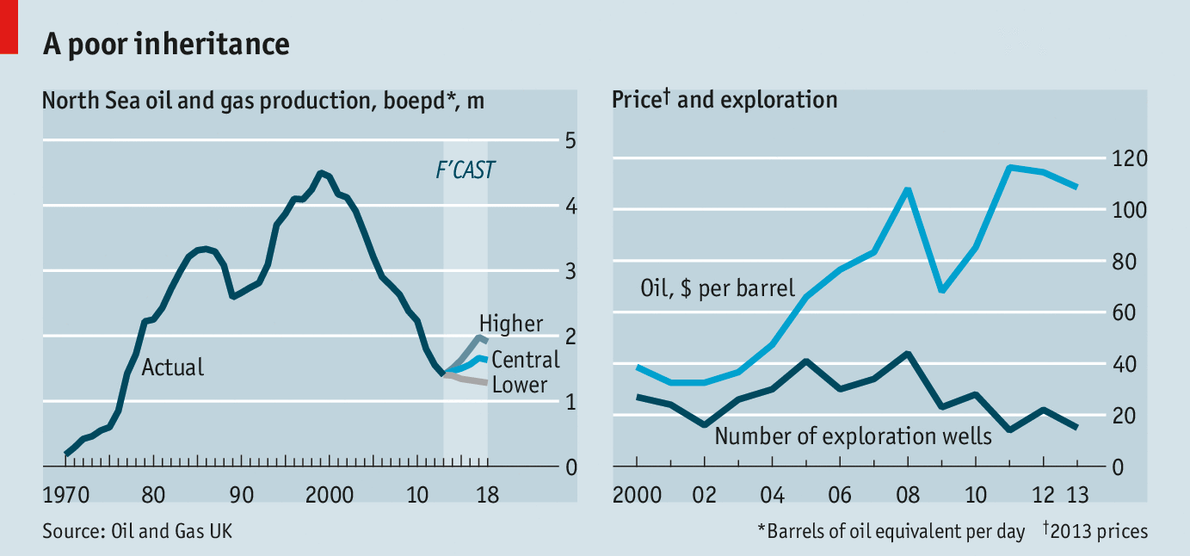
Easy. the price volatility is a red herring. The real curse is that the UK already rode the peak of production, but the average of all North Sea fields is now in terminal decline.
In particular, you will spend more and more money (currently about 8bn OPEX/yr and growing [0]) but only get a declining production: lately about -5% less oil/yr [1]). There are still many billions to be made, but it won't fuel _growth_ in Scotland. (the link you provided explains how the UK already took that opportunity)
There are all sorts of reports, including the ones which point out that the oil and gas fields off the West coast of Scotland have remained unexplored because the British Ministry of Defense banned it because the nuclear submarines needed to get safely in and out of the Faslane naval base (Europe's biggest accumulation of nuclear weaponry, just 30 miles from Scotland's largest city).
My belief, based on the most recent independent reports, is that there is a great deal of oil and gas left ... but ... even if there was not a drop, it would still be better for the Scottish people to control their own destiny.
Note that I didn't mention anything about the independence. I'm pretty agnostic about it. Managing a resource is good, but one has to be realistic about the prospects. I think wind energy is an awesome resource for Scotland too, often overlooked.
I linked to data and analysis. Where are the sources for the conspiracy about the "unexplored banned resources"? (note that the exact same reservoir behaviour (steep production decline due to rapidly falling pressure) is happening in Denmark and Norway, where the British Ministry of Defence has no authority and there is no "Faslane" naval base).
What then, do you say to the idea of the Shetlands declaring independence from Scotland if Scotland declares independence from the UK? I think they might have the same arguments you put forth...
Sure, it might be a good thing for the Shetlanders to push for but, legally, the entity which was undemocratically coerced into the union is the one which must leave it. Scotland as a whole needs to become independent first.
> A people who gain the chance to govern themselves, who become the masters of their own destiny, they grow.
What he's saying is that without a Scottish currency, they won't be the masters of their own destiny. Using the pound is OK for a while, but there are advantages to not following London's monetary policy.
It is something of a red herring to suggest that the pound, and the right to decree monetary policy, belongs to England alone. The Scots have done just as much to make it what it is, with Scottish oil being what made sterling a stable petrocurrency and, therefore, allowed the UK to become a power a financial powerhouse in the Eighties.
Realistically, after the bluff and bluster of campaigning has passed, the UK will strike some sort of deal with Scotland because, quite simply, they don't want to be left holding the national debt. If England claims Sterling as it's own, Scotland can legally walk away from any responsibility for the banking bail-outs. None of that will happen, however, because it is in the economic interests of both to co-operate.
REMEMBER, England was furious when Ireland left the UK, and did everything they could to renege on the terms of the peace treaty, including the size of Northern Ireland. The one thing they didn't fuck with was their own economic self-interest. Ireland, as the UK's biggest trading partner, continued to use the pound Sterling for more than 50 years after independence. Think about that.
Worst case scenario, the loonies from UKIP somehow get into power and insist on punishing the Scots for daring to leave. The Scots will simply create a currency that is pegged to sterling, just like the ten other countries who have been doing so for decades, or like the 14 countries that have pegged to the dollar, or the 20 countries outside the currency union who have pegged to the Euro.
You could say that pegging would be bad, because they would not have any control of monetary policy but, actually, that is the entire problem with the current arrangement. The shift from industry to financial services, propped up by Sterling being a petrocurrency on the back of Scottish oil, is what decimated Scotland. Every decision taken in Westminster enriches London and the South-East, the rest of the UK is an afterthought.
This whole debate is ridiculous, much like Texas perennially threatening to defect. No way that the UK would let Scotland leave with the oil revenues. There is that other article that points out that if Scotland defected, the Shetlands (oil revenues) would have an equally good claim to leave Scotland too.
Then what would Scotland be? The sucking welfare hole that swallows a huge amount of UK tax money, without any more tax money to support it. I.e. the poor backwater of a frontier country it once was...
Not only did the Edinburgh Agreement indicate that the UK would honor the results, but the UK government also explicitly granted the Scottish government the right to hold the referendum (constitutional issues would normally be a power reserved by the UK parliament).
The principle doesn't just apply to changes of government, it means that a commitment by parliament is only good so long as parliament consents to that commitment. It can be changed or overruled at any time.
Sure but for a Government being able to function depends on you being able to take their word to have at least some value. They have committed to this. I think it is reasonable to assume they will stick to it. Yes governments break promises, but I think this is one they will stick with.