People who don't work at all. That's the choice (maybe more like outcome) the society went with. For what might the first time in history, the rich are working more than the poor[1] and labour participation rates are dropping[2].
In many ways this is a superior alternative. Children don't work. They used to. People spend a lot more time in school at the beginning of their life when it has the potential to have the biggest impact. It's not all bad. Although not quite living up to the dreams from 20th century either.
There's also something to be said about positional goods. A lot of people are driven by status and they work to be ahead of others. Elizabeth Warren believes that this explains why, despite technological progress, regular middle class family needs two incomes where one was enough a couple decades ago[3], they're competing for the same house, or school district. It doesn't explain everything but it's a factor.
I think competition is the main villain here. Zero-sum games, prisoner's dilemmas, arms races and tragedies of the commons stole the four-hour workday from us, and many other good things besides. A nice toy example is "20% time" at companies like Google, which tends to evaporate as soon as your performance evaluation compared to your peers becomes tied to your performance at your main project.
The only solution to competition is centrally enforced precommitment. First, the government should actually enforce the eight-hour workday. Then it should reduce the workday, for all employers at once, so no one can get ahead by cheating. I don't see any other solution.
> The only solution to competition is centrally enforced precommitment. First, the government should actually enforce the eight-hour workday. Then it should reduce the workday, for all employers at once, so no one can get ahead by cheating. I don't see any other solution.
This would not really be a solution. All it would result in is more people taking work home, because job evaluations would still be based on how much progress one made on the primary project. To get ahead and get that next promotion, many people would still feel compelled to work extra (unreported) hours. I suspect a madate such as what you propose would simply push the long work-days into being unreported.
This is basically what happens in graduate school (in the US, at least). I just finished a PhD program; as part of our contrats students agreed to only work 20 hours per week. There is no way one could finish a dissertation working on 20 hours per week, so everyone worked longer hours. Sure, you could complain about how many hours you worked (and some people did), but that did not change the fact that only 10–20% of Astronomy PhDs get faculty jobs, so if you want that faculty job, you need to put in the hours to do great research, regardless of the mandated 20 hour limit.
Do you think there /is/ a solution to the problem? Or is this just one of the side effects of capitalism?
I'm not trolling here...just curious. My own mind tends to go in the direction of the parent, but, I also see how enforcement would be next to impossible.
I think you're trying to solve a wrong problem. Work isn't a problem. Work is what propelled humanity to explore, understand and conquer the world around us. Human work is a requirement for the development of medicine, greener technologies, safer transportation and even space exploration and colonization.
If there are any problems about work, they are about making it more enjoyable, making good work more widely accessible and distributing the proceeds fairly.
That is the exact problem with the 4 hour workday and other forms of part-time work. As I've heard many people describe part-time work : 40% of the pay for 80% of the work.
Until that changes, I would not expect part-time work to happen for anyone but really high up managers where such a trade may actually make sense.
I am not sure there is an institutional or global solution. But I am also not convinced it is an institutional or global problem. There are certainly individual solutions—accepting a different standard of living in exchange for fewer working hours, selecting careers which have better working hours—but I have trouble envisioning a global change (short of a cultural attitude shift) which would "solve" this "problem".
Sorry, tragedies of the commons don't have individual solutions. If everyone else is overfishing the common supply, you overfish as well, or go out of business. If everyone else is using performance enhancing drugs, you use them as well, or drop out. If everyone else is working 80 hour weeks and thus bidding up the price of houses, you do the same, or you can't buy a house. These things are very well studied in game theory, and I wasn't kidding when I said the only solution is centrally enforced precommitment.
You are equating basic competition with the tragedy of the commons. Even if it were a zero sum game (which it is not) it still would not be an example of the tragedy of the commons. The tragedy of the commons is when individuals have the option to consume, but do not have to bear the cost. They then choose to over-consume because they have no incentive not to. In your example the people who work 80 hours to afford a house, have to work 80, thus bearing the cost themselves.
The market value of labor, relative to other goods.
Also see the book "Two-Income Trap", it basically describes how households didn't become better off from making both partners work, because that just bid down the price of labor relative to housing and education. Everyone ended up in the same position as before, but now they work 2x more and cannot opt out. Also the non-working partner in the family provided a safety net because they could start working if things got rough, and now that safety net is gone.
> Everyone ended up in the same position as before, but now they work 2x more
Surely the extra people working produced more output (e.g. ~twice as many bugs fixed/year or ~twice as many new anti-cancer drugs/year). Supply of some things would remain constraint and their prices would be bidden up, but many others would have their supply increased and prices could even fall (e.g. due to capital costs spread over a larger number of units). We definitely have not ended up in the same position as before.
Sure, it's not the same position. Smartphones are getting cheaper. But how much do you spend on smartphones? The main argument is about things like housing and education, which don't seem to be getting cheaper.
Forcibly reducing the workday doesn't sound like a good idea, the optimal number of work hours depends on your specific situation. If I love my job, I could be ok with 9 hours a day. If I hate my job but it pays really really well, I could be ok with 4 hours a day or less.
You have to understand that no proposal for the government to enforce specific outcomes is ever an attempt to solve an actual problem. It's always, in every case, someone's attempt to make reality conform to their own ideological prejudices.
You have to understand that no comment is about describing reality as it is, but rather someone's attempt to make reality conform to their own ideological prejudices.
I'm guessing those wages exclude benefits, because when you consider total compensation it actually reflects growth in productivity.
Total employee compensation as a share of national income was 66 percent of national income in 1970 and 64 percent in 2006. This measure of the labor compensation share has been remarkably stable since the 1970s. It rose from an average of 62 percent in the decade of the 1960s to 66 percent in the decades of the 1970s and 1980s and then declined to 65 percent in the decade of the 1990s where it has again been from 2000 until the most recent quarter.
Not only are the goods positional, but also much of the new work that's been created. The extra hours aren't replacing children on the farm or in the factories (the developing work takes on those jobs as a much lower cost). They're being created in professions like marketing, banking and civil law which exist to a large extent more to defend their employers' margins from competition than improve productive output. A corollary of this is that, purely theoretically, a four hour workweek might be achievable for the middle classes simply by trading those hours worked that have a negative impact on the economy as a whole for leisure. The problem is that nobody knows which half of their advertising budget is wasted (but there will be no shortage consultants willing to charge expensive hourly rates to offer an opinion), and everybody knows that even though their own exceptionally hard-working investment manager spent hours making the wrong bets against the economic downturn, somebody sat on the upside of that trade and everybody would suffer if there was no liquidity whatsoever.
Beyond positional goods, the other money-suckers are higher education and healthcare, which are both on the one hand arguably an extremely good thing for increasingly large amounts of economic surplus to be thrown at despite inevitably diminishing returns, and on the other hand utterly ridiculous in the US.
>>People who don't work at all. That's the choice (maybe more like outcome) the society went with. For what might the first time in history, the rich are working more than the poor[1] and labour participation rates are dropping[2].
Wow! Sorry, but did you actually read and critically analyze the links you provided?
The first link for example is utterly ridiculous. First, it defines "rich" people as those who have a Bachelor's degree. In which bizarro world is this actually true? Second, the author argues that these so-called rich people work more because of factors like "winner takes all" and "earning more money makes leisure more expensive." Whereas he completely ignores the elephant in the room, which is that poor people are almost always hourly and are discouraged (if not forbidden) from working overtime. In contrast, higher-paid workers are salaried, so of course their companies do their best to suck as much work out of them as possible. This fact alone can single-handedly explain the discrepancy in work hours.
Of course, what the submitted article is talking about when it says "rich" is actual rich people. You know, those who have "fuck-you money," either because they come from wealthy families or because they made a lucky exit. Those people don't have to work at all, and in fact most of them don't.
In the past century, the average retirement age has been steadily decreasing up until very recently when it began going up again[1]. People spend more time in school earlier, but education usually leads to working later in life as well[2].
> education usually leads to working later in life as well
Do either of these explore why? My initial uninformed guess is that knowledge based fields many college grads go into are much less tied to physical fitness and thus workers are able to continue their jobs later into life when physical labor wouldn't be possible.
Capitalism`s greatest strength is also its greatest weakness. The profit motive is so strong that it often ends up creating irrational scenarios such as the economic situation we have today.
European countries seem to have struck a far better balance by harnessing the profit motive of capitalism while preventing disasters such as for-profit healthcare, for-profit education, for-profit government policies (for the rich), for-profit prisons, etc.
It is fascinating how powerful cultural and institutional momentum can be. I regularly run into very intelligent and rational Americans (particularly on HN!) who defend American institutions (e.g. healthcare) in spite of all the widespread data about them being massively inefficient.
In the end, we reap what we sow. The profit motive brings great riches, but to a tiny few. The rest, sadly, often become the servants who enable the lifestyles of these outliers. Conversely, the outliers become the American Dream, seducing the average worker ever onwards with promises of riches and comfort just a few lucky breaks away.
That and the absolute horrible response to the word Socialism which is equated directly with Communism by large parts of the electorate.
The US system is very good at produce big winners at the expense of everyone else - http://www.youtube.com/watch?v=QPKKQnijnsM astounded me even though I already knew the distribution was inequitable.
Please explain how for-profit education is a disaster. By all measures, private schools in the US are superior to public schools, and the US's private universities are consistently rated best in the world.
You also can't generalize about e.g. for-profit healthcare based on the American situation, because the regulatory environment is so extreme as to have to created a government-controlled crony-capitalistic oligopoly. The for-profit healthcare in less regulated countries like Mexico is inexpensive and amazing.
you equated "for-profit" education with "private schools". The two are not the same. Most of the category that you think of as "private schools" are non-profit, but religious or otherwise not government-sponsored.
I can only assume the parent is blaming the spiraling cost of education on Capitalism, when in fact it's the perpetually increasing federal loan guarantees spurring massive inflation that is the root of the cause.
The spiral in healthcare was also caused by the government taking over the industry in the late 1960s. No coincidence both industries began to skyrocket in cost at exactly the same time, shortly after Nixon ended the gold standard, and the Fed acquired free reign to generate immense inflation and aggressively tamper with interest rates (spurring the cheap consumer debt boom of the past 40 years).
Everyone recognizes that healthcare and education became very expensive recently. Nobody seems to ask what changed in the last few decades to cause that. They act like Capitalism didn't exist in 1960.
> the US's private universities are consistently rated best in the world.
By whom? In particular, are there any ratings of American versus European universities by people who have experience of both? I only have experience of the latter; from what I've heard from Americans talking about their university experience, it sounds markedly inferior.
Okay, taking a look at the criteria they say they use.
Most of the weight is on research. Fair enough. I'm prepared to believe that conclusion, at least as an overall tendency. However, the context of the discussion was education, and that's the context in which I'm disputing the basis of the claim of superiority of American universities.
Of the fraction of the weight placed on quality of teaching, a significant chunk goes on 'perceived prestige' which obviously begs the question.
A small chunk goes on student/teacher ratio, which is a weak indicator; in particular, its behavior is more threshold than monotonic (i.e. you don't want it to be too high, but there's no real advantage in having it remarkably low).
And a chunk goes on total budget per teacher, which is a positively perverse criterion and tends to substantiate the stories I've heard about the level of waste in American universities.
So that's the 'world university rankings'. Moral of that story: when you see an official looking table that seems to support a controversial conclusion, look carefully at where the data comes from.
(Sibling comment since it's not giving me a 'reply' link for some reason)
To be clear, I'm not claiming European universities are better for education (as opposed to research) than American ones. I only have experience of the former, so I'm not in a position to make that claim. I'm merely disputing the reverse claim. I'm saying unless we can find accounts from people who have experience of both, the correct position to take is an agnostic one.
The U.S. system has both research universities and teaching colleges. Some institutions are both (e.g., Harvard), but many are one or the other.
>when you see an official looking table that seems to support a controversial conclusion
I've presented some data. If you have contrary data, present it. Otherwise it's just your opinion, no? I mean, you dispute the metrics they use, but don't provide any of your own. What would be a better measure of the quality of teaching?
For profit education is good at delivering education for those that can afford it; in the case of university education that means providing an excellent degree programme and qualification which saddles graduates with cripplingly high loan repayments they will take over a decade to pay off.
What they add in prestige, they subtract by making continuous employment a full-time professional job the only practical option for the average graduate. I'd hesitate to call that a "disaster", but it is a huge factor in the phenomenon the article (edit: and particularly the Economist link posted by spindrift http://www.economist.com/news/finance-and-economics/21600989...)
describes: educated professionals in the US actually [necessarily] working more hours than the average person.
When America was still Capitalistic, still had a functioning free market system, the results it produced in both education and healthcare put the European welfare state model to shame. If you go back 30, 40, 50 years America embarrassed most of Europe in both healthcare and education. For decades America had both the best healthcare system, and a very cost effective system. That reputation has only been lost in the last 20 years.
It's only the last two decades, with America's collapse into a second-rate welfare state in the French model, with the unemployment and debt to go with it, that a very select few European countries have caught up (most of which are tiny, homogenous and generally locked down on immigration; and the prime example, Norway, only got there due to half a barrel of oil per day per person).
Most of Europe consists of impoverished, backwards welfare states. It seems a lot of people like to pretend Spain doesn't have 36% real unemployment, that Portugal isn't as poor as it is, Greece isn't still watching its failed soft-socialism model erode as promises can't be kept, and they seem to like to pretend that eastern Europe doesn't exist at all. There are only a few countries in all of Europe in fact, that are good examples. Germany is the only large example that is working, both the UK and France are drowning in massive piles of debt, having stolen from the future to fake present prosperity. Denmark and the Netherlands are two of the most indebted nations on earth per capita, both having stolen from the future to fake today as well.
I hardly see any examples where the European welfare state model has actually worked. I'd love someone to show me where I'm wrong about stealing from the future to fake present prosperity via massive debt accumulation.
>>When America was still Capitalistic, still had a functioning free market system, the results it produced in both education and healthcare put the European welfare state model to shame. If you go back 30, 40, 50 years America embarrassed most of Europe in both healthcare and education. For decades America had both the best healthcare system, and a very cost effective system. That reputation has only been lost in the last 20 years.
Your narrative is flawed. The reason America was ahead of other countries many decades ago has nothing to do with it "still being capitalistic" or "still having a functioning free system." America was ahead because other Western nations were still recovering from WWII. Many of them got invaded, and those that did not get invaded still got a lot of their cities and economies destroyed. London for example was pummeled by more than one thousand V2 rockets, and Dresden was flattened with 3900 tons of high explosives and incendiaries, killing 25,000 people. America suffered nothing like that.
Norway doesn't actually spend any of theoil money. Its all saved in a rainy-day fund. Said fund now owns over 1 % of all publicly listed sticks in the world. Norways welfare state is run of non-oil income, generated by maximizing the number of middl-class taxpayers in the coutry. Much the same strategy as Sweden, Denmark, Finland, Nederlands, Belgium, etc etc employs.
Americas welfare expenses is actually about 1/3rd of what the really successful European eco0nomies spend. Germany, Austria, Switzerland...America spends about what Italy and Spain does per person in welfare. A bit more than Portugal and Greece, but definitely UPIGS territory.
Americas model worked in the decades after world war 2, when all competition was bombed into ruins and needed American resources to rebuild. There is basically three countries that didn't get ruined by WW2, America, Sweden and Switzerland. All had the same prosperity-boom after WW2, despite very different policies.
> When America was still Capitalistic, still had a functioning free market system, the results it produced in both education and healthcare put the European welfare state model to shame. If you go back 30, 40, 50 years America embarrassed most of Europe in both healthcare and education.
You mean, when Europe had done less to advance out of the destruction of WWII, and much of it was under the thumb of the Soviet Union? Sure. Of course, being "capitalistic" in a different sense than the mixed economies of Western Europe had nothing to do with that; even 50 years ago the US was also a mixed economy with significant regulation and social welfare systems (some of both of which have been disbanded in the interim).
Why do you think private healthcare isn't working? Free market is typically inefficient if 1) there's not enough competition or 2) customers don't make optimal market decisions. Which one is it in private healthcare?
I'd say that consumers have a hard time making optimal market decisions.
First, it's difficult (though not impossible) to price-shop for medical care. Then sometimes your medical care is time-sensitive in a way which few other purchases are: if I slip and cut myself badly, I'm not likely to price-shop for my ambulance, then carefully compare emergency room price schedules, then gather bids from various doctors who'll be operating on me...
Also, "health insurance" distorts purchasing decisions by hiding costs -- if your insurance will pay any doctor you go to, and its only cost to you is some abstract impact on the rate your employer pays for their group insurance plan, you're not terribly motivated to be price-sensitive.
You could overcome all these things by wildly changing the way our system currently works. But if you're doing that anyway, I'd much prefer a government single-payer system.
In a nutshell, because the American private healthcare is not free market. It is a fragmented socialized system run by insurance companies and private hospitals. I am not absolutely convinced that free market medicine is bad, but I am absolutely convinced that the U.S. doesn't have it. As another commenter pointed out, I am not really free to go to any provider I like. I go to the providers dictated by my insurance company and my insurance company is dictated by my employer.
I am Canadian, but living in the States. I have experienced both systems, and I can say unequivocally that I vastly prefer the Canadian socialized system. The quality of care that my family has received has been about the same with very little out of pocket in either case, but in Canada, I simply don't have to think about healthcare, ever. It is simply there for me [EDIT: even if I am unemployed].
Yeah, it's similar here in the Czech Republic, healthcare is basically free for everyone (with some exceptions). But I wonder if a free market healthcare with the right regulations wouldn't be more efficient.
Poor negotiation and group think stole the 4 hour workday.
I've seen companies where you can have 2 devs working on the same project, one making say $30,000-40,000 and one making like $60,000-70,000. They do the same work, but have wildly different valuations because of their ability to negotiate.
If people negotiated higher rates and fewer hours, that is entirely possible to achieve and eventually could be the norm, but most people don't negotiate for anything. They think an extra $2,000/yr. is a big win, but then turn around and work an extra 10 hours a week at a job they hate.
The value in unions was that they would negotiate harder than individuals will. They perhaps outlive their usefulness and aren't great as an entity that should last forever because demanding more money every year doesn't always work if the company isn't having a good year, but the point still stands that lack of negotiating power is a problem.
C levels executives make outsized amounts of money because of 2 things - the higher you get in an organization, the better you probably are at negotiating (otherwise you wouldn't make it to the top), and many have agents that negotiate on their behalf (just like pro athletes).
I'm not an expert at negotiation, but I do know that the people who know how to negotiate well can get wins that the average person can't comprehend. A lot of people could negotiate their way into a 4 hour workday if they tried, they just don't know how.
I appreciate your comment the most. If you want something then make it happen. Don't wait for the slow crawl of society to take you where you want to go.
Well, bosses have been known to threaten to fire workers if they are found to be discussing how much money they work. People act as if it would be impossible to work at a company where people could know what other people make.
Yet, public school teachers have a pay schedule that is pretty cut and dry, government workers' salaries are public record, etc. Somehow people manage to work those jobs without any kind of mutiny due to freely available information. I'm sure there are other companies where this works out just fine.
Mostly, companies take advantage of the information asymmetry to pay as little as they possibly have to. It works for them as long as people don't find out their getting screwed. If people find out, they negotiate better. Ultimately, that probably leads to people getting paid better or getting a better paying job.
If companies just took care of the employees well to begin with, it wouldn't matter if people knew how much other people were getting paid. At the end of the day, it's a problem of greed, and that's an unsolvable problem as long as humans are involved.
This is not well thought out:
"If everyone worked fewer hours, for instance, there would be more jobs for the unemployed to fill. The economy wouldn’t be able to produce quite as much, which means it wouldn’t be able to pollute as much, either; rich countries where people work fewer hours tend to have lower carbon footprints."
The economy is not a zero sum system, almost by definition. Working less will not mean more jobs are available. In fact, lower economic output may reduce the number of jobs available significantly.
Also, correlation does not imply causation. Modern societies with lower carbon footprints are those with smaller industrial/shipping industries and good public transit. That probably correlates pretty well with reduced working hours, but selling this a ecological alternative is a bit of a stretch.
I prefer to think about USA as no-vacation-nation. Just because it's good to think that there a lot of guys working 24/7 and if you don't do so, you are retired.
You can't do the smart work more than 4 hours a day, right, maybe it's just beyond energy exchange capacity in our brain that support extra concentration.
But everyone have a lot of a dumb work, documentation, settling professional conflicts in mail, pinging standstill tasks, routine refactorings or other forms of small product polishing, whatever.
I'm not sure that the 4 of "smart work" is including all those 20% of work giving 80% of value, its sounds funny but sometimes you have too much energy to do very valuable routine.
If you have predisposition to depression (as i do) you can liberate your own time and just waste it to extension your depression experience. Wow it's really worth it.
Depression is just negation of any actions. When external factors is punching your arse its hard to negate. When not, welcome to slow way down.
As an immigrant who has been in the USA for some 15 odd years, I think this is about right. I've done a fair bit of traveling, and imho parts of Europe, South Asian & South American countries have a very work-less, pro-vacation culture. Its like, lets work a little bit for the money & then go home & spend time with the family. Here in the USA, I worked with Partners & MDs at GS with multi-million $ networth, and they'd still show up to work at 7am & leave work at 7pm. I'd often wonder what the motivation was. Too much peer pressure. Partners work 12 hours, so MDs clock in 13, so VPs are forced to do 14 & associates all-nighters. Forget 4 hours, if you can get Wall St to do the regular 8 hours instead of 12+, that would be an achievement in itself.
Sorry, i don't want to injure any of the technical writers. They are the only guys keeping big projects from informational collapse. Moreover, they are some kind of project detectives, collecting clues about how this pile of * actually works.
But if you are making something, you have to make some pieces of human-readable information about it and the poor quality is significantly better that no internal documentation at all. That the way developer or manager can help real technical writer.
Also you can express your thoughts in short notes, schema drafts, checklists, documenting your mindflow. It's very usable and nearly impossible to delegate. You can steer at the lines and rectangles or lists, looking for missing points or removing redundant. Not hackworking, just harmonizing the details because it's odd to have time to polish shoes and no time to polish work.
I guess it does depend highly on lcoation. I live in Vancouver, Canada. For my fiancee and I, our cell phone bill comes to about $150/m and internet is $40. That alone is $1,200 a year.
Cars are another expense that's gone up substantially over the last 20 years. We pay $140/m in insurance and at $1.40/L gas, at least $150/m in gas. That's $3,500 a year not including servicing (minimum $100 every ~3 months) or car payments ($280/m). All in, just owning a car costs us about $7,200 a year.
Transit is alright in Vancouver, but not sufficient for a small family. I live in North Delta and work downtown Vancouver. I have a 7 year old daughter that needs to be dropped off at school, and picked up from her Grandma's in Surrey. I also coach her soccer team and play myself. For the individual transit alone is typically sufficient, but as soon as you have certain responsibilities a car quickly moves into the 'necessity' column.
Collage, rent, cars and healthcare take up an awful lot of the available income for most people, so if these are more expensive then that accounts for a lot.
Not really increasingly expensive. For example, a TV is actually a lot cheaper (not to mention better) than it used to be.
We have/want more stuff then people in the past. Houses are larger. Families have more cars, more clothes, more toys, etc. Plus things that didn't exist like cell phones and internet access.
That's a macro vs micro problem. On a macro level it doesn't matter how many greenbacks or grams of gold or seashells or BTC are in play, the median dude is going to, almost by definition, live in the median house, and his extractable wealth by definition will become the median price.
The median of whatever China decides to ship to us, will by definition, be the median quality TV and be sold at the median price. Either sell at that price or throw away profit or stuff warehouse with unsold merchandise.
Its the same effect as .gov donating money for day care or housing or schooling has no direct effect on rates... all it does is make the item more expensive.
I guess one way of putting it is you can't expect people to be richer if you do give all of them more money (aka inflation).
> the median dude is going to, almost by definition, live in the median house
That's somewhat true (but you can improve the quality of the median house, just can't improve size).
> The median of whatever China decides to ship to us, will by definition, be the median quality TV and be sold at the median price.
But that's not true. Buyers decide the median quality of TVs, not sellers. And TVs can be so cheap that everybody only buy the most expensive one, and still it makes no impact on their budget.
Every physical good is exclusive to some degree, but that degree varies wildily.
This could be done, but it'd need to be some kind of modern take on the old labor movement. People want 4 hour workdays, but they don't believe it'll change. Set up a site to allow people to specify their employer and essentially "opt-in", expressing their support for a 4-hour workday, but make it anonymous insofar as you'll only see a number of people at your workplace that share the same sentiment. There'd need to be some unique key to confirm that each person can only opt-in once. Compare the opt-in number to the number of employees reported on a company's tax paperwork, have the site get popular (whole project in itself unless there's good grassroots support), and suddenly you've got a nice obvious display of support within various companies for the 4-hour workday. Making it harder to ignore the will of the masses (or at least verifying that such a will exists) is a good start, I think.
Universal basic income is the case that gives the rich, ruling class the maximum power over everyone else. Everyone gets dependent on government money, and it takes an act of Congress to increase the baseline pay.
I disagree, BI doesn't mean that people would be more (or less) dependent on government money. BI is about a different structure of income redistribution, the magnitude of income redistribution is a different problem. The BI could be $1 per year.
Although what many BI proponents actually want is to increase the magnitude of income redistribution, they want a system where you get livable money even if you don't work, no question asked.
It's a horrendous idea for several reasons. Are we so out of ideas to fix our problems, we're now saying that working less and giving away money to people is the answer?
When you give away money without the commensurate work in a capitalist economy, prices explode, and inflation is the same as lower wages. We get away with subsidizing food. Food is cheap, there's a massive supply.
Things that we've declared human rights and there is not an unlimited supply..
Medical care and college tuition. Both we've directed massive capital inflows towards. We don't even raid the treasury for the latter, we put the crushing debt on the kids. At best, permanently making their future a little dimmer.
This basic income crap is not the answer. These people need to learn something about how capitalism works. Only giving value to others is compensated. Do some powerful folks extract too much from the system. Yes. Nothing a tweak of the tax code wouldn't fix. We need some laws changed for sure. They won't do it though, too many cowards.
... No. That's not how those numbers are related. Consider a case where I give every US citizen $500/mo, and a software engineer makes an additional $5000/mo. Then 11 unemployed persons have the same spending power as a software engineer, which is markedly different from 0...
Wouldn't it lead to massive inflation making those $500 practically worthless? The engineer's nominal salary would rise meaning you would need a magnitude more unemployed persons to have the same spending power.
It is not increasing the supply of money, so I don't see why it would cause inflation. Even if it did cause dramatic inflation $500 would become the new $250 not the new 0.
> “If every man and woman would work for four hours each day on something useful,” Benjamin Franklin assumed, “that labor would produce sufficient to procure all the necessaries and comforts of life.”
True, but I hope we aspire to more than necessities and comforts of life. If we worked more and directed the effort, Armstrong might be a name of a town 240,000 miles away.


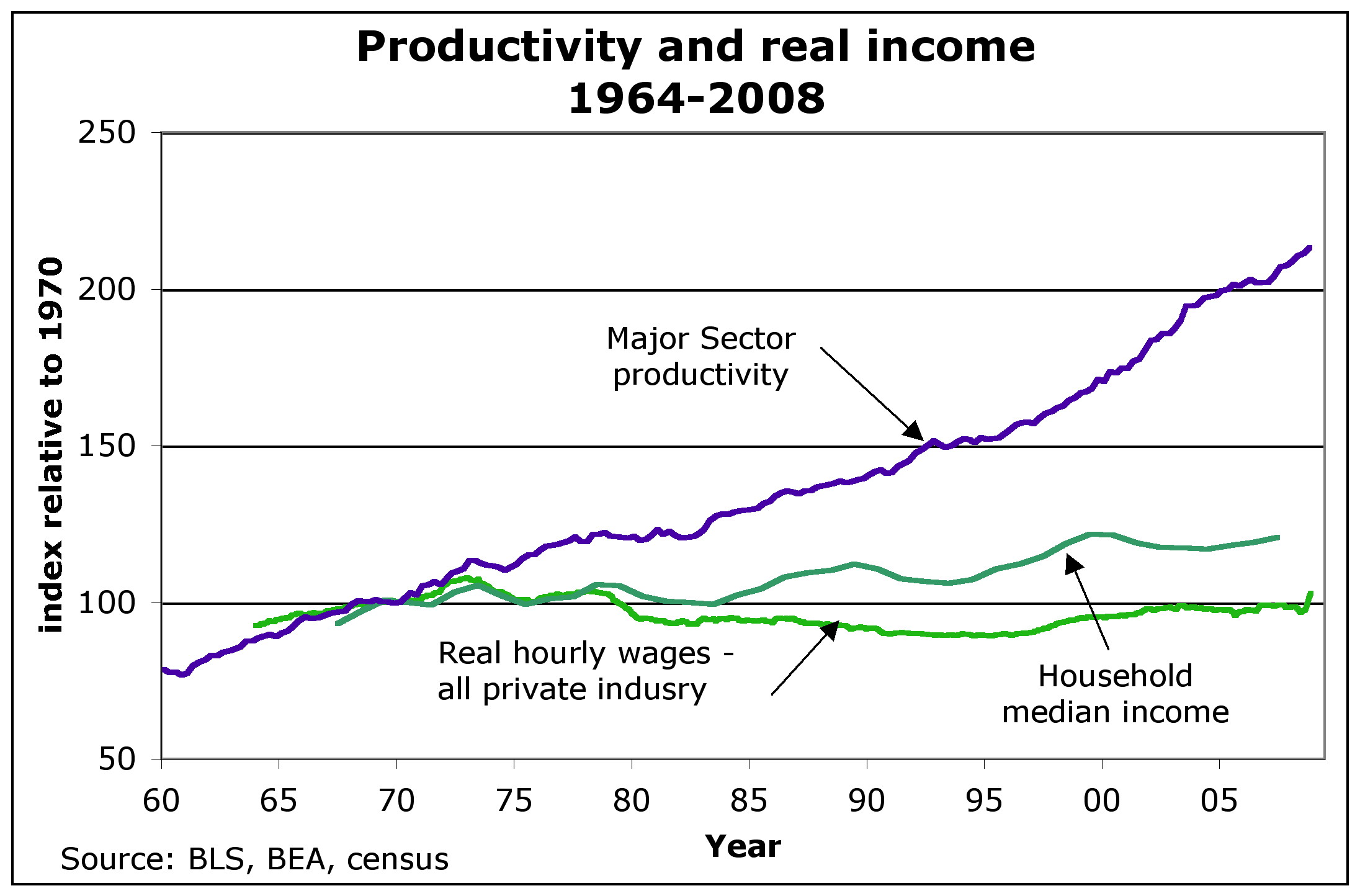
In many ways this is a superior alternative. Children don't work. They used to. People spend a lot more time in school at the beginning of their life when it has the potential to have the biggest impact. It's not all bad. Although not quite living up to the dreams from 20th century either.
There's also something to be said about positional goods. A lot of people are driven by status and they work to be ahead of others. Elizabeth Warren believes that this explains why, despite technological progress, regular middle class family needs two incomes where one was enough a couple decades ago[3], they're competing for the same house, or school district. It doesn't explain everything but it's a factor.
[1] http://www.economist.com/news/finance-and-economics/21600989...
[2] http://equitablegrowth.org/2014/08/18/equitable-growth-make-...
[3] http://www.amazon.com/The-Two-Income-Trap-Middle-Class-Paren...