This article ignores a lot of peer-reviewed literature from planning, public health / injury prevention, and civil engineering in favor of some folksy wisdom of a lieutenant cop. A good starting mental model is that vehicle speeds increase both the frequency and severity of crashes.
The article weakly, and quietly made an argument that I do agree with. Namely, roadway design needs to accompany speed limits to ensure people actually drive the desired speeds. Wide lanes, big setbacks, homogenous environments encourage speeding regardless of what is posted. But let's be clear, we should have our design follow our policy, not our policy follow bad designs that were put in place by roadway engineers of yesteryear.
That message seemed to be lost in the race to tell us something tantalizingly counterintuitive. I love "everything we know is wrong" storytelling as much as the next guy, but only when that's actually backed up with solid evidence. Take for example this gem from the article:
> “We all speed, yet months and months usually pass between us seeing a crash,” Lt. Megge tells us when we call to discuss speed limits. “That tells me that most of us are adequate, safe, reasonable drivers. Speeding and traffic safety have a small correlation.”
That would seem to be at odds with this peer reviewed article (sorry, paywall, but you can read the abstract):
> Respectively, they found evidence for an exponential function and a power function between speed and crash rate. Both types of studies found evidence that crash rate increases faster with an increase in speed on minor roads than on major roads. At a more detailed level, lane width, junction density, and traffic flow were found to interact with the speed–crash rate relation.
Respectfully, you didn't read the rest of the abstract to the article you cite, and the next few sentences support what the article says:
>Other studies looked at speed dispersion and found evidence that this is also an important factor in determining crash rate. Larger differences in speed between vehicles are related to a higher crash rate. Without exception, a vehicle that moved (much) faster than other traffic around it, had a higher crash rate.
Which is the whole point of this article. The article isn't saying that isn't dangerous, it is saying that speed differential is more dangerous than speed. It is saying that speed limits are generally ignored by most people (most people drive some combination of the speed of traffic and the speed they feel comfortable with), however the few people that DO listen to them cause accidents because it makes the differential speed much higher.
> A good starting mental model is that vehicle speeds increase both the frequency and severity of crashes.
This is a horrible starting model. The severity of crashes is physics, but the frequency can't be looked at in isolation. Even the article you cite hints at the fact that the relationship isn't that simple: In figure 1, rural roads with higher speed limits have a shallow linear relationship between crashes and speed, while urban roads with lower speed limits have a much steeper, exponential relationship between crashes and speed. Which counteracts a very simple "speed increases the frequency of accidents".
...however the few people that DO [pay attention to speed limits] cause accidents because it makes the differential speed much higher.
It's just an abstract that we're discussing here, I know, but the abstract absolutely, categorically does not say that. At all. You're guessing that's what it means.
Sorry, that is from the article (the OP), not the paper that was linked to. The article states that the 10% of people who actually pay attention to the speed limit increase the differential between speeds of cars when the speed limit is too slow.
Respectfully, I did, and you're failing to acknowledge what I wrote in my initial posting.
> it is saying that speed differential is more dangerous than speed.
No it's not, the article is saying that a delta in speed is a factor in crash frequency. (And no, I didn't copy paste the whole abstract, because I was posting the part of the abstract germane to the quote I cited from the original article.)
> This is a horrible starting model. The severity of crashes is physics, but the frequency can't be looked at in isolation.
No, it's still a good starting model. If you read all the way to the end of that abstract, I think you'll see my point:
> Without exception, a vehicle that moved (much) faster than other traffic around it, had a higher crash rate. With regard to the rate of a (much) slower moving vehicle, the evidence is inconclusive.
So, much faster moving vehicles always had higher crash rates, while much slower vehicles... inconclusive.
There's a saying in statistics (George Box) that all models are wrong, but some models are useful. I think you'll find examples where speed isn't a problem, but those aren't the norm. If you're looking for a simple univariate model that goes a good long ways toward explaining vehicle safety, I'd challenge you to come up with a better one than what I've proposed here.
The article isn't claiming that faster speed == safer. It clearly states that raising the speed limit has little effect on the speed that most people travel. The only group of people whose driving speed it significantly affects is the 10% of people who follow the speed limit exactly (who are usually the slowest drivers). Therefore, by raising the speed limit, a large majority of drivers will drive at the same speed (no faster), but the slowest drivers will speed up and the speed differential drops, making the roads safer, as your linked article agrees with.
There was little evidence presented that justified the assumption that most people won't drive any faster with a raised speed limit, but if we take that as true, then its conclusion is consistent with the research you linked. It is NOT making the claim that driving faster is safer. In fact, it again clearly states that in an ideal world, everybody would just travel at slower and safer speeds, but that we can't effectively enforce such a low speed limit.
As the article states, the 85th percentile rule is as old as the hills, and the principle about speed differential is as well. All the data I've ever seen would appear to support it. Do you have any theories as to why states with higher speed limits (or in Montana's case, no speed limits) don't have terribly different worse outcomes from those that have lower ones?
What about the Autobahn, me passing traffic with a difference in speed of 100km/h at times (it's entirely possible to reach higher values w/ faster cars, reckless driving, unusually slow traffic on the slow lane, like trucks).
I think it can work. Obviously it cannot work without education and experience, but pointing at speed differences as the one stat that leads to chaos and mayhem seems empirically wrong.
Mentioned this in another thread and I'm still looking for researh around this topic:
A Dutch engineer once told me (back before 2004 I guess ) that they once raised the speed limit on the roads in Netherlands and found that counterintuitively, - average speed decreased.
His explanation IIRC was that
1. once people break the rules it doesn't matter how much
and
2. when speed limits felt more correct more people respected them.
this, according to him, meant that even if some people were driving faster a lot of those who used to break the rules now followed them.
I'd still love to know if anyone has any more pointers to research on this and I am fairly sure someone around here knows a whole lot. ( I got some unexpected input in the other thread already.)
That map looks like high scores in an arcade game encouraging you to beat them. Can you beat the 276 km/h (!!) or 247 km/h on what seems to be a long tunnel or a bridge?
Is there any documented effect of that data being public to people trying to "beat" the speeds?
Interesting! Of course the Dutch are also leaders in highly designed shared streets that make the hippest of the hipster urban designers in the US swoon with envy. Unless we're talking about major highway facilities (and perhaps not even then), my hunch is that we're looking at some radically different street design.
> Let's not forget that the speed limit was never about safety. It was about saving fuel in an oil crisis.
The establishment of the national maximum highway speed limit of 55mph was about that. Speed limits more generally (which predate that by quite a long time), not so much.
EDIT: As it has been accurately pointed out that the above response is US-centric, more generally: the establishment of reduced speed limits in many jurisdictions in the early-mid 1970s (including the US national maximum highway speed limit of 55mph) were due to the concerns of saving fuel in an oil crisis, but that is not true of speed limits more generally (either before -- stretching back to more than a century before automobiles existed -- or after the 1970s.)
Sure, that doesn't change the fact that your statement upthread is still generally wrong. But I've updated my response to it to be more general and less US-centric.
It wasn't even about that. It was about appearing to do something about the oil crisis.
Actually saving fuel would have involved sitting down a dozen auto manufacturers and persuasively asking them to participate in a cartel to improve vehicle fuel efficiency without disproportionately harming any individual participant's competitiveness.
Instead, they ordered 250 million people to slow down. According to the article, only 10% are generally willing to do that consistently, and that just increases the collision rate.
So in the end, the 55 mile per hour speed limit wasn't about anything but ignorant management doing something with a high visibility to appear wise, leaderly, and decisive. But it actually just hurt everyone else. We've seen that story so many times, the details are practically unnecessary.
The sad thing is that the people that really need to learn the lessons of history are too busy trying to crank out more illustrative examples.
Correct me if I'm wrong, but the studies you're referring to are examining speed, but not speed limits. It doesn't seem to me that the two are equivalent.
This might be another "tantalizingly counterintuitive" observation, but raising speed limits may not necessarily make everyone go faster. What it might do, though, is make people more courteous to each other.
As an example, if the speed limit is 50mph and you're going 50mph and someone is tailgating you, the fact that they're tailgating you probably frustrates you and makes you less likely to speed up or switch lanes. In fact, depending on your personality, it might make you mad enough to slow down or brake check them. However, if you're going 50mph because that's the speed you're comfortable with, but the speed limit is 65mph, you'll probably still be annoyed at somebody tailgating you but you might also be more sympathetic and hence less likely to do something passive aggressive.
I'm annoyed that the taboo thing to say in this discussion is whether increased traffic fatalities is always an inherently bad thing. When you're talking about societal-scale policy, it's impossible to make anything 100% safe; rather, it's about acceptable trade-off in risk. We could make a universal speed limit of 10mph and traffic deaths would probably vanish, but we don't because the impact on transport is too great. People like to brush off this argument with "should someone die just so you can get to work 5 minutes earlier", but if you start multiplying those 5 minutes by millions of people, there is an actual trade-off to consider.
Average US worker spends 25 minutes on a one-way trip to work. Lets assume an average speed of 60mph (hint: it's slower). If you went at 70 instead of 60, then you'll save a whole 3.5 minutes.
Here(http://webcache.googleusercontent.com/search?q=cache:jWbI1mK...) is a link to a NHTSA presentation on speed limit changes and its effects on crashes. Notably, when states were given control of speed limits, we saw raises from 60-65 to 70-75 mph in some situations, and a 35% increase in fatalities.
if we do the whole "life is worth $3M dollars" argument, divide by two because I'm trying to make this favorable to you (even though car fatalities disproportionately affect young people), letting people go 70 instead of 60 could still end up causing almost 10k more deaths per year, so there's $15B in lost value per year. At least I'll get to sleep in for 3.5 more minutes.
You still haven't shown that the increased risk of danger outweighs the aggregate time savings. It's a big consideration when looking at things like, the value of screening for unlikely outcomes.
3.5 minutes/trip saved * 2 trips/day * 200 working days per year (probably more) = 1400 minutes saved per year per person.
working-age population of US (2012) = 243 million.
Employment-to-population_ratio = 67%, so 162 million.
Let's say that half drive, or 80 million.
So, 80m * 1400 minutes = 112 billion minutes a year saved by speeding or 1.9 billion hours. At a wage of $10 per hour, that's $19 billion, which is a bit ahead of the $15b loss of value per your number, but I'm sure our confidence intervals overlap.
112 billion minutes = 213000 person-years of being stuck inside a car saved by speeding. With a US average lifespan of 79, that's 2700 total additional lifespans spent in a car by losing those 3.5 minutes.
so, 2,700 additional lifespans of time saved in trade for 10,000 people killed, let's pretend each of them was halfway through their lifespan (40) so we lost 5,000 lifespans of time, or net loss of 2,300 lifespans. Sounds like it's not worth the time savings.
>At least I'll get to sleep in for 3.5 more minutes.
Come on, that's not a fair argument. The effects are obviously much bigger than one guy saving 3.5 minutes.
To get closer to the meat: If your calculation always outputs numbers that make slower traffic look better, no matter what the starting speed is, then your methodology is wrong. Your method here would make 15mph look better than speeds 20mph or faster, despite a 15mph speed limit being a blatantly terrible idea.
(Also doesn't your assumption of an average speed of 60 bias your argument heavily against high speed limits? I would expect saving 4 minutes on a 30mph route to be much safer than saving 4 minutes off a 60mph route. Is my expectation wrong here?)
actually my argument is based more around 60 mph average speed because that's more or less the average speed on highways and people spend a decent amount of time driving on highways and the like. Also, the increased fatality rates were concerning a rise from 60 to 70mph.
Obviously if we're going from 15 to 20 the numbers change. But at the same time if people were on average driving around at 15mph on average car accidents wouldn't be such a big issue, instead of the leading cause of death among teenagers.
actually with lower speed limits you would gain more time by going 10mph faster. For example, if people were driving at 10mph on average, going 20mph would half their transit time. The point is that the speeding people commit usually doesn't earn them much more time, but disproportionately endanger themselves and those around them at higher speeds.
>actually with lower speed limits you would gain more time
Right, not sure why you have 'actually' there because that was my point. When you picked 60 vs. 70 you were picking the speeds most likely to favor not going faster.
>the speeding people commit usually doesn't earn them much more time, but disproportionately endanger themselves and those around them
It's the 'disproportionately' that's at argument. A tiny-per-person cost for a noble purpose seems like an obvious choice, but when you repeat the action a billion times over it gets more complicated.
This is the reason I do not speed. I figured I barely ever drive more than 10-15 miles one way, hence going from 60 to 80 miles per hour is only going to save me a very few minutes and increase my chance at 1) getting a ticket, and 2) wasting 30 minutes when a cop pulls me over.
I hate slippery-slope arguments, but I feel that if you are going to advocate the scenario you seem to have advocated, then you can take it a lot further. For example I feel that anyone whose car stalls while crossing the San Francisco-Oakland Bay Bridge should be banned from driving for life. Because every time someone stalls on the bridge at rush hour there's a traffic jam clear back to Reno.
How much time would we all lose because of the small increased risk of increased traffic accidents and the road closures to clear them? It almost feels like an area of knowledge that I'm clueless about, but someone has spent a lot of time and effort studying.
End of the day, you shouldn't have laws that 80% of the population breaks during the ordinary course if business.
I've found myself in vehicles towing trailers where 65 mph was about as fast as I could go. I continuously had cars passing me. If everyone is a criminal, something is wrong with the law.
Well, there seems to be this myth that its OK to speed 5 miles above the posted speed limit, so the speed limit is still useful. It'll just be limiting the speed to 60 instead of 55.
As to whether things are enforced that way, that's a different story.
There's a lot of truth to that. Many places use 7-10 mph over as a threshold. Smaller tickets always get plead down, and cops get measured by collars or tickets.
I don't think skirting the limits has much impact on behavior as the limits go up. In my personal observation, I've observed little if any difference between highway driving on the Deegan Expressway in NYC (50 mph), i95 in South Carolina (70/75) or the mass pike (65). Once you hit 70-80 mph, driving requires more attention.
On the other side, you have absurd local limits as well. The standard for streets in most towns in New York was 35 twenty years ago. Now it's 30, with zones as low as 15 or 20 mph near schools. It's a scheme to get bigger tickets and more drug arrests in "school zones". I wish they'd just get to the point and put up a toll barricade.
Is the statistic NYC posts a lie? For a few years they've had signs up claiming that 80% of pedestrians hit at 30 mph survive, while 75% of pedestrians hit at 40 mph were killed.
That seemed like a pretty good reason to have lower speed limits in pedestrian areas to me.
Seems like it would be a better reason to increase the physical separation between motorized and non-motorized traffic. I'd wager that more pedestrians would survive near 40 mph traffic if there were more energy-absorbing materials between them and the cars. The signs are probably just up to cut down on lawsuits directed toward the city.
The goal of improving roads is to increase the throughput of traffic. If it seems as though a problem could be solved by slowing down traffic, that's like solving a problem with a circuit by throwing a resistor into it. It may solve the immediate problem, but it will also reduce the overall efficiency of the circuit by converting energy into heat rather than usable work.
They could also put up signs that say 100% of the people who drive 40 mph reach their destinations 33% faster than those who drive 30 mph. It's just a distraction from the fact that solving the problem in a better way is more expensive than just blaming drivers and letting insurance handle the fallout.
It's entirely impractical to expect NY to build collision barriers at every spot where pedestrians get near cars within the city. Unless you want to have raised / underground pedestrian crossings everywhere (which have generally not been found to work very well, and are ugly as hell too), the reality is you're going to have traffic and pedestrians intermixed within the city.
"The goal of improving roads is to increase the throughput of traffic" - that is considered an outdated goal by most planners these days. For one thing, if you increase the capacity of roads, you simply encourage more driving, and things end up congested anyway. In many cases urban planners now actively seek to decrease the throughput of traffic on mixed-use streets in urban areas.
It is far more impractical to employ live humans to enforce speed limits and jaywalking ordinances in the name of safety. We don't see the solutions that best improve safety because there are many other considerations in play.
As I mentioned before, the urban planners who are adding resistance to the system are not helping the overall efficiency. Intentionally decreasing the capacity of urban infrastructure is almost criminally stupid. It approaches the level of solving an overpopulation problem by conducting a decimation lottery every time the number of people approaches some upper limit.
Some planners are shutting down some roads to increase throughput, by encouraging greater use of more improved roads. Others are altering roads, or installing traffic circles, or adding stop signs and speed bumps, just to make vehicle traffic gratuitously more difficult. Those people are the assholes.
Congestion results from insufficient infrastructure to meet public demand. If your sidewalk is too narrow for the foot traffic, and people get jammed up and spill out onto the street, you cannot solve the problem by making it narrower and throwing caltrops onto it. And that doesn't work with cars on roads, either.
You can quickly invent a distinction between a road and a street, where roads are indeed intended to maximize throughput but streets are intended to provide access.
So maybe those signs are on streets where throughput is not the primary goal, and where substantial barriers would interfere with people moving from their parked cars to the sidewalk and the like.
A line of parked cars between traffic and sidewalk is a substantial barrier on its own.
If you look at a high-traffic street where parking is prohibited, the Magnificent Mile in Chicago, you'll notice that there are gigantic concrete planters between the cars and the regular pedestrian traffic. Retail stores protect their entrances with concrete bollards. Construction zones protect workers from traffic with segmented Jersey barriers and water-filled crash barrels. Those are actual solutions.
But then you have suburban pearl-clutchers who lobby for a 15 mph speed limit and speed bumps in their cookie-cutter subdivisions, rather than actually making their streets safer for pedestrians. Or by replacing yield signs with stop signs. Those people don't realize that "change the law" is not always equivalent to "fix the problem".
While it might be socially acceptable, we'd all also agree that going 5 over the posted speed limit is "breaking the law", which is exactly the problem - it's encouraging a societal norm of "kind of" following the law, which is extremely problematic (especially when you consider that enforcement is often not applied evenly.)
They say 85% break the limit, but by how much? According to a 2003 UK study only 25% of people break the 30mph speed limit by more than 5mph, and only 20% break motorway speed limits by more than 10mph.
Actually, the article says “I’ve found that about 10% of drivers truly identify the speed limit sign and drive at or near that limit,”. That is what we were discussing here, not the 85/15 percentile thing. (Sorry I should have said 90% rather than 85%).
Of course the article doesn't say what those other 90% are doing. I suspect they aren't all breaking the limit - probably some are going slower than the speed limit.
The article repeatedly mentions that there is very little correlation between posted speed limits and traffic speed. He goes to great pains to explain that traffic speed seems to be independent of speed limits. The paper you quote states that there is a correlation between accident frequency/severity and actual speed not speed limits. The argument in your comment is based on precisely the fallacy that the article says most people unfortunately fall for, which is that there is in fact a strong correlation between posted speed limits and traffic speed.
And yet occasionally lets slip quotes like the one I posted earlier, in which the officer sites anecdata that speed isn't the problem. The article I posted was specifically countering that notion. The broader issue I have with this article is its prescription for bringing speeds and speed limits closer together--namely increasing the speed limits. I think using roadway engineering to decrease the speeds is actually addressing the first order problem.
If you are talking about an urban boulevard, then I agree. Engineer the street to lower speeds, and increase safety because there are pragmatic options (roundabouts, speed bumps, more signals and stop signs. But if you are talking about intercity highways, something like Los Angeles to Phoenix to Denver to Des Moines, then just increase the speed limit.
The Priceonomics article's main point is that raising speed limits doesn't (much) raise actual speed, so it's not inconsistent with papers (like the one you linked) that show that increased speed causes more and worse accidents.
Obviously it's hard to judge studies by one sentence summaries, but some of those papers sound like extraordinary claims. "Speeds declined by 5 km/h. Fatal crashes declined by 12%." Come on, really? We're going to imagine that a 3mph change in speed (at speeds around 80mph) could possibly be causal to a 12% change in fatalities?
I haven't looked at the refs, but you're welcome to. I suspect wikipedia is more reliable than priceonomics.com, although you have to look at the sources yourself to be sure.
As I said, to the extent that the article made the case for combining speed limits with roadway design, I agree.
However, the quote from the Lieutenant was clearly stating that speeding was not the problem. The whole article appears to have been either crafted or embarrassingly not crafted to muddle these two questions.
There is conflicting evidence on the matter. A local (Vancouver) video[1] circulating here had some strong arguments that our speed limits are kept needlessly low. If you're interested in such things, it's a well done video and worth the 15 minutes it takes to watch.
That video only gained traction in social media because it is telling people want they want to hear. It's always important to filter everything you read through "do I want to believe the thesis/conclusion of this?" Because a lot of people throw critical thinking out the window when they want to believe something.
That's not a refutation of the facts presented in the video though. There seem to be an equal number of people who support the status quo and don't want to look at facts that challenge what they want to hear.
The facts should speak for themselves regardless of what each of us wants.
Wrote my masters thesis in transportation planning on traffic calming. Peer review or it didn't happen. Not that peer review is perfect, but a viral video with an obvious agenda doesn't do it for me.
Generally, worth taking government reports with a grain of salt. I've participated in a few, and the standards are often much lower than peer-reviewed articles. That said, on a quick skim, I don't see anything that strikes me as being obviously wrong / overturned (FHWA was 1997).
But, I also don't see either source providing justification for driving faster. Both reports seem to accept this (in fact, this is about as close to pure physics you'll find in transportation engineering):
From the FHWA's report:
These requests are founded on public knowledge that crash
severity increases with increasing vehicle speed, because in a
collision, the amount of kinetic energy dissipated is
proportional to the square of the velocity. Simply stated, when a
vehicle is involved in a crash, the higher the vehicle speed, the
greater the chance of being seriously injured or killed.
and quoted by the BC report:
A driver’s choice of speed can impose risks on other road
users. Crash severity increases with increasing speeds because in
a collision, the amount of kinetic energy dissipated is
proportional to the square of the velocity.
Now, beyond this, there are some subtleties. Both of these reports state that crashes are more likely to occur when there is a greater delta between fast and slow roadway users. That's fine. They also talk about how speed limits are more likely to be exceeded where the roadway design encourages higher speeds. Emphatically agree.
So, now we are left with a policy question. Surely we agree that habituating people to breaking the law is bad. If people respond to a combination of law and roadway design (perhaps leaning more heavily on the latter), and we want behavior in line with law, what should we do? Ease the law or change the roadway design?
Normatively, for most roadways (especially those containing bicycles and pedestrians), I say we need to move more toward changing the roadway design to discourage higher speeds. On some highways, it might be appropriate to lift speed limits, though even then I'd tend to cast a cautionary gaze toward the Montana experiment that was referenced elsewhere in this thread.
> If people respond to a combination of law and roadway design (perhaps leaning more heavily on the latter), and we want behavior in line with law, what should we do? Ease the law or change the roadway design?
Or change the context in some third way (e.g., enforcement)? The thing with roadway design is that the roadway designs which enourage higher speed are generally the same ones that are safer at any given speed, so changing the design to reduce the incentive for high speed may not improve safety as much as the reduced "natural speed" would seem to suggest -- and may retain the high delta beteween fast drivers and slow drivers that you note is a major factor in accidents, just reducing the median.
But what if through technology we could get enforcement of existing limits to a place where the probability of penalty for violations was higher (even if the penalty range had a lower bottom end)? One problem with law as an factor in behavior right now is that the probability of any given violation (or even a pattern of consistent violations) being punished is so low that the law serves more as a very weak social signal and the source of an inverted lottery of punishment than as a rational utility factor in regular behavior calculations.
With more consistent enforcement, we may be able to reduce the delta between high and low speed drivers (as the high speed end is usually significantly above the legal limit) without changing the law (at least, the speed limits in the law) or the road design significantly.
Enforcement is certainly part of it (planners and civil engineers make jokes about the ever-changing number of "E"s involved in planning--engineering, enforcement, education, encouragement, entomology, et cetera). From my own experience, enforcement is the number one thing people ask for at public meetings, and the very last thing they are willing to pay for. Enforcement is crazy expensive.
Technology, as you point out, more broadly deployable, as well as cheaper and less likely to discriminate. For that reason, I actually kind of like speed / red light cameras. However, they are wildly unpopular to the point of being made illegal in many places. Plus, I think there are legitimate concerns about surveillance aspects of our newly smart cities.
With respect to "safer at any given speed" designs, I think you have to consider that, in order for safety to hold, you need to make some unrealistic assumptions about other factors remaining constant. Also, many of those so-called safer designs really do everything possible to eliminate other kinds of roadway users from the mix.
An automobile monoculture isn't very robust, and it also assumes the wrong units of analysis. Traffic engineers used to measure mobility in vehicle throughput. Amazingly, if you shift your units of analysis to people, monoculture looks less compelling. And that's even before you consider physical activity, environmental externalities, and a raft of other issues.
That's why I'm for average speed traffic cams and ruthless, fully automatic ticketing of speeders. When the probabilty of getting caught and punished reaches almost certainity, people start to "factor it in regular behavior calculations".
But this is going to be a hard sell for both drivers (who feel entitled to their high speed) and law enforcement (which treats ticketing as a revenue source; widespread deployment of such system would dry up the money stream almost immediately).
It would be an easy sell if drivers (such as myself) didn't feel convinced that highway speed limits are arbitrary. 100km/h is a very unlikely number for an engineer to calculate as an upper boundary for a road.
It wouldn't be a tough sell to lower speed limits on some portions, and raise it on others, even on a time-neutral but safety-positive basis, but yet, the powers that be stick to their arbitrary number.
> 100km/h is a very unlikely number for an engineer to calculate as an upper boundary for a road.
I haven't seen any actual calculations used for setting speed limits, but I do remember being taught in school (on physics lessons) that if you want maximum road throughput then after factoring in safe distance (which is proportional to square of velocity) you end up with ~50km/h as a sweet spot. Even if some other factors (like fuel efficiency) alter this calculation, 100km/h feels quite plausible to me.
Also I believe that many consider speed limits as arbitrary because most people seem not to care about safe distances anyway.
Frankly the conclusions of that video are "cars are safer, so we can drive faster" which totally glosses over the fact that cars are safer and fatalities are down as a result. Raising the speed limit raises the fatality rate back up to 1950's level and that point just isn't made.
Ultimately, how many deaths are acceptable for people to get to work 5 minutes earlier?
the article repeatedly mentioned: raising speed limits does not raise driving speeds on roads. humans are kind of strange in the fact that they drive at a speed they are comfortable with.
also, while that (faster = crash more) may be true, its not the only thing going on. it may be the case (and one argued in the article) that driving speed differences results in more crashes.
"raising speed limits does not raise driving speeds on roads"
I suspect that's a temporary effect. The speed people are comfortable at is mostly a learned phenomenon. The more they drive fast safely, the more comfortable they feel.
Remember when you first started riding your bicycle? 10 mph was super fast and was super scary. And it is; that's faster than the speeds that the human body was evolved to support.
And yet, as someone who travels almost exclusively by motorcycle, there is a limit to how fast I am willing to go which varies depending on the road I am on. My bike will easily go much faster, and I feel like I could safely command the bike even going fair bit faster, but I am not comfortable going faster on a regular basis.
Yes. Motorcycles are like that. Nearly every motorcycle is physically capable of going faster than the rider is comfortable doing. It's very hard to do that on a bicycle, except perhaps for offroad downhill type rides. On my usual road (bicycling) loop, there's one corner where I actually have to control my speed to feel safe, but even there I could probably take it a good 20% faster than I do. (It's a slightly bumpy, banked right turn @ an intersection at the bottom of a steep hill) So, for 15 seconds out of a 1.5 hour ride, I'm limited by something other than muscle power.
This reminds me, since standard speed limits were set, automobiles have drastically increased in their abilities. Rear independent suspension, lighter weight, disc brakes, radial and tubeless tires.
Just like on a bike, the first one was a heavy steel one with thick tires. Now, I'm riding a road bike that weighs a tiny amount and has dual compound tires.
>This article ignores a lot of peer-reviewed literature from planning, public health / injury prevention, and civil engineering in favor of some folksy wisdom of a lieutenant cop.
More than that, it's pure econo-meta - regulation is bad, freedom is good, if you leave people alone they'll behave responsibly, and everyone wins.
It's a moral parable (for economic values of 'moral') not a peer-reviewed paper.
Here's a newspaper piece that summarises some of the relevant peer reviewed research and draws a different conclusion:
I think it's pretty interesting that you advocate for narrower roads and short setbacks because you belive that on roads like this people are less likely to speed.
I don't know if people are less likely to speed on those roads; I think it is unlikely because growing up in a small town, people speed on backwoods roads all the time. Still, I'm not sure that this is the case.
What I do know is that roads like that are less safe, particularly if you DO speed.
So, unless you can show me that making a road less safe for speeding reduces the rate at which people drive, I'm going to keep thinking that that argument is like saying you can't give out condoms to kids because it makes them more likely to have sex.
In it, Dimauita et al credit every foot of lane width with a 2 mph increase in vehicle speeds, and Wang et al credit each additional lane with a 6.5 mph increase.
Risk compensating behaviour[0] is a real thing; the question is whether that effect is significant in any particular case. Making the roads look less safe will make people drive more carefully, but it has to be shown whether this will cause a net decrease of actual crash rate.
> Making the roads look less safe will make people drive more carefully, but it has to be shown whether this will cause a net decrease of actual crash rate.
There is also the matter that many of the ways to make roads look less safe would in actual fact make the roads less safe. At a given speed, narrower lanes increase the probability of a collision. Parked cars on the side of a road increase the probability that one will be hit, or conceal from motorists the presence of pedestrians about to step into the street.
People focused on speed are asking the wrong question. The question is not "how do we get people to slow down" but rather "how do we make the roads safer"? Speed is only one variable.
"I think that we should set speed limits to somewhere around where they are now or lower, and then re-engineer our roads to make it harder for people to speed. This is practical and will save lives, and the evidence supports this."
If I'm reading you correctly, I have a number of problems with it:
1. I don't think it's in any way practical to re-engineer roads on the massive scale that would be necessary to do this. If, as asserted, the majority of people exceed the speed limits the majority of the time, you're talking about re-engineering the majority of roads. That's an enormous project compared to resetting the speed limits.
2. You're a bit light on details about what you would do to make people obey the speed limits, but you list as contributing to speeding "wide lanes, big setbacks, and homogenous environments." Leaving aside homogenous environments (are we now talking about re-engineering not only all of our roads, but also all of our cities in general?), I'm sure that making lanes narrower and setbacks smaller would in fact make people drive slower, but would it actually increase safety compared to the counterfactual of not re-engineering and increasing speed limits? I doubt it. Certainly, I don't see evidence for it.
3. Hidden in here is a question of legitimacy. Are current speed limits a result of a social consensus about the speed/safety tradeoff made by an open society? I don't think that there's any convincing evidence that they are. They appear to be a reaction to OPEC and a revenue model for local governments at least as much as they are about a democratic consensus -- and to the extent that they are about a democratic consensus, they seem to be based on one in which the democracy in general was not aware of the deleterious effects of low speed limits in terms of speed differentials.
So, look, the situation right now appears to be:
a. Roads designed for speed, but with artificially low speed limits leading to inflated danger.
And a couple of possible future policies could be:
b. Roads designed for speed, with higher speed limits leading to reduced danger compared to a.
c. Roads designed for lower speed, with the same or lower speed limits leading to reduced danger compared to either a. or b.
It seems like you've jumped to the conclusion that option c is the right one, but I don't know that it is, even granted that it is the safest option.
speed definitely increases the severity of crashes, but i'm not convinced that it increases frequency. even so, the #1 factor leading to increased frequency of crashes is distracted driving (sorry, don't have time to look up relevant links). if it exists, the correlation of accidents with speed is likely much weaker than with distractedness.
if we really wanted to reduce motoring accidents, rather than regulating speed, we'd regulate away everything you can do in a car other than drive (radio, food, shaving, makeup, newspapers, etc.). i'd even suggest that driving fast might cause you to be less distracted because of the higher severity of a crash (would be an interesting research topic).
Maybe we should go back to Cadillac Eldorado 'bullet' style steering wheels (and no seatbelts) which really were as much use as a spike in the middle of a steering wheel.
It would reduce the number of crashes. Its essentially the same argument as your comment's grandparent, that we should make the roads narrower to reduce driving speed.
I would not trust the average person with higher speed limits. If they want to be adequate, safe, reasonable drivers, then they should drive at a slower speed and get used to it. I get the feeling that the reason most people who speed do it is because they overestimate the amount of time they'll have to get to where they're going and speed up when they see they're gonna be late.
You obviously didn't understand the article. It didn't say that speed wasn't dangerous. It said that speed signs only give us the illusion of safety because the majority of people disregard them anyways.
It also ignores that speed limits are largely determined by what speed would allow you to safely stop if there was an road obstruction (traffic, animal, merging vehicles, etc).
I found myself disagreeing with the premise that highway speed limits don't influence people's driving speed. I may simply be part of the 15%, but consider the following anecdata: On I-90 in upstate NY, the "speed limit" is 65. I've gone by several state troopers at 70-75 without issue or confrontation. I don't go faster, not because traffic dictates, but I'm concerned about litigious policemen. To put it in Freakonomic terms, I'm going just slow enough that I won't get caught. If the limit was 10 mph higher, I'd drive 10 faster, as would everyone who was on the road for more than one exit (or governed semi tractors).
There is very little crowding on the stretches of highway I'm most familiar with. If the speed limit was 120, I'd probably cruise around 90 or so, assuming it wasn't rush hour. I propose that there is a diminishing impulse for travel rates as they increase, but also that on well-cleared, divided, limited-access highways, we have diminishing utility for speed limits as a regulating concept. Highway driving is the easiest driving to do. There are more variables in control than anywhere else. Why not re-evaluate the roads, not based on the 85th percentile of drivers living under the threat of litigation based on arbitrary bureaucrats, but on simple road capacity and volume?
Starting a couple of years ago, Virginia started bumping up the speed limit on the more rural sections of interstates from 65 to 70MPH. Part of the stated rationale was that a lot of people speed anyway, but a lot of other people drive the speed limit, and this disparity is dangerous. By bumping up the limit, you're in essence telling the law-abiding drivers "it's OK to keep up with traffic" and the gap in speeds will narrow.
In my experience, the opposite happened. It seems that the people who were driving 65 before don't want to go any faster. The people who were speeding before still constrained their speed to some factor above the speed limit, and now they go even faster still. Previously, the spread was around 65-75, now it's more like 65-80.
In contrast, the interstates around DC are all limited to 55, yet people regularly do 70 there as well.
It seems clear to me that, while speed limits don't impose an iron control on vehicle speeds, they do influence it.
A sibling poster mentions studies that say it changes little if at all. Perhaps what's "clear" to me isn't true. However, I wonder just how those studies were performed. How long did they wait after the changed limit to measure the change in speed? Most traffic on most roads consists of people who make the trip regularly, and it will take time for them to change their habits, up or down.
“Over the years, I’ve done many follow up studies after we raise or lower a speed limit,” Megge tells us. “Almost every time, the 85th percentile speed doesn’t change, or if it does, it’s by about 2 or 3 mph.”
This is consistent with most drivers behaving like _archon_ (and like me). For example, if every driver thinks she can safely drive 90 mph, but 80%, like _archon_ and me, stay below 10 over the limit out of fear of police, while 20% drive as fast as they like, then raising the limit from 60 to 70 will have no effect on the 85th percentile.
The article seems to quietly conflate the fastest 15% of drivers ignoring the limit with "most drivers" ignoring the limit. Which is odd. However, even under the _archon_ model, increasing the limit would lead to a reduction in speed variance.
Had the unique experience of entering into Utah where the highway speed limit was 80mph (~ 130 km) and had no desire to drive any faster than that, it was a very comfortable speed for that road and everyone was going about the same speed so it didn't clog up or get a lot of people changing lanes to adjust.
For a long time in Nevada there were no speed limits (prior to the 55 law) and we'd drive up 395 toward Reno at 80 - 85 mph which was just fine.
It seems like you just have to believe that making a faster limit won't ratchet people to 'limit + 15' where they are when it is 65.
Just as Megge can point to the results on hundreds or thousands of roads which have become more safe or equally safe when the speed limit increased, other researchers looking at data sets of speed limit changes have come to the opposite conclusion and advise that raising speed limits comes with the price of thousands of roadway fatalities.
Although the article seems to support Megge and the studies he likes, it's not clear why (other than maybe that it makes for a more interesting blog post).
And honestly, I can't imagine I'm the only one who feels comfortable going 80 on a 65 MPH highway but not on a 55 MPH highway. I guess it is possible, but it seems hard to believe.
The speed limit drops arbitrarily from 65 to 55 from MA-146 to RI-146 at the state border. Risk of a ticket aside, 80 is fine on either side of that invisible line (long straight flat highway with trees on either side).
Yes, according to that article. What I'm driving at is that making an arbitrary change based on how drivers react to an improper restriction may in fact lead to imposing another improper and arbitrary restriction.
A change of 5 mph either way won't change anything fundamental, and so a traffic study will report minimal changes.
You do raise a good point. I know that, when I started driving, my dad taught me a neat trick: drive 8.5 mph over the speed limit, and you'll never get pulled over. That's (supposedly) because a ticket for anything less than 10mph is simply not worth it for the cops. If you go any more than 8.5mph over, though, you might accidentally cross that 10mph mark, and if a cop's around he'll get you.
And, sure enough, any ticket I've ever gotten is because I was going over 10mph faster than the speed limit.
>'That's (supposedly) because a ticket for anything less than 10mph is simply not worth it for the cops.'
Depends on your cops.
I've witnessed tickets for 5 over (40 in a 45), 4 over (49 in a 45) and a stop, thankfully without a ticket for 1 over (31 in 30).
I'm given to thinking of it as a lottery. Someone is getting pulled over, today me, tomorrow someone else. I'm just glad I haven't had a case of 'marijuana smell' for 10 years or so.
I'm also in the "drive a little under 10 over" camp, and I totally accept that once every 10 years (or whenever), I'm going to be in the wrong place at the wrong time and get a ticket for it. I'm OK with that. It's not fair, but it's well below the bar of meaningful injustice for me to really care about it all that much.
I think it more depends on your jurisdiction. When I'm driving somewhere new, I'll make sure I'm not going faster than average (even if that's below the speed limit). In places that I'm more familiar with, I'll do 9 over.
Where are these slower roads though? If I were a cop, I'd be much more likely to pull people over for speeding in more residential areas, which tend to have these sub-55 speed limits.
I agree. Going 10 over on the freeway/highway hardly matters for the most part because it's not like that 10 mph is the difference between being able to or not able to stop if something runs out in-front of your car, you're already going at least 65 mph anyway. It's a different situation if it's a smaller road or a side-street with lots of houses around. Going 25 vs. 35 could very well be the difference between being able to stop fast enough if a kid runs out on the road.
To elaborate on why it "isn't worth it for the cops"... friends who are in law enforcement have explained to me that it's too easy to get a ticket thrown out for anything under 10mph due to arguments of device/speedometer precision.
Most (all?) cars have speedometers which already overstate speed of a vehicle. This is I believe because of laws which forbid speedometer to overstate shown speed (by some margin) but not understate it so if you are driving 8.5mph above the limit it's probably actually even less than that.
I think it also depends on the area. I did get pulled for 3 or 4 over the speed limit once. I think it was mainly because I was on a military base. Fortunately I did not actually get ticketed.
I studied Structural Engineering in University, which was under the Civil program, and, at least in Canada, we don't design for what people will go, but for how drivers can handle unexpected conditions, like cars turning out in front of them, a loss of traction due to ice, and visibility at night. I've also seen multiple studies that show that during high visibility / traction days (summer during the daytime) the speed limit can be safely raised to at least 130km/h for most highways that are 100km/h.
One interesting thing I observed while driving to university was that there was this one section of highway that was marked at 60km/h, but everybody drove around 95km/h. Every now and then there would be a cop that would give out a bunch of tickets, but it didn't seem to change the speed people went.
Well it turned out that the person that ordered the sign had a dyslexic moment, and the speed limit was later changed to 90km/h. What was interesting was that the design of highway (the guards, the lane width, the shoulder, the banking of the ramps) were all cues for drivers and they drove the actual intended speed without regard to the maximum speed sign.
Excellent example. I've noticed a few roads by me that are marked for 45mph that made me think, "woah, that speed limit is quite high for this road", but then I realized that it's actually on-par with the actual speed that people drive on that road (40-45). Then, there are other roads that are marked for 30mph that everyone drives 50mph on and you wonder wtf they were thinking when they set that limit.
Also, the State Police in my state, PA, typically won't pull you over on a highway marked 55mph unless you're doing over 80mph, so what does that tell you?
> I've also seen multiple studies that show that during high visibility / traction days (summer during the daytime) the speed limit can be safely raised to at least 130km/h for most highways that are 100km/h.
When I lived in Lincoln Park, Chicago (a dense urban neighborhood), there were no speed limit signs. I think the speed limit was 25 mph, but between the narrow streets, parked cars, frequent intersections, and lots of pedestrians, I rarely felt comfortable going faster than 20. They could have had 100 mph stop signs all over the place and I still wouldn't have gone faster than 20.
The speeding system we have here seems to make a lot more sense to me: On most highways, there is no speed limit. The only (theoretical) limit is the motor limitation of 155 mph (250 km/h), which can be taken out, but will almost always lead to losing any kind of motor warranty.
In practice, there are limiting signs to 75 mph (120 km/h) for passages where the road is not good enough or there are narrow curves, unclear conditions etc. In my experience, this system works wonderfully: when the road is good, you can drive as fast as you like, so people are more concious about paying attention to the road and their rear mirrors, especially when hogging up the left lane.
I acknowledge that completely overtaking this system would be impossible for the US, simply because the roads are not up to it and the driving tests are not rigorous enough, but I think Germany serves as a fine example that there would be no harm in raising the speed limits a few notches.
I'm also German and I would like to have a general speed limit on highways.
Your theory sounds all nice and works if you drive on empty roads, but as soon as there's a bit of traffic the lack of a speed limit results in a very stressful and uncomfortable driving.
The main problem is the speed difference between the individual lanes. On the right lane you have the trucks which are limited to 90 km/h by law, so that's the maximum speed you can usually drive on that lane. Now most highways only have two or three lanes. No speed limit usually results in a difference of at least 40 km/h between lanes and always-changing speeds because of traffic. Driving in a small car with a low-power engine is no fun at all, your only choices are getting stuck behind trucks at 90 km/h or a constant speeding up, slowing down, switching lanes and pushing your car to its limit.
My personal theory is that this is one of the main reasons why German drivers are so aggressive. The drivers most in favor of no speed limit are usually also the most aggressive.
It depends on the Autobahn. I strongly felt what you described on pretty much any Autobahn around cologne where there always was a lot traffic and many on and off ramps. However, my ride usually would take me from there onto the 44(?) towards Paderborn and there was no speed limit and it was a joy even in an old Golf 2. There were very few on and off ramps and moderate traffic. My car would be able to speed up to ~220km/h over the course of several minutes, but it was so worth it.
Yes, the main point is that I pay more attention when driving faster on a freeway. One need only take a road trip in Australia to see how ridiculous low speed limits on open roads are. 110 kmh limit with, yes, very strong enforcement in place, in a completely rural area with few cars around, no people, no pedestrians, on a long drive (it's ten hours from Melbourne to Sydney with basically nothing in between).
Result -- zone out on cruise control, look at your phone, talk to others in the car, etc. Focus on the road? Nope.
Australian traffic camera tolerances are also set ridiculously low, and there are far too many variations in limits.
I fully support 50kmh urban street limits, but the open road sections should have a day/night limit, where the day limit is 130, like most of Europe and some parts of the US. There should also be limits to how often a speed limit can change in a single stretch of road, and highway speed zone changes should have a minimum of three signs at even spacing to indicate the change approaching, at the spot and one more reminder.
There should also be a ban on concealed traffic cameras - getting a fine long after the event has very little effect on the behaviour, apart from generating feelings of injustice.
Exactly -- sure, you can still hide behind a truck and go 100 km/h all the time -- but most cars efficiency sweet spot is around 130 km/h, and driving at that speed leads to more dynamic, occasionally passing trucks, etc.
When I consistently drive at the speed limit (in the Netherlands, 120km/h) I have to fill up every 4 working days. When I consistently drive 100 km/h I only have to fill up every 5 working days. Takes 20% longer but the tank also lasts 20% longer.
Depends on the car. If you have a tiny engine, then it will use large amounts of fuel at high speeds. If you have a large engine, it will use less. My personal experience:
Peugeot Partner 2.0 HDi - 6-7l/100km when driving in city traffic, 12-13l/100km when driving at 140km/h,
Land Rover Discovery 3 4.4L V8 - 15-16l/100km when driving in city traffic, 9-10l/100km when driving at 140km/h.
Basically your engine should stay below 3000rpm - if you have to keep it at 4000rpm just to maintain a certain speed then it's too much for the engine and it's not being efficient.
110 isn't that much different to the US's 75. There is much stronger enforcement though. I spent six weeks driving around the US, multiple hours most days, and I was generally 0-5 mph above the speed limit... but I didn't have to look at the speedo. Came home, and it was painfully obvious just how much of my attention was split watching the speedo like a hawk because people can and do get fined for doing 64 in a 60 zone. And the fines aren't trivial.
I'm sure you hear this all the time, but it's my understanding that US drivers are not nearly as well "trained" as German drivers. Anecdata, yes yes. It's trivially easy to acquire and maintain a driving permit here in the States, and it shows.
(US citizen here - I don't know about German drivers, but of course the skills of Germans are legendary. The automotive media tells us all German drivers are as skilled as Walter Röhrl. I'm only partially kidding.)
Ding ding ding! The solution is better driver training and mandatory retesting for all drivers at regular intervals. So many drivers of all ages are absolutely terrible. Everyone should be able to go 85 MPH on a six lane highway but you can't because there are so many bad drivers.
Driving is not a right and it should not be treated that way.
There is some truth to that, we have more training: 14x 45min of theory school-style lessons and at least 12x 45min of practice with a certified driving instructor. Also, the minimum age to be driving on the road is 17, and you have to be accompanied by someone 21+ until you are 18.
The skills here are not legendary per se; the mean might be a bit better. The difference is that people seem to have more respect for other drivers and dangers on the road, creating more awareness overall.
But still, I think allowing skilled drivers to drive faster would do no harm to the population, if the faster people stick to the guidelines. For example: you do see the occasional snail moving in the left highway lane, but it won't be long until he is ushered away by some faster car with some furious flashes of the brights.
On a perhaps related note, a road I used to drive regularly had many curves and signs warning you to slow down at each one. Only one of the curves actually required you to slow down to navigate it safely. Guess which corner was where all of the accidents happened? If you "cry wolf" too often, people will ignore the speed limit (or caution signs or whatever). If, however, the speed limit is usually appropriate, people will take note when it changes, and drive appropriately.
I think it would work to just make the inside lane unrestricted and only have speed limits on the outer lanes. That way, slow and fast drivers aren't endangering each other because they're in completely separate streams of traffic.
Except that could encourage people to stay out of the right lanes -- leading to confusion or wasted lanes when trying to pass people, which happens all the time. If you closely watch a german highway, there are 2 to 3 lanes (per direction) for the most part, and the speeds are quite consistent: The rightmost lane is full of trucks going 60 mph (90-100 km/h), while the middle lane is going around 80 mph (130 km/h), which is the advised speed, or Richtgeschwindigkeit. The leftmost lane is left exclusively for passing slower cars and those going 100+ mph (160+ km/h).
The data from Montana always struck me as interesting. It's not an awful lot of data presented in this report [1], but there was a substantial increase in traffic fatalities when Montana shifted from "Reasonable and Prudent" speed limits to posted-and-enforced speed limits.
I then found this report [2] which indicates that yearly fatalities are approximately double of what they were in the late 90s (and is now around the third highest fatality rate in the nation [3]). It's a good guess that traffic volume has gone up, but safety technology has improved as well, so there are a number of variables that have to be accounted for. The differences are certainly stark enough that it merits some consideration, though.
Nationwide, traffic fatality rates have been on a steady downward march over the last couple of decades [4], so Montana's tremendous leap in fatalities is absolutely anomalous. If I was debugging it, I'd start looking at what changed around that time. On the face, it certainly looks like posting and enforcing speed limits made the roads less safe, though.
  The source looks somewhat unreliable and biased. I looked up FARS data for
  1998,1999,2000 for number of fatal-crashes in Montana (state), for (nhtsa)Roadway
  Functional Classification=Principal Arterial - Interstate and get the following
  figures for crashes by month:
  1998-4,0,2,4,5,1,5,4,0,0,3,2,30
  1999-2,2,4,2,1,0,2,9,4,2,1,5,34
  2000-2,1,4,5,1,5,3,3,3,1,4,4,36
  However the "study" has
  1998-4,0,2,4,5,1,5,4,0,1,3,2,31
  1999-2,2,4,2,1,0,2,7,4,1,1,4,30
  2000-4,2,8,5,2,7,7,3,4,1,6,7,56
  I've removed the section, it's obviously made up numbers for 2000 for interstates
  to suit an argument, nowhere near fact. There is a reason for the use of reliable
  sources in Wikipedia and this is a case in point. Alex Sims (talk) 10:13, 25
  January 2011 (UTC)
See what someone with an authoritative sounding domain name can do!
I was looking for government numbers for those years, but didn't have much luck. Thanks for the FARS keyword - that looks like it should have the datasets I need! I'm going grab and parse them and see if there's an actual difference in the data.
I somewhat doubt the data was made up, but it's possible that the roadway classifications were chosen in such a way that the datasets supported the point.
No I think the so called paradox was made up, To verify:
  http://www.nhtsa.gov/FARS
  Select tab "Run a Query Using the FARS Web-Based Encyclopaedia"
  "Query Fars DATA" which takes you to
  http://www-fars.nhtsa.dot.gov//QueryTool/QuerySection/SelectYear.aspx
  For each year 1998,1999,2000
    Select Query Year, e.g. 2000, then Submit
    In the top section Tick
     “Roadway Function Class”
     and “Month”, then Submit
    Select State: Montanta, and RFC Roadway Function
    Class “Rural-Principal Arterial-Interstate”
    Select Univariate Tabulation
    Select Variable - Crash Month and “Show Zeros” Yes
I've always loved this example. I lived in MT pre, during, and after this experiment. We went from:
- 65 Mph
- "Reasonable and prudent" daytime speed
- 75 Mph daytime speed
During the reasonable and prudent period, I think many people still had an internal model of 65 Mph. Certainly many people did drive faster. In my younger days, friends and I would find straight, empty sections of highway to flirt with death. But... many many people still set their cruise control to 65.
Case in point, my parents and the parents of many of my friends were careful to clarify that "reasonable and prudent means 65 mph, or you will have your driving privileges revoked." I was out from under the parents' roof by the time things went to 75, but I know my own highway averages went up with the codification of 75 mph.
Very interesting. How well do you think that 65 MPH internalized limit (during R&P) mapped to the 85/15% split as described in the original article?
Do you have any other insights into other factors that might have contributed to the change in fatalities, or do you think it was just as simple as "people are driving 10 MPH faster on average", with correlated increases in fatality rates?
That's a really interesting question. My unscientific hunch is that there were two different populations of drivers on MT roads at the time. Lets call them the daredevils and the 65-ers.
I'd bet that among the 65-ers, it probably did map pretty well--or at least approximately as well as it did in states that retained a 65mph speed limit. You might have seen a few people creep up maybe instead of setting your cruise to 72 mph, in hopes of skirting a ticket, you set it to 75 because... round number?
The daredevils are pretty much by definition going to be exceeding the speed limit, but they could arguably be described as a different group, i.e. one that didn't internalize the 65 mph. A common narrative amongst Montanans of the time was that out-of-state types (most likely Californians, horror!) were coming to MT to treat our roads like a raceway. I'm sure that probably did happen to some extent, though who knows if it was actually a common occurrence.
IIRC, Sweden has had a "zero pedestrian deaths" goal for the last 10 years or so. Part of that policy was road design, but another pillar was the reduction of urban speed limits to 18 mph, and vigorous enforcement of such.
The number of accidents did not drop substantially, but what did drop was the severity of the accidents. An accident that would have been a fatality in the past is now a broken leg or two.
There's got to be a term for it, but the factors that influence how fast people drive on a road include how well it's been maintained, how congested it is, but also purely visual factors like whether there are trees or signs or buildings crowding the edges of the roads.
There's also the "They aren't serious about it" effect. Warning signs should be reserved for locations where it really would be dangerous to exceed a certain speed, either because there's an intersection just after the crest of a hill, or a reverse-banked curve, etc. So people have been trained to ignore the warnings because they're so familiar and have proven (most of the time!) to be not all that important.
"Traffic calming" is the term used for the stuff you described that causes drivers to instinctively slow down. Curb extensions at crosswalks and narrow lanes seem to be the most effective measures, in my personal experience.
I'd trade a reasonable (15-20mph) speed limit on city streets if it meant people could blast it on the highway.
It's silly to me that so much of the speed limit conversation is around highways, when really the dangerous streets are the fast non-highways (where you see the unfortunate folks walking in the shoulder.) If anything we should slow those down so people don't go faster than 30mph, if we want them to be safe environments for walking.
Sure, speed up the freeway all you want, but don't conflate the freeway's inhumane paved wasteland with every street.
Their reasoning about the dangers of low speed limits make a lot of sense when you're looking at highways, but I don't think they'd necessarily apply to city or residential streets where there are frequent red lights, pedestrians, etc. Of course, the right thing to do there is probably to configure the roads so that people drive more slowly naturally by narrowing lanes, having trees on the side of the road, etc.
It doesn't even make any sense regarding highways. Ignoring their embarrassingly flawed standard for setting speed limits based on a percentile of speed limited traffic, there are so many other factors that go into the danger of traffic that are wholly and totally separate from speed. I would argue that the speed is exponentially less significant than the skill and training and experience of the drivers.
Take a comparison of the USA with Germany (where there are even roads that don't have a posted speed limit, which foreigners misunderstand for unlimited speed allowed). The USA's per capita automobile death rate is over twice as high as Germany's, in spite of speed limits in general being lower in Germany and there being far more and more generous roads in the USA. That's even with Germany being far more populated than the USA.
So you might say, well, Americans drive more. Statistically speaking though, you would think that more driving on wider, bigger roads and in less densely populated areas would lead to less accidents and not more. And then when you look at the statistics of automobile deaths per miles driven you get a 55% higher death rate in the USA than in Germany. There seems to be rather tenuous correlation between traffic danger and speed, at best.
The problem is horrible drivers, not speed. We should have a far more rigorous system of driving qualification and recertification. But who are we kidding, speed limits and enforcement have nothing whatsoever to do with safety.
Divest the conflict of interest between governmental coffers and speeding tickets and then you can maybe start having a case that the motivations are somehow related to safety. But that's a whole different issue called unfettered government corruption and graft.
> The USA's per capita automobile death rate is over twice as high as Germany's, in spite of speed limits in general being lower in Germany and there being far more and more generous roads in the USA. [...] Statistically speaking though, you would think that more driving on wider, bigger roads and in less densely populated areas would lead to less accidents and not more.
The relationship between forgiving roads and safety does not necessarily run in the direction you assume. People generally drive at a speed that feels safe, so a road that feels safe will have faster speeds. Faster speeds don't necessarily lead to more crashes, but they definitely lead to a higher rate of serious injuries and fatalities.
Given a difference in fatality rate between two developed countries, I'd definitely look at factors like traffic engineering before jumping to the conclusion that, say, Americans are just worse drivers than Germans.
I agree completely that traffic engineering is much better in Germany and makes a huge difference. Roads are better sign posted, on ramps are very generous.
As I mentioned elsewhere in Germany you are also not allowed to overtake on the right on the Autobahn. So there is a huge push for slow drivers to stay on the right and cars are nicely sorted by speed. Therefore you need to relatively rarely change lanes whereas in the US people will constantly change lanes on freeways especially in busy places like LA. That not only leads to higher risks and makes driving more aggravating, but also slows everyone down. It happens quite frequently here that I will be on a 3 lane freeway and there are three slow cars next to each other. That would be unthinkable. I believe that this allows the German Autobahn to serve more cars than freeways in the US while having in average fewer lanes. I always have this metaphor in my head where I think of it similarly to a Ethernet cable that can now submit more data because the protocol allows for fewer collisions etc.
I have been driving 8 years in Germany and then 9 years in the US.
In my experience, driving on US freeways requires less lane changes than on German autobahns. This is mostly due to the facts that in the US everybody is driving about the same speed; in Germany, as mentioned above, if you want to drive faster than the trucks but not fast enough to stay always left, you are constantly switching lanes to overtake people in the second lane. If you want to drive a speed that is lower than the 'general' second lane speed, you even need to go in and out from the truck-lane.
Furthermore, since it is OK to overtake on the right in the US you don't need to change lanes if your lane now goes a little faster than the lane on the left. Even though you shouldn't stay left for a prolonged time if you are [much] slower than the rest (even in the US), it is OK to be overtaken on the right.
Though, I am faster on German freeways (driving around 160-170km/h), I enjoy driving in the US more as it is generally more relaxed.
I somewhat doubt that the German autobahn rules are better with dealing with medium-high-traffic situations than US rules. Would be interesting to see actual data on this claim.
Given the large differences in standards, training, and attitudes about driving in the US vs. Germany. I would say calling American drivers as a whole, shittier, than German drivers is a not too far off assessment.
The data in the Wikipedia article you cite can also be sorted by road fatalities by 1 billion vehicle/kms. This accounts for variance in population, auto ownership, and amount of driving.
  Country and traffic fatalities per 1b veh/kms.

  United Arab Emirates 310
  Brazil	55.9
  Slovakia	24.5
  South Korea	22.8
  Bulgaria	19.1
  Estonia	17.5
  Cyprus	16.7
  Czech Republic	15.7
  Malaysia	13.8
  Spain	8.5
  New Zealand	8.3
  Japan	8.3
  Belgium	7.7
  United States of America	7.6
  Slovenia	7.6
  Austria	6.9
  France	6.3
  Canada	6.1
  Switzerland	5.6
  Israel	5.2
  Australia	5.2
  Germany	4.9
  Netherlands	4.9
  Malta	4.9
  Finland	4.7
  United Kingdom	4.3
  Iceland	3.8
  Sweden	3.7
  Ireland	3.4
  Denmark	3.4
  Norway	3.3
As usual, everyone in the Nordics is home counting bullion, so nothing going on there. But among the more vibrant quarters the U.S. doesn't seem especially dangerous.
The United Arab Emirates at 310 seems like an outlier but if you search for areb drift on youtube you can get a hang of what is really going on.
I live in Brasil, which, unsurprisingly ranks pretty high as well. Bad roads and unsafe vehicles explain part of the problem; but what I think accounts for the gist of it is something I haven't seen commented here: people speed because they want to be faster than other people. The speed limit merely makes this easier by limiting risk averse or society minded people.
I stoped driving long distances a year ago because it was stressing me out and because a car here is too expensive (compared to bus for long distances and taxi for short ones).
What I noticed in myself and in drivers around me was that traffic was regarded as a competition. Being faster was better. If someone was faster than you you'd be passive-aggressive towards him/her (mostly him). Brasil ranks 2nd (to last) on this list because of the way we view cars: they are really expensive, even in an expensive country such as ours. They are regarded as a life milestone, one of the main goal in our lives. They become a way of posing yourself as superior to the masses. This results in a more competitive traffic. Closing people off, tailgating and speeding (50% more than the limit - above this you risk losing your license and get fined for about $500) are the bread and butter of a good sum of our drivers. Our national speed limit is 120kmph (75mph).
Why do most people speed slightly? Is it because of the time they will save? I bet most don't even look at their watches while doing so. For a fixed distance, the speed x time is a hyperbole, which means diminishing returns for greater speeds for distances greater than the value of your speed. I posit that the gain is not time, but a better position at an acceptable risk in a competitive game we call transit.
In New Zealand, the posted speed limit is often too high for the road. If you drive the speed limit, YOU WILL CRASH AND DIE - frequently taking another car with you.
This is because:
1) Very few divided highways
2) Blanket speed limit of 100kph on open roads
3) Fun road obstacles - hairpin turns, single lane bridges, blind corners and no shoulder drops down cliffs.
Wow, I was thinking just that. It's the only place i've seen posting a 100km/h limit on a narrow, barely two lane winding road, hugging a cliff. It was almost like a dare. The speed I felt safe at was no more than 50 km/h
Interesting to see Germany with 4.9 below the US with 7.6. In Germany, long stretches of quite a few Autobahns do not have a speed-limit at all. There are, of course, other differences between driving in the US and in Germany.
source: I have been driving in both countries for more than 8 years; moved to the US little more than 8 years ago.
Per-capita is a bad way of measuring auto-fatalities.
The US is very spread out and requires a lot of driving. For example, just driving from SF to LA requires more driving than Cologne to Berlin.
Per mile driven is much better, and it narrows the US gap with other countries substantially. (The US is slightly lower than Japan, slightly higher than France.)
Per mile is much better, but also not that good. There are a lot of variables here. How much of driving is at freeway speeds versus how much at lower speeds (where even worse accidents are less likely to cause fatalities)? How good is trauma care in that country (which can turn what would be a fatality in country A into an injury in country B -- and note that part of how "good" trauma care is has to do with how remote from a hospital traffic accidents are)? How modern are vehicles in that country, and what percentage are what kinds of vehicles (air-bag equipped modern cars are much safer than older cars, which are in turn much safer than motorcycles)? What kind of intersection traffic control is there? How good are the roads?
It depends what you're trying to measure, no? I agree that for the point being made it's not ideal, but I think it's separately noteworthy that in the US, poor planning and more car-dependent lifestyles lead to a higher rate of traffic fatalities because of how much more Americans end up having to drive.
I don't think you're disagreeing with the article's premise. Your "horrible drivers" can include people who either drive far too fast or far too slow, thus creating a speed differential. Lt. Megge's idea concedes that you can't get the fast drivers to slow down, but maybe you can get the slow drivers to speed up.
(Aside, I agree 100% about more rigorous licensing. I spend 3 hrs on the highway each day; easily 80% of the drivers I see are utterly incompetent: texting, driving slow in the left lane, passing on the right, lights off at night, falling asleep, etc. Heck, I saw one driver eating out of a bowl with both hands.)
People who drive slow in the left lane are a problem, people who pass on the right are also a problem. Both these problems can exist independently. (Frustrated drivers don't have to pass on the right; on three-lane highways, people sometimes pass in the rightmost lane when the leftmost lane is free.)
Part of the idea behind the 85th percentile speed idea talked about in the article is that drivers understand the dangers around them and slow down accordingly. If there are a lot of pedestrians around, most drivers will slow down a lot. Not all of them, but that's why you ignore that last 15%.
The one thing the article doesn't mention though is a phenomena of traffic queuing at speed, which happens with average speed cameras. It supposedly increases the chances of collisions, because everyone is going at the same speed, not paying enough attention (because little is changing) and not maintaining enough stopping distance. I don't have citation for this unfortunately. Maybe someone else has a link to the study.
I've lived in the US all my life, with my excessive number of years split between Michigan, North Carolina, and northern and southern California, and in all of those places the proper range of speeds was anywhere from the posted speed limit to a hair under 10 MPH over the posted speed limit (I prefer the latter :). Go slower than that and you start blocking traffic, go faster than that and you might get a ticket.
This is when driving on highways and major roads, at least.
I vividly remember the days of 55 MPH speed limits in the US, and it was pretty much the same then (a hair under 10 over was the optimal speed, but 10 over was a lower speed back then).
Anecdotal experience and all, but at least for me and other drivers that I've observed or talked to about it, just because people tend to go over the limit doesn't mean that the limit has no effect.
This is all fine by me. I only mention it because this is exactly the kind of topic overly logical people (and/or inexperienced drivers) tend to get bent out of shape about. Just because the speed limit isn't strictly enforced doesn't mean it's useless, and just because a cop could theoretically take advantage of people's behavior and give a bunch of tickets to people for going 5 over doesn't mean that it's a conspiracy by the police.
I think that the road design is a key factor in how fast people drive, not limits.
Wide lanes, one-way streets, and cleaned-up sides without obstacles encourage driving faster while narrower passes and trees/bushes on the side make you naturally slow down. On a road or street well designed you would drive at the limit even if you didn't know what the limit is because the limit is set to the "natural" speed of the road. This is what I believe is behind the sergeant's thinking.
On residential streets, a very narrow design would be the first thing to do in order to slow down automotive traffic and make the street more pleasant and safe for pedestrians. There are streets where it's nearly impossible to drive faster than 10 mph, so there are really no practical limits for speed governance in road design.
Conversely, on highways even astonishingly high speeds can be reasonably safe such as on German autobahns. Highways are mostly protected against the worst accidents such as head-on-head collisions. Things usually go wrong when someone disrupts the traffic flow by unattentive, blind lane changes. This is a completely different safety assessment than what's in effect on the streets of populated areas.
A similar effect can be noticed on sections of roads with dedicated overtaking lanes. Cars that are travelling below the speed limit for long stretches of road (and can't be overtaken due to the road), tend to speed up to the actual speed limit when an overtaking lane comes along - likely due to the more open road, they feel safer driving faster, etc.
This makes it more difficult for all the (often frustrated) drivers behind to pass the slow car when the time comes, often meaning they put on the afterburners and exceed the speed limit to overtake - which could lead to more accidents, especially if they are trying to squeeze past at the end of the overtaking section, if it is quite short, or there are many cars stuck behind as 'prisoners'.
The problem with speed limits is that people think they are a license to go that speed, or a little faster, regardless of the conditions. Americans are nearly universally useless at slowing down for things like ice, heavy rain and fog. They ignore things like stopping distance and diminished reaction time in poor visibility.
I agree that there is room for debate on speed limits under ideal conditions on well-maintained roads with bridges that have not been left to rot for decades.
Anyone who has driven internationally will recognize that Americans turn into homicidal/suicidal maniacs when conditions deteriorate--all because they don't understand that the speed limit only applies in ideal conditions.
Driving on U.S. roads in bad weather is a horror show.
The problem with speed limits is that people think they are a license to go that speed, or a little faster, regardless of the conditions
I never thought about it that way, and I agree. Speed limit should DEFINITELY be dynamic depending on weather conditions, location, time, traffic etc...
Sounds like an idea for a startup. Electronic Paper Remotely Updating Speed Limit Signs. Get a government contract to replace all the signs and PROFIT :D
I didn't get this from the article, but are there no automated cameras in the USA? In Belgium there are tons (I pass 5 on the 10 minute drive to my girlfriend), but they're a joke. If people know the road they're taking, they drive however fast they like, until they get near a camera. They slow down until they're out of reach and then speed up again. Also only about 1/3 actually have a camera in them, but they get rotated every once in a while.
Actual policemen with a camera are rather rare - considering how much road we have - and they get reported to radio stations. Though they're not allowed to tell listeners where they are exactly, only which road they're on.
There are automated speed cameras in the U.S. I know of several in the DC area. They seem to be calibrated a bit over the posted limit, probably to cover themselves for variance in the accuracy.
Cars who know where the cameras are drive whatever speed they want until the immediate vicinity of the camera, where they slow down to just over the posted limit. Then they speed back up again. Drivers who don't know about them either follow the social cues ("hey, everybody else is slowing down"), or get flashed for a ticket.
In the UK we have (only a recent thing, so afaik it's not massively common yet) "average speed" cameras - they take a photo of you at two points along a road, and calculate your average speed by how long it took you to get from A to B, then ticket you for speeding if it was too quick. That prevents people from just slowing down when there's a camera coming up.
Having moved to the US from Germany, it always stroked me as particularly dangerous that it is common to overtake cars on the right and have slow cars and fast cars in any lane. The article mentions that different speeds are dangerous. I think enforcing cars sorting themselves properly into the right lane would make a huge difference in reducing accidents and allowing traffic to o faster. I wish law enforcement could focus on that instead of giving tickets to people who go 5mph/h faster than most other cars.
If there's a state that should win the price for speed limits that make no sense, it must be Hawaii. We have stretches of straight, extremely wide highways with no intersections and a speed limit of 40mph. Then you come to an old, narrow, and curvy road and it's 55mph. Or it could be 35mph. It's like the speed limit is set by a random number generator.
There is very little in this article about the interests of anyone not driving— crash severity is due to speed deltas, and pedestrians and cyclists are almost always moving much slower than automobiles. And a self-interested driver won't slow down to keep pedestrians safe, since pretty all of the consequences of a auto-pedestrian crash fall on the pedestrian.
Granted the consequences are almost aways greater for the pedestrian, but running someone over is very detrimental to the driver as well - there might be severe criminal or civil liabilities depending on where the accident takes place, among many other consequences
The lower the speed limit, the easier it is to generate traffic ticket revenue. It's a money game. In California, they tell you that whatever the judge tells you your traffic ticket fine is, say $100, your total is 6 times that when administrative fees are added in.
They're more if you add in how much your insurance premiums go up. I believe it's $300 per year per point so $900 for 1 point since they last 3 year. (at least it was $300 a year for me for getting 1 point).
I believe low speed limits give police officers a legal means to stereotype drivers and pull them over. Since everyone is now speeding, they can pick and choose who to pull over and have a legal reason. Young? sketchy car? minority?
This article continuously states that speed limit signs have little to no bearing on how fast people actually drive, and it says Lt. Megge is actually arguing this. If it has no bearing on how fast people drive, and changing speed limits actually doesn't affect the speed of traffic like they say in the article, why are they changing them? Why are they too low right now? Why does the 85th percentile matter at all? If people pay as little attention to speed limit signs as is mentioned in the article, wouldn't changing them have no effect on safety whatsoever - be it lower or higher, better or worse?
Cops would spend less time issuing useless tickets and concentrate on the real speeders.
A driver looking out for cops is a distracted driver. You shouldn't be worried if you are following traffic and going at a reasonable speed. That's not the case at the moment.
I'm an advocate of getting rid of speed limits completely. Rather than having speed limit signs, post signs that suggest the highest speed for reasonably safe driving. If there is an accident that causes you or someone else damage, the court can use those signs as a way to say that you went against better judgment and assign a greater punishment.
I'd love to know what the best speed to drive at is, rather than having the posted speed limit be the speed at which no one drives except when the police are around.
The punishment idea never really seems to deter drivers, and it has one critical flaw: the punishment for driving like a maniac and causing a 10-car pileup that killed a whole bunch of people is already that you didn't survive it either.
Getting bad drivers killed along with several other innocent people is not an acceptable way to solve the problem of road safety.
All traffic laws do one thing: increase the likelihood that all drivers behave predictably. Going a certain speed. Stopping at a stop light. Not changing lanes erratically. It's all about being predictable to other drivers so they have time to react to your presence. Being unpredictable is the quickest way to get into a collision. Speeding but being predictable is a lot safer than going the speed limit and swerving erratically.
I used to live in Atlanta where all of the major highways were capped at 55 around the city. The average highway speed was probably 75-80. If you drove the speed limit, you would be the most dangerous car on the road by forcing the flow of traffic to run around you.
Let's just focus on getting self-driving cars out the door as quickly as possible.
Raising the speed limit to the 85%/15% ratio isn't necessarily the safest way to handle the driving. If there's a road where more than 15% of drivers are going faster than the speed limit, one option is to raise the speed limit, but the other option is to change the road so people won't drive so fast on it.
Exactly. Ideally, speed limits are an expression of policy that reflect the normative values and desires of a jurisdiction. The best case would be for us to build roadways that reinforce those values.
Many roadways in the US were engineered under a set of assumptions that are incongruous with modern empirical understanding and with modern values. Wide roadways with big turning radii were thought to be safer. Turns out that encourages behaviors that are less safe for a multitude of roadway users. Similarly, there was a 20th century modernist notion that we should use the car for everything. Our bodies (everything from stress measured by cortisol levels, to obesity, to heart disease) object.
The 21st century task of planners is to figure out how to retrofit a system built around monoculture into a system that can accommodate a larger aggregate number of people. Part of that is traffic calming.
This only makes sense as a solution to the problem "some people are going faster than the little sign says they should". By design, it doesn't make anyone any safer; it makes them less safe. What problem are we trying to solve?
That would likely make the road more dangerous for the 85% who drive under the limit. Like any engineering project, roads must be designed with headroom…
Since this is HN, what about technological solutions? Better speeding cameras could enforce speed limits universally. Self driving cars would obey speed limits automatically, however they could safely drive at much faster speeds than humans (albeit with significantly reduced fuel efficiency, which I think will be an issue.)
Well I don't want to die but I also don't want the ticket. In SF between Candlestick Park and Oakland the speed limit is 50 but most traffic goes 65-70.
I have a friend who got his last point going 65 in that area. He pays $7000 a year in car insurance because of his points.
So, I'd rather they raise the speed limit to 65 (so people got 65-70) rather than keep it at 50 which almost everyone but a few (me) ignore.
The trick to speed control is to set the speed limit 10-20 mph slower than you expect traffic to actually go, and never or infrequently enforce it until it exceeds +20mph. This is the M.O. for many places already.


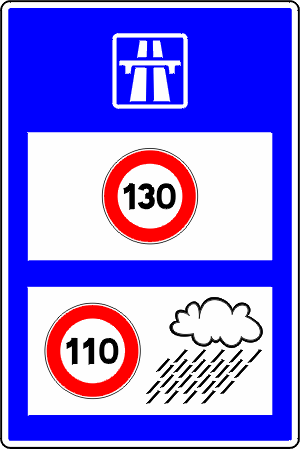
The article weakly, and quietly made an argument that I do agree with. Namely, roadway design needs to accompany speed limits to ensure people actually drive the desired speeds. Wide lanes, big setbacks, homogenous environments encourage speeding regardless of what is posted. But let's be clear, we should have our design follow our policy, not our policy follow bad designs that were put in place by roadway engineers of yesteryear.
That message seemed to be lost in the race to tell us something tantalizingly counterintuitive. I love "everything we know is wrong" storytelling as much as the next guy, but only when that's actually backed up with solid evidence. Take for example this gem from the article:
> “We all speed, yet months and months usually pass between us seeing a crash,” Lt. Megge tells us when we call to discuss speed limits. “That tells me that most of us are adequate, safe, reasonable drivers. Speeding and traffic safety have a small correlation.”
That would seem to be at odds with this peer reviewed article (sorry, paywall, but you can read the abstract):
> Respectively, they found evidence for an exponential function and a power function between speed and crash rate. Both types of studies found evidence that crash rate increases faster with an increase in speed on minor roads than on major roads. At a more detailed level, lane width, junction density, and traffic flow were found to interact with the speed–crash rate relation.
Link to article: http://www.sciencedirect.com/science/article/pii/S0001457505...
Priceonomics's banner ad tells me it is selling a new book titled "Everything is Bullshit." Quite right.