Cannon shells cannot be fired over the horizon either. Firing over the horizon will convert the projectile's forward momentum into height, it will reach whatever its apex is, run out of momentum and then fall due to gravity. The angle is just too steep.
The only way to make this an effective weapon is to fill it with explosives (since then you've just created a mortar). But firing explosives from a railgun has its own issues.
Most weapons which depend on a steep parabolic curve to hit their targets also have explosives in them, like artillery, mortars, ICBMs, etc. You can use a less steep curve to deliver blunt force to a target (catapult, cannon, gun, etc) but these weapons have a finite range as the earth is curved, therefore you'd have to tilt them too far back to overcome that, which will cause all that lovely forward force you're depending on to do damage going up into the sky as it flies higher and higher.
You seem to be saying that in order to fire a projectile farther, one needs to make launch angle closer to vertical. But that is not the case, unless the distances get very large you always achieve the longest distance by firing at a 45 degree angle, so half the velocity is in the horizontal direction. Making it more vertical than that will make the range shorter.
For extremely large distances (probably not relevant for naval railguns), the curvature of the earth becomes significant. But the correction goes in the other direction, it is optimal to fire at an angle more horizontal than 45 degrees. In the limiting case, the optimal angle for an ICBM is 22 degrees [1], and they will re-enter the atmosphere more horizontal than veritical [2].
Rather, in order to hit further away targets you need to initially fire at more than 45 degree. A higher trajectory gets you into thinner sections of the atmosphere more quickly so you lose horizontal velocity to air resistance less quickly. Air resistance doesn't seem too big a problem to us in our day to day lives, but increases as the square of velocity so at the speeds that artillery shells travel it will tend to start out as a much stronger force than gravity.
What ICBMs (and space_bound rockets) do is to travel vertically initially to get out of the thickest part of the atmosphere before starting to put on rotational velocity. You'll notice the article you linked specifies a reentry angle of 22 degrees, not a launch angle of that. A missile has an advantage over artillery in that it can apply thrust over time, and wait to start accumulating horizontal velocity until it has gained some height.
EDIT: A better way to explain things. When a bullet leaves the barrel of an artillery piece the forces on it are dominated by air resistance. As it travels it's kinetic energy decays exponentially with distance due to air resistance, and eventually it's traveling slowly enough that gravity becomes an equal source of acceleration as it settles into terminal velocity.
> You seem to be saying that in order to fire a projectile farther, one needs to make launch angle closer to vertical.
I didn't say anything even close to that. Not even ballpark.
I said that if you fire at a high angle you won't have much kinetic energy when the projectile finds its target. This topic is about firing non-self-propelled projectiles (cannon balls, railgun pellets, etc) from a ship or some other platform near sea level, several people are claiming that you can fire at a high enough angle to escape the horizon while still maintaining enough forward momentum to do significant damage, I am saying that at those angles the forward momentum is largely consumed as height.
The projectile will travel away and up, and then after it reaches its apex where it has consumed a lot of its forward momentum to elevate itself it will fall back to earth only at the speed gravity carries it at (minus wind resistance).
So while, yes, you can likely hit a ship or other target beyond the horizon, you cannot do so with more kinetic force than the projectile's weight being carried down by gravity (which is typically not very much relative to the kind of speeds we're talking about when initially fired).
I think you have an inaccurate understanding of how projectile motion works.
First, there is no particular angle that you need to fire to "escape the horizon". The horizon is not a well-defined distance (it depends on how high how above sea-level you are), and in any case you never need to fire at a steeper angle than 45 degrees.
Second, momentum is not "used up" to elevate a projectile. If you ignore air resistance, a cannon shell will hit the ground with exactly the same speed as it was launched (no matter what angle it was launched at). For example, if you fire it straight up, then the kinetic energy of the projectile when it lands (again, disregarding air resistance) is exactly the height it reached times the force of gravity. And that is exactly the speed it had when it was initially fired (which is how it could reach that height).
> First, there is no particular angle that you need to fire to "escape the horizon".
You cannot make up fictional quotes then chastise me for my lack of understanding based on those quotes. I'm not even going to respond to that.
> Second, momentum is not "used up" to elevate a projectile.
That is where you're mistaken. The higher the angle that the projectile is launched at the more energy that gets transferred into elevation.
So when firing straight forward you transfer almost no energy from forward momentum into height, which is why when you stand straight, stick out your arm, and fire at a target down range you have to adjust for gravity.
As you point the "gun" further and further upwards the "bullet" will travel higher and higher but start to hit the ground at no more than its terminal velocity. This is because energy is going towards height from forward speed until forward speed is near zero.
> If you ignore air resistance, a cannon shell will hit the ground with exactly the same speed as it was launched (no matter what angle it was launched at).
Then where does the energy come from in order to gain their altitude? If we take what you just said literally, then a mortar is an impossible kind of weapon, since you have no way of making the projectile travel upwards, only forwards.
The problem with that is that you just contradicted your own post. Earlier you said that 45 degrees was the optimal angle for distance, correct? So you acknowledge that at different degree elevations projectiles travel different distances, would this also be correct? Therefore if we combine these two points together: that different degrees cause projectiles to travel different distances, and that that travel requires energy, you must acknowledge that that energy has to come from the projectile's forward momentum.
If you acknowledge that forward momentum is converted into height at higher degree elevations (as you did earlier, see 45 degree point) you must also acknowledge that energy is being eaten for this additional height.
> For example, if you fire it straight up, then the kinetic energy of the projectile when it lands (again, disregarding air resistance) is exactly the height it reached times the force of gravity.
That is incorrect. If you fire a projectile straight up it doesn't come down "times the force of gravity." In fact things cannot exceed their terminal velocity which is 1x gravities unless they're being artificially accelerated (e.g. firing a rocket straight down can go beyond 1x gravities, but a falling brick cannot exceed 1x gravities).
The image you posted in the sister comment made me see what's going on. You are arguing according to the Aristotelian theory of projectile motion, while the other commenters assume the Galilean theory. See e.g. this link: http://www.met.reading.ac.uk/pplato2/h-flap/phys2_2.html#sec... .
(In the presence of strong air resistance, the Aristotelian theory is not a bad approximation. If there is air resistance, a falling object will indeed gradually slow down to a terminal velocity, like you write in your last paragraph.)
I'll try to explain it with simplified physics. Let's assume for a moment that the projectile is fired 50 ft off the surface at a speed of mach 8, or about 9k fps. If we assume no resistance vertical or horizontal at a 50ft drop the projectile is travelling downward at 55 fps by the time it hits the ground. As you can see, the horizontal velocity is still orders of magnitude greater than the vertical velocity. As you start to deal with curvature of the earth your drop distance will increase, but not enough to overcome the 9k fps in horizontal velocity any time soon. The horizon is 3 miles off, or 16k ft. Less than 2 seconds of travel time for our projectile. Of course, there's always going to be resistance, so at some distance the horizontal velocity line will cross paths with the vertical terminal velocity, but I doubt that happens at any practical firing distances.
You seem to have forgotten the actual problem scope.
Nobody is claiming that railguns (or cannons) don't work. The issue is that to fire a projectile over the horizon the projectile's angle has to be increased.
This poses one of two issues:
- You fire the projectile SO fast you overshoot the target
- You fire the projectile to hit a target just over the horizon but to do so it no longer contains enough energy to do measurable damage to the target.
I'm going to assume that the designers have considered this, and that even though it's over-the-horizon the projectiles will still have significant momentum when they hit.


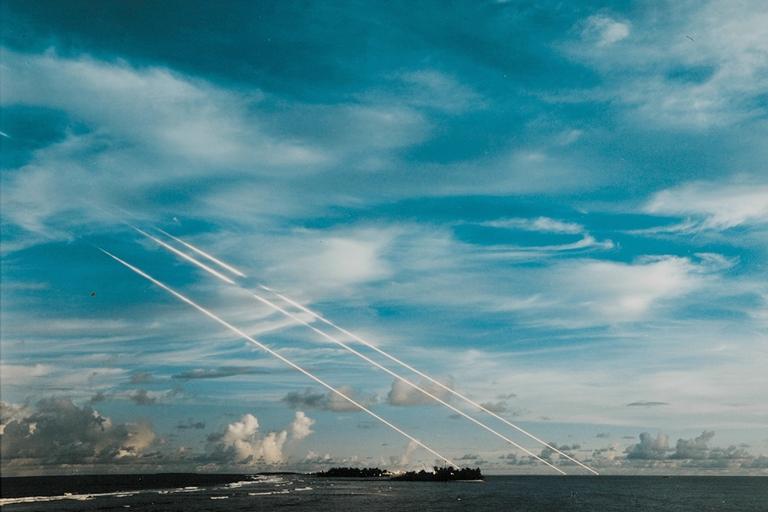

The only way to make this an effective weapon is to fill it with explosives (since then you've just created a mortar). But firing explosives from a railgun has its own issues.
Most weapons which depend on a steep parabolic curve to hit their targets also have explosives in them, like artillery, mortars, ICBMs, etc. You can use a less steep curve to deliver blunt force to a target (catapult, cannon, gun, etc) but these weapons have a finite range as the earth is curved, therefore you'd have to tilt them too far back to overcome that, which will cause all that lovely forward force you're depending on to do damage going up into the sky as it flies higher and higher.