As a wee lad in the last millennium I was an authorized Nintendo repairman.
Blowing on the cart sometimes worked, if there was errant dust or fluff in the way. But in the long run the salty moist air would cause a corrosive layer of gunk on the contacts. Normal procedure was to open each cart and clean them with a good eraser then an alcohol wash.
The bigger problem was bad design in the original NES. The cart plugged into a component that looked like a harmonica and then pressed downwards, levering against a pretty heavy spring. This perpendicular stress caused the contacts to break, first causing contact flakiness, then failure. The SuperNES and GameBoy fixed this problem with a vertical insertion that carried over into the N64 and others.
I was about 8 years old, and convinced a local video store in my small town that I could repair Nintendo games. I brought them home, and if they were indeed not working, I would get a Q-tip, apply some rubbing alcohol, and swab/scrub the contacts. This nearly worked every time.
I got slightly called out when a customer brought in an actual Nintendo that was broken. I ended up taking it home, opening it up, turning it on (probably not the best idea), and went through each component on the board to see if anything looked out of place. I ended up finding a capacitor that was a bit bent, so I straightened it out with my fingers and, viola! It worked! I returned the Nintendo back to the shop in working order and felt like quite the little man.
I had free game and movie rentals for life, as well as being able to pick out what Nintendo games the store was to order next. I was in gaming heaven.
Let me pedantic while being clueless at the same time, the western NES design introduced the problem, since the original famicom had vertical insertion cartridge already right ?
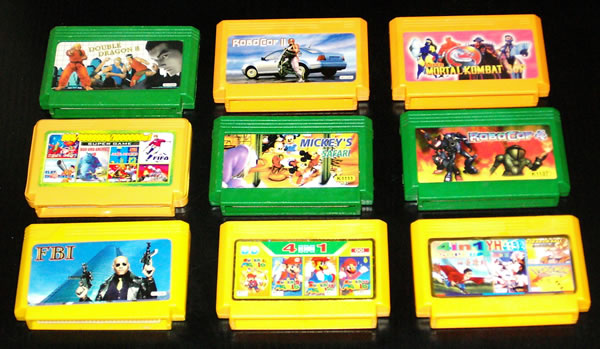
In Russia we had so-called Dendy[1] (hardware clone of Famicom made in Zelenograd) which had that exact vertical slot. Guess what, we used to blow into our cartridges too when they didn't work.
[1] Actually, history of game consoles in Russia in early 1990s is quite curious. Nintendo themselves weren't interested in our market, so Russian-Chinese manufacturers promoted their clone quite freely. I believe it was even better than original famicom, since original controllers were detachable and easily replaced and also it came with a lightgun. Cartridges were cheap and abundant, about $2-4 each. Also there was a lot of 10-in-1 (100-in-1 even) catridges. After SEGA released their mega drive 2 console in Russia, dendy business started to decline. Look at this pic: http://upload.wikimedia.org/wikipedia/commons/6/67/Dendy%27s... Ridiculous bottom-left cartridge with the picture of Morpheus from the Matrix and hilariously named FBI was clearly released in 1999 or later. Anyways, all our favorites were the same with the rest of the world: mario, contra, battle city (this one was a real hit! everyone had it). Ah, sweet times.
if there actually is dust and blowing actually takes it out of the cartridge then it works. the article was saying most of the time it wasnt dusty so there was no point to blow on it but we all still do it, hell i've done it on CD's, flash drives, power connections, pretty much everything electronic if a quick unplug replug didnt work i have tried blowing in it and eventually it works though blowing doesnt help it makes me feel like im doing something to help it work.
Blowing may have worked at getting the dust out of the cartridge - assuming you observed it - but that doesn't establish that the dust was the cause of the problem.
When I worked for my uncle's video game business in the mid 1980s I often had to remove the ROMs/EEPROMs from coin-op video games and used an eraser as well to clean the corrosion off the legs.
The PacMan series were the worst and the single data and power connector would always fail, often scorching the PCB causing the traces to lift and come loose. The legs on the EEPROMs on Ms PacMan I worked on fell off I think they were just pressed on, they were a weird gold colour. That was a bad day.
Another interesting fact is that the NES was deliberately designed with the horizontal loading rather than the vertical one (as in the original Famicom) so it looked less like a videogame console, helping to dodge the stigma that consoles had after the Great Crash of 1983.
If this was true, then why could you stick a game genie into your system, not press down, and still get the game to work, even on a broken NES with bent or non-connecting contacts?
The contacts were never the issue. the CIC lockout chip is the culprit everyone's ignoring.
The force was actually borne by the contacts? Man. You'd think they would have put the contacts on something more flexible, and transmit the force with the outer covering.
Yep. I think the idea was to make it behave like the toploading VCRs which were around at the time: insert then press down. Very often customers would refer to the cartridges as "Nintendo tapes".
Sure, the American NES was deliberately designed that way in order to not look so much like a video game device, because everybody was paranoid due to the video game crash having happened recently.
I'm really asking a mechanical question. Basically, if you're going to build an insert-and-press-down device, it would make sense to have a mechanical system to handle all of that separately from the electrical contacts. Basically, you'd have the cartridge slide into some kind of device which captures it and has the springs and latches to make the system work as desired. Within that device, you'd also have the electrical contacts with the cartridge, but set up so that the fragile electrical contacts don't actually transmit the spring's force, which goes through the outer frame instead. You made it sound like the force got transmitted directly through the electrical contacts without any separate spring-loaded device, which seems like a pretty obvious failure point.
Kinda. The point was to push the contacts into position, so some of the force landed there, but I don't think the contacts were actually the fulcrum of the lever. Look at pictures 10 and 11.
I did it on mine in college -- and then I did it for my suite-mate after he noticed that I never had any problems with my NES -- and then I did it for everyone on my floor who had an NES... :) Works like brand new.
Alternatively, if you're really, really brave, you could do what I did: disassemble the NES down to the header, and use a small screwdriver to bend the pins slightly back into position.
However, it is easy to bend them too far, and increase the insertion force required to actually load the game. Or worse, snap off one of the contacts.
I did this with an NES that I purchased for $5 off eBay (over 10 years ago), and have had no problems since. I believe this was a year or two before the 72-pin replacement was widely available.
I have done this and can confirm it was really easy to do the fix. It works, but it should be noted that if you leave your cartridges pushed down in the system all the time it will just wear out quickly again. The design is just flawed.
I was an kid pre-NES, and got an old system at a yard sale for my kids. I quickly learned that I could reseat it 20 times, clean it with alcohol, pencil eraser, whatever sane tactic, none of them worked as often as blowing into the cartridge.
I had never heard of blowing into the cartridge before. I didn't get the technique from other kids, and I had never had to do it with Atari, Intellivision, C64, or any other system. I learned it out of desperation, and it worked. I don't care what scientific evidence or common sense points to the contrary, it worked.
I obviously havent matured very much because the 10 year old in me wants to say "nah-ah blowing works every time"
Perhaps I was kidding myself all those years but I swear the games would work after blowing on them. Oh well not the first time Ive found a fundamental of life was all a lie (and yes the trick to getting Nintendo games to work was a fundamental life skill back then)
I actually think it wasn't blowing on them that did it, but the act of blowing on them and then inserting the cartridge more deliberately the next time. And each time after that, being more deliberate. It was the act of putting it in 'just right' that did it, not blowing at all.
What always worked for me was inserting a 3x2 Lego piece, oriented vertically, between the cartridge and the top of the NES container. This pushed down the game by about 3-4mm. This trick was common knowledge in the neighborhood where I lived during the mid 80s.
Our trick was that once the cartridge was pushed down, you could slide it left and right a tiny bit into place until the pins lined up, then it would work.
So I used to pull out Unibus cards from the PDP-11 and rub the contacts with a pencil eraser to get the corrosion off them. HP machines of course had literally gold plated connectors which did not corrode pretty much ever.
The trick that always worked for me was to insert the cartridge and then pull it out just enough to where the near edge of the cartridge would just barely scrape against the console as it was pushed down. This was far more effective than blowing on the cartridge.
My house mate and I are currently moving through our Killer Instinct phase on SNES, and I just lent my NES to my 18 year old sister and her boyfriend who borrow it regularly.
I'm taking this article very seriously, as I am from the family of people who blew in the cartridges (and the console) up until I read this :)
Is it really worth it the risks to play on the real thing? I don't have my NES anymore (my parents convinced me to give it away when I got an N64), but I think that I'd still use an emulator and boot it only once every few months rather than risking breaking it. And using It Might Be NES (emulator for the PS1/One/2) on a CRT TV is almost the same anyway ;)
Now, I realize there's no point in having something without using it, but my point is if parsimony isn't a better policy.
It was a revelation when I decided to try actually cleaning the contacts on a NES. The results of a little alcohol and a brush made of folded notebook paper earned me the reputation of a magician in my circle of friends.
The "Placebo Effect" isn't "something tricking you into thinking it works" - it's the fact that having a belief that something works produces better outcomes. I doubt that the mental state of the child has any detectable or consistent effect on the function of the console.
This is the second report I've read that says that it doesn't help. But there's something these reports are missing, because the simple fact is that it DID work. I've personally proven the hypothesis a hundred times in my childhood: (re)insert cartridge X times -- doesn't work -- blow -- works. It was extremely rare that blowing did nothing in my experience, and the solution in those cases? blow harder.
I always found that if blowing no longer worked, that I could plug it into the Game Genie loader and it would usually work. I suspect because the fit into the Genie was much tighter and the pins were less worn or corroded.
Definitely. Around my old neighborhood, Game Genie was a highly prized accessory if only for that reason. Cheating was all well and good, but having your Nintendo actually work? That was the real advantage!
The Game Genie is a mini cartridge that attaches to a game cart (to apply cheats/mods through a code-entry screen). This combo is then inserted into the NES, Game Genie-first. The combo is too long to be pushed down, and the NES door remains open while playing.
I never understood why you don't need to push "down" the Game Genie; a bare cart would never function unless pushed down...
Nevertheless, every game I had that would not work in the NES would work just fine with the Game Genie attached (and you can always choose to enter zero cheat codes). The Game Genie seemed to make everything a bit tighter. When inserted into the NES, there isn't much wiggle room, if I recall.
edit: Wikipedia says, "Therefore, the Game Genie was designed in such a way that it did not need to be depressed in order to start the game. This design put even more stress on the ZIF socket than standard game insertion, bending pins and eventually causing units to be unplayable without the Game Genie present." https://en.wikipedia.org/wiki/Game_Genie
you didn't need to push down on the game genie, because the "push down" was to enable the CIC lockout chip. Galoob spent a considerable amount of time (and legal fees) bypassing the CIC chip. this allowed all games to run without problems on most NES systems.
I did that as well, but I don't think that actually makes anything better. Your breath is very moist and when you blow through your shirt, you're still getting essentially all of it.
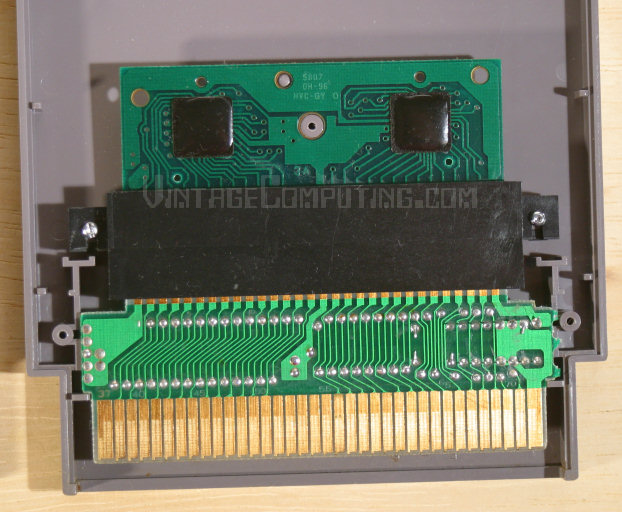
I'm surprised seeing those photos of the game boards outside their cartridges. Not only are they much smaller than the cartridge, but they are really just some memory and the lock-out chip!
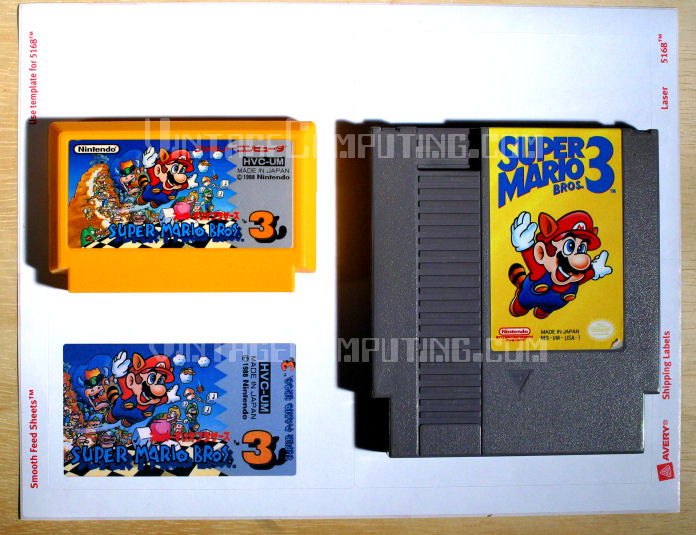
The article didn't include any pictures of Famicom carts, but basically, they're about half as tall as NES cartridges. I haven't popped open any NES games, but I'd have to guess most, if not all NES games just used a Famicom sized board to simplify manufacturing. Here's a comparison shot of the NES and Famicom versions of Super Mario Bros. 3:
While most later systems featured mostly standardized cartridge designs, Famicom carts wildly vary in color and design from publisher to publisher. They're quite pleasing to look at:
Another piece of trivia: The Famicom had a 60 pin cartridge port, while the NES had a 72 pin cartridge port (iirc they removed a few pins, relocated a few from the Famicom's bottom port, and added pins for the lockout chips). A few early games literally consisted of a Famicom game board plugged into an internal 60-to-72 pin adapter. So, for a while, the cheapest way to get a Famicom converter was to rip apart a cheap game like Gyromite and hope it was part of a certain run. You can see the converter clearly here:
As for technical details, you're mostly on the dot, but most later games also featured mapper circuitry to allow the NES to address more memory. Some boards used simple 7400 series, while others used customs ICs, some of which were fairly expensive, to expand the system's capabilities. Simpler ones just allowed for more complex bank switching schemes, while the most expensive ones featured things like interrupt generators and additional sound generating hardware. The sky is the limit for what you can stuff in a game cartridge, so the NES and SNES were designed to be very expandable through their cartridge ports. That's part of what makes cartridge-based games special to me; they're not just data on a disc, they're full-fledged hardware extensions of their host console.
I used to blow in them, but I found that the double cartridge technique (putting two in at a time causing the pins to press harder) worked a lot better. Sometimes if things were really bad a 'snap-in' technique would work. To perform this technique you insert the cartridge partially and then apply downward pressure causing the cartridge to forcefully jump into the slot. This was likely very bad for the system :)
I don't think I ever blew into my NES cartridges, but I remember taking them out, giving them a gentle shake with the connector end pointing down, and putting them back in. I expect doing this was as much a placebo as blowing (it's not as if there were chip crumbs stuck in there), but it made me feel like I was doing something productive. :/
We all thought it worked :) All of my friends with NES growing up encountered the same problems overtime. It was clearly a design problem as described in the article. The SNES was so well designed, I still use it to this day (almost 20 years later).
Holy crap, everyone is wrong. I didn't think I'd see this day on HN.
The reason people resorted to blowing in the cartridges is because of the CIC chip. The so-called "Lock-Out" chip on the NES is responsible for the Blinking power button and games not working.
"Sometimes," I hear some of you say, "You'd take the game out, put it back in, and it'd sometimes work. Why?" Well, imaginary question-asker, because the a faulty CIC will work sporadically. if the code passes the CIC check, it continues without issue. if the CIC fails halfway through your game, your game doesn't stop working. If you power cycled the system, then you'd notice the CIC failure. Blowing on the cartridge worked for the same reason doing 200 pushups will make water boil.
Nesdev.org has a decent amount of information about this chip on their wiki, if anyone's interested.
TL;DR - clip two pins on the CIC chip, never blow in a NES cartridge again.
They were addressing whether or not blowing in a cartridge fixed a problem. The same problem the CIC lockout chip was responsible for.
Therefore, they were addressing whether or not ignoring the CIC lockout chip fixed or alleviated a problem. clearly, it does not.
Perhaps you can explain how ignoring the cause of the entire problem, blaming the cartridge slot, and then working from a false presumption mean that they're not wrong?
In my experience, DS cartridges are far worse than NES cartridges for this issue. I don't know how they corrode the way they do, but I've sent my carts to Nintendo numerous times for replacement.
What a stupid article. You're supposed to cough into the cartridge, not blow in it. Then you insert the cartridge, slap the system's sides twice, and power on
I remember using rubbing alcohol on a q-tip against both sides of the connector. That seemed to work well when blowing on it and rubbing it with your shirt didn't.
Isopropyl alcohol as sold in US drugstores/grocery stores is about 30% water, though, and the alcohol evaporates a lot faster. So for the most part, those who were cleaning their cartridge edge connectors with rubbing alcohol might as well have been breathing on them or using water by itself.
One thing I couldn't tell from the article was whether those fingers actually were bare copper, or gold plated. If they were bare copper, I'm amazed that they lasted a week. If they were gold-plated, then the connection problems would have been strictly in the harmonica connector inside the console itself, at least until people started using pencil erasers. Blowing on the cartridge itself would certainly have had no effect.
Another possibility is that Nintendo made the mistake of flashing gold directly over copper when they should have used an intermediate layer of nickel for passivation. This would probably result in connections that were better than bare copper would have provided but not as reliable as a proper surface treatment would have been.
I got a NES a few days ago with some games. Yes, blowing into the cartridge works just as it always has. It can take 10 tries without blowing without getting any video/audio, but blowing another game once or twice and the game is on.


Blowing on the cart sometimes worked, if there was errant dust or fluff in the way. But in the long run the salty moist air would cause a corrosive layer of gunk on the contacts. Normal procedure was to open each cart and clean them with a good eraser then an alcohol wash.
The bigger problem was bad design in the original NES. The cart plugged into a component that looked like a harmonica and then pressed downwards, levering against a pretty heavy spring. This perpendicular stress caused the contacts to break, first causing contact flakiness, then failure. The SuperNES and GameBoy fixed this problem with a vertical insertion that carried over into the N64 and others.