Here in the UK, tomatoes from the Netherlands are the most common sold in British supermarkets.
Unfortunately, they are quite flavourless. The type of tomato (and price) makes no difference (organic, vine-ripened, salad). Most of them are usually semi-ripe. Even if you allow them to ripen at home for a few days, they are still quite tasteless.
Presumably, Italy keeps its best tomato produce for themselves and I don't blame them (although Italian tinned tomatoes are widely available in the UK, just not the fresh variety).
Netherland is quite famous for its ability to grow completely tasteless vegetables. After WW2, people didn't consider taste very important; only appearance, size, cost, and maybe nutritional value mattered, so lots of tasteless vegetables were bred.
Eventually customers started revolting, and now there are plenty of very tasty tomatoes available. They're more expensive, though, and not everybody can afford them. To a lot of people, cost is still a factor. And maybe even more so for export.
You are missing the key quality for which industrial scale produce has been selectively bred over the past century: shippability. The ability to be placed in a box and moved thousands of miles without falling apart is the paramount quality of mass produced produce. Go to a farmer's market, be anything but delicate with a large heirloom tomato and you will understand what I mean.
Since growing myself, I have found a whole new appreciation for vegetables. For all these reasons the stuff you buy in the shop can never be as good (at a reasonable price anyway). It takes very little expertise to grow vegetables yourself, that are better than 90% of the stuff you can buy in the shops.
I disagree that consumers didn't find taste important, but probably was trumped by other factors. The major factor (not mentioned in your list) was a result of the industrialisation of farming and marketing (I.e. supermarkets). Vegetables had to be able to transport and store well, and maintain appearance at the end of that. So process (both breeding and other) were adapted to those goals.
If people found taste so important, tasteless vegetables wouldn't have been so successful. And it wasn't just tomatoes either; the most common potato, the bintje, and later the superbintje, are also famous for having very little taste. In my youth, this was considered normal.
During my student days in the early 1990s, I started buying organic whenever possible, and organic potatoes weren't bintjes. When fellow students came over to eat, they were stunned at the taste. "What did you do with your potatoes?" I just boiled them, nothing more. (I'm a pretty mediocre cook.) They just had no idea that potatoes could taste like that. Tasteless crap was the standard. Even when people could afford better, they didn't know it existed.
When I was kid (in the 80s, in Hungary), we ate according to the season. More vegetable in the spring, more fruits in the summer, vegetables, beans, fruits in the autumn and mostly meats and apples, (oranges, bananas - when they were on sale) in the winter.
Now you can buy everything every time, but even the meat is less tasty. Personally, I'd still rather buy food according to the season.
I don't find it to be better or worse than any other Northern European countries. And I can't find good tomatoes at any price - the more expensive on-the-vine ones smell good initially but only taste slightly better.
>"After WW2, people didn't consider taste very important; only appearance, size, cost, and maybe nutritional value mattered, so lots of tasteless vegetables were bred."
Do you have a citation for or more info about this? Were genetically modified tomatoes introduced after the war? I would have thought that came much later with the rise of Monsanto[1].
Most fruits and vegetables we eat today have been genetically modified but by selective breeding sometimes over hundreds of year. Take corn for example something that is found almost all over the world its current form is because of genetic modification natural corn looks quite different.
Coming from the southern part of Europe, here in the UK groceries (save for Whole Foods 5pounds a bite..) are almost always tasteless.
Except for the apricots at the Turkish deli down the street. I don't know where he gets them from, they are the best apricots I've ever had by far =)
Mediterranean vegetables that taste good are unfortunately luxury products in the UK. You can get good tomatoes, you just have to pay 2-3x as much. It's because the mediterranean diet is a middle class thing, so supermarkets segment the market, because people will pay. Whereas in France, Italy, Spain etc that food culture goes across all classes.
They probably coming from Malatya - Turkey, which famous with its apricots. If you want to taste really good tomatoes ask your Turkish deli for Çanakkale tomatoes or pink tomatoes coming from Turkey.
Italian here. I don't think we really want to "keep the best produce for ourselves" - I'm sure our producers would just like to sell at the highest price. Instead, there is a problem with transportation and timing: if you harvest well-ripened tomatoes, they spoil quickly, which is something big distributors hate. Here you can usually find the best tomatoes in small markets in the right season; tomatoes from big supermarkets are usually pretty tasteless (unless you get lucky or know how to choose).
It's the same reason people tell me that bananas in banana-producing countries are way better than what you can find here: our bananas ripen during transportation, and the end result is very different.
PS: it's much easier to find very tasty cherry tomatoes, but they're also much more expensive.
Quality has a price. If you buy the cheapest tomatoes you get the lowest grade, if you're prepared to spend more you get better quality and more taste.
The Germans are extremely interesting in this respect deriding the lowest quality Dutch vegetables with all kinds of name-calling ('waterbombs') but at the same time they keep buying them because they are cheap.
If you want quality you will simply have to be prepared to pay for it, this goes for many more things than just vegetables.
Germans are not willing to pay money for food. They expect food to be cheap, they don't care too much about the quality of it (in general, of course).
Germans sometimes joke about themselves that some of them will spend +1000€ for a barbecue without a problem, yet they'll put the cheapest 0.50€ sausages on it.
I could not disagree more. I actually never met a german who joked about being cheap with food. Quite the opposite is true.
Also the per capita household expenditure on food[1] is above the average of European countries. Higher for example than in the UK or Austria, which have comparable incomes.
I live in Berlin and used to live in Vienna - I hear such jokes all the time, that Berliners will eat just about anything as long as it's cheap and won't immediately kill you.
You don't have to go far to see the difference either: Austrians and south Germans are already much more "food-oriented" than north Germans, so this may be a regional thing rather than encompassing the whole country.
The joke isn't by Germans saying they eat cheap food but by other immigrants saying it about Berliners/Germans (i lived for a much longer in Austria and never heard this said about Austrians).
I think the locals wouldn't joke about themselves that way cause to them the way they are is just "normal".
And surely you've heard Berliners say that Berlin's local food tradition is the Döner (i.e. there is no "local food")? I guarantee you no Bavarian or Austrian would say that about their own food tradition.
(And BTW I have no ill will towards Berlin or Berliners, I think it's one of the best places in the world to live in)
I disagree. I have grown up in Poland, in 70-ties and 80-ties. We were agricultural but poor country with communist economy. The meat - ham and sausage were rationed, so were sugar. Some of largest strikes in 1976 broke out when government attempted to raise the regulated price of sugar. My mom's salary equalled to 8 USD per month at black market exchange rates.
But the quality of basic food stuff was amazing. The real black bread with honey (razowiec) at every shop, good white bread, fresh milk delivered to your door by 6am every morning, cheese, cottage cheese, butter, potatoes, tomatoes, apples. Most people were first generation city dwellers and they knew how to select good potatoes and tomatoes. And it was all dirt cheap.
Now tomatoes - imported or grown in Poland are tasteless and potatoes are just a commodity - you cannot find any tasty variations. Sausages are mostly disgusting and unhealthy - few years ago it had been discovered that multiple companies are using chemical salt (for de-icing roads in winter) in sausages. Ham is mostly water.
The comparable black bread, good cheese, real sausages etc. one can buy in fancy, hipster, organic shops but at prohibitive prices. Prices that lower class cannot afford.
The income levels in dollar term over last 30 years had grown expotenially in Poland, farms are heavily subsidies also through EU CAP.
So how can one explain that the economy cannot deliver relatively cheap and tasty basic food products (at much higher profit margins as the consumers are now more wealthy and more health conscious) - a task that ineffective, communist economy fulfilled with relative ease.
> So how can one explain that the economy cannot deliver relatively cheap and tasty basic food products (at much higher profit margins as the consumers are now more wealthy and more health conscious) - a task that ineffective, communist economy fulfilled with relative ease.
That's pretty simple: Poland is now importing a lot of stuff that it used to grow at home. And since Poland is not the wealthiest country it doesn't get the high priced quality stuff.
A lot of stuff that worked under communism does not work equally well under capitalism until a long period of leveling has passed. And on that front Poland has done exceptionally well compared to some of the alternatives, even so there is still a long way to go.
Incidentally, I lived in Poland before the wall fell, and of course what you should add to your story is that if tomatoes were available they tasted better, but they really weren't available all that often.
Well market supposed to be self-regulating automata aiming at discovery of optimal price at maximum benefit to the consumers. And it is clearly not working like that - both price and quality benefits are nowhere to be fund.
Isn't over 30 years of market leveling enough in case of tomatoes? If the choice is between growing tasteless tomatoes or importing similarly tasteless tomatoes then I am under impression that market isn't working well in that case. At least not for a consumer.
If you are telling me that growing tasty tomatoes at large scale is absolutely impossible under capitalism then I will cry "Komuno wróć" :)
The article that started this discussion is about super modern technology used in farming. It reminds me of old joke about modern farming in USSR - they plow with tractors, they sow with airplanes and they watching bread on TV.
Agriculture is not based on capitalism within the EU. The rate of funds for countries distort the market. It is more similar to the soviet model: this country does heavy industry, this one will deliver timber…
As a Belgian, I'd happily pay x4 to x5 the price of the average tomato you can buy in the supermarket here. But I can't. There's an 80% chance tomatoes are tasteless, and a 20% chance they're amazing. I want amazing tomatoes, every single time. :(
You can learn how to tell them apart if you want. Stepdad was a greengrocer so to me this is second nature but when looking for tomatoes take the smaller ones and the darker ones. They're most likely to be the ones that taste better, even when you pick them from a batch. People instinctively seem to go for the brighter and larger fruits but those are almost always the bland ones.
Smell and taste are so intricately related that loss of the sense of smell usually translates into a significant loss of the sense of taste so you are absolutely right. But smelling the produce before buying is considered pretty bad form where I live.
That got me laughing but being the serious kind I am now wondering if we're wired up in such a way that if one tomato is bland and the other is rich in smell that we can tell the two apart reliably enough to know which is which?
I always think of us as having two eyes, two ears for stereo vision and sound but never think of us as having 'two noses' to determine the direction of a small or two different smells at the same time.
I live in Amsterdam but I always try how strawberries smell before buying. And in my experience they smell the same if they come from true same batch so I only need to try once.
"quality" is a subjective term. You can optimise a tomato for color, flavour, longevity, size (automated picking), and several other parameters. The Dutch tomato industry is very good at optimising for what the market demands, that's how it got to be so big. The market apparently demands the flavourless 'wasserbomben', I don't see a reason to put blame at the producers. If the market would demand something else I have no doubt the Dutch tomato industry would be able to provide it (Dutch supermarkets typically sell half a dozen varieties).
The lack of taste is not a problem of when the fruit is shipped. Its a indicator for a lack of stress. The plant is not attacked by insects, fungi and deer. Thus it does not produce the aromatics we expect.
Unfortunately, many people are okay with this and expect it. I honestly can not imagine Netherlands farmers and engineers unable to simulate that stress.
So its a purely lack of customers knowing the difference.
As an Indian, who has lived and worked in USA, UK, Singapore and LatAM, I can attest that produce in supermarkets in all these geographical regions are tasteless. Mostly because, as someone mentioned below they are now bred for ease of shipping.
Even in India, vegetables are slowly going the tasteless route, particularly chillies and garlic, but they are a lot more flavorful than their western world counterparts. I remember as a kid garlics were so pungent, you could smell them from a mile. Not the case anymore.
In Sweden we tend to get e.g. tomatoes from the Netherlands, Spain and Morocco. From a consumer perspective it seems random - the price doesn't really factor in at all.
Tomatoes from the Netherlands are almost always tasteless.
Tomatoes from Spain are often tasty, but sometimes tasteless.
Tomatoes from Morocco are sometimes tasteless and sometimes horrible.
So I look for Tomatoes grown in Spain and wish for the best...
Italian, or Albanian tomatoes are the best. You guys live so up-north, that it takes a long time for tomatoes to get there so you are most likely going to get shipped the 1. Tasteless type, that happens to resist longer on shelves, or 2. Unripped tomatoes that get ripened on the way there.
There is a huge difference in taste between in vine ripped tomatoes and the one they are picked up still green.
The northeast US has the same problem. Tomatoes in California are usually pretty good, tomatoes in Boston taste like crap. (the joke is that Boston is the last stop for a tomato truck, before they get thrown in the ocean as trash).
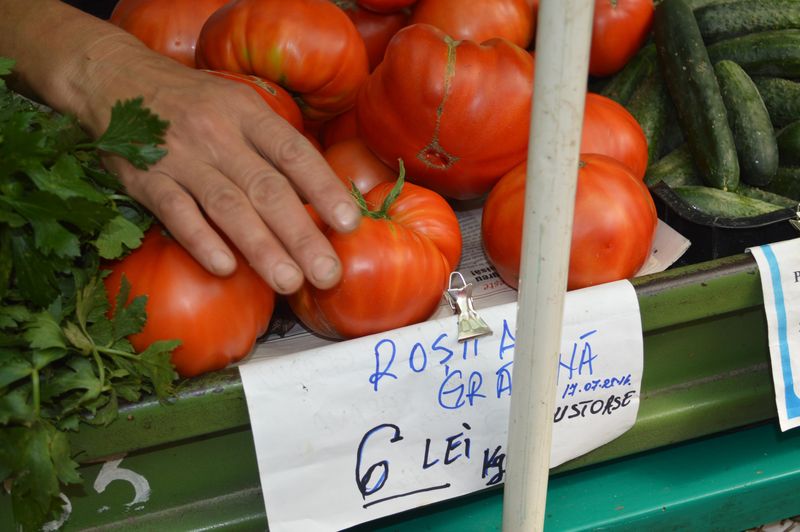
Homegrown tomatoes here in Romania are pretty tasty, maybe even indistinguishable from the ones you'd find in Italy. Especially the ones that people in the country side grow in their gardens and, even more so, the late summer, early fall breeds of tomatoes. When you cut one open, you literally want to shove your face in it.
Note: 6 LEI (RON) is 1.2 GBP, but can find them as cheap as 0.8 GBP, depending on the city, market or seller.
The problem is that I don't think we produce enough of them for export as they're only grown naturally, they don't last more than a few days, even when in the fridge, and they are seasonal. Households tipically pick them as they ripen for immediate consumption, sell any surplus on the local markets and, by the end of the season, harvest them for around 10 gallons of tomato juice for winter.
The countryside folk also lack the education to seriously market them, lack the money to produce in larger quantities, etc. Which leads to supermarkets being chock full of import tomatoes though (we also have the Dutch ones) :/
So true - Dutch tomatoes are awful bland tasteless cardboard. Best tomatoes in the world I've tried are in Serbia in the summer, bursting with incredible delicious flavour, perfect complement to their delicious grilled meats and sausages.
In next door Albania they are called "Zemërkau", which it translates "cuore di bue". Very delish, and fortunately local farmers like to grow them for themselves, so you will always find cheap good ones during the season.
The reason they are really good as they are the most similar to the original wild tomatoes, and less likely to have been modified just because their color and shape as most grocery common tomatoes are.
I've had amazing tomatoes of this species, but I've also had many watery ones...so I'm guessing the greenhouse-to-supermarket waterbombing effect is more important than the actual species.
I've been buying what they call "Plum Tomatoes" and they are much better than anything else I can get here in Sweden. Technically I think they are Grape Tomatoes, as they are quite small.
These are reliably at least fairly good in the UK, too, along with cherry tomatoes (about the same size, but round). Plum tomatoes are a bit firmer and cherry tomatoes are a bit sweeter.
What do you mean by "supervised watermelon type tomatoes"? Are you referring to some of the the huge heirloom tomatoes? I find there yellow ones particularly flavorful. Much better than there Dutch stuff.
Everyone here is mentioning Italy, but I associate it with Greece. The first time I walked into a grocery in Rhodes I learned what good tomatoes smell like.
There are flavourful varieties such as Tasty Tom or small plum tomatoes, but they are much more expensive at €10 per kg versus €2 per kg for a basic variety and less than €1 per kg for the most tasteless variety.
It's just a fact with the increase in globalisation and specialisation, fruit is picked unripened and is allowed to ripen while being transported and while sitting on the shelves in supermarkets. Nothing beats local produce which has been allowed to ripen on naturally and picked when ready.
Unfortunately that's not a particularly efficient way to farm and also fruit is only available in season this way.
Our cuisine and diet has a poor reputation, but I think some of our actual produce (vegetable and dairy) is not so bad. We don't have the warm or sunny climate for flavoursome tomatoes, but root vegetables grown here can be fine.
It's also common for cows to graze outside for part of the day (true of Ireland and Sweden too). It's subjective, but I think it makes for much nicer tasting fresh milk (compared to the UHT variety that is more of the norm in other European countries).
I think that’s just cultural conditioning. Many of the products found in continental supermarkets are equally disappointing for visitors from the UK :)
Its not culture, it is for the benefit of big companies. The best tasting vegetables also spoil easily. The ones sold in supermarkets are the varieties that can be sold longer, usually with poor flavor.
It's culture that lets them get away with it. If British people valued tasty tomatoes, they wouldn't buy the rubbish in the supermarkets. Everyone would know a guy who can hook them up with the good stuff, for a price, and the geriatric mafia who control the allotments would be rolling around in Bentleys.
Where are you shopping? My experience is that UK supermarkets are normally higher quality (esp in fresh and refridgerated goods) than other countries. Often lower priced too. Supermarkets I've seen in other western countries (Italy, France, US, Finland) have invariably been pretty disappointing.
Nope. Vegetables and fruits are tasteless.
If you don't find them tasteless then I'm afraid that you never ate proper ones in your life.
And I tried pretty much all the uk supermarkets: Waitrose, M&S, Tesco, Morrison, Sainsbury's, Ocado, Amazon, Iceland, Asda and probably something else that I'm forgetting.
And let's not start speaking about the tuna.
I have to bring it from Italy.
I spent up to 9 or 10£ for all kind of tinned tuna, even in glass and in olive oil and it was absolutely inedible.
Whenever I let anyone living here to try my tuna they are so shocked and amazed that I have to give them some tins to carry home.
And the tuna fillets in the glass are even better.
And what about porcini mushrooms?
The only place where I can find them frozen is an expensive Italian shop.
In the supermarket you can find only the tasteless dried ones if you are lucky.
My experience is the opposite. I find a narrow selection of mediocre goods in the UK, and a much wider variety of high quality products in the continent. I can't get decent charcuterie without going to a deli, and half the French products I want to buy I have to go to Waitrose to get. Everything from beverages to cheese is really limited, typically only two brands in any given category, one of them usually the store brand.
I feel like the UK supermarket industry took The Paradox of Choice too seriously.
> Everything from beverages to cheese is really limited
The UK produces more varieties of cheese (about 700) than any other EU country. A lot of that is from small independent producers. Obviously, you'll find a narrow(ish) selection at the supermarket, but it's pretty easy to find a wider variety from specialist or online retailers.
I found that out very soon in NL where you see mostly Dutch cheese in the shelves and just a very tiny small section with "world" cheese. Cheddar cheese became rarity at home these days.
Seconded. I don't think the parent comment to this has a strong basis in fact. The UK retail sector is one of the most competitive and dynamic in the world. I live in a small town and within 10 minutes' drive I have 3 large supermarkets open 7 days a week, stocking thousands of lines, with products ranging from budget to expensive. There are many smaller grocery shops also open 7 days a week. There is fantastic local produce if you eat in season. For range, price and convenience few other countries are close to the UK as regards mass retail. I studied this in a uni course and also speak from personal experience of living abroad.
It may be competitive, but the utility function isn't flavour or choice, it might be price or convenience or microwave dinners or something.
I speak as an Irishman who had a terrible time merely finding decent bread when I moved here (there is zero good soda bread in any British supermarket, I actually imported and froze mine for the first few years, then I went the bread maker route, until I made my peace and stopped eating bread at home), with a German partner for the past ten years who feels even more strongly about it than I do.
The implication of competitiveness is competition, and one aspect of competition is choice, both of type, and of quality. If you cannot create great tasting food with the plethora of choice available in the average UK supermarket the problem is not with the products on offer. The range and quality are near the best civilisation has ever had to offer.
You can find plenty of southern Spanish produce in greengrocers (it's usually so ripe it's nearly about to go off). Works OK if you want to eat it immediately.
Are tomatoes grown in the UK more tasty, or is it all the same?
I am asking because I've moved back/forth a couple time between the US and Canada, and tomatoes made in the USA or central/south America are tasteless in the US. When I see tomatoes made in Canada in a US store that's what I buy, no matter what the price is, organic or not. Savoura is the brand that I prefer, but then again, I am not sure it is Canadian, and they make it all over the world and it taste different depending where they come from...
> Presumably, Italy keeps its best tomato produce for themselves and I don't blame them
I think this also comes down to the trouble with transporting those types of tomatoes without loss due to spoilage.
The tomatoes you describe are exact the same as tomatoes sold here in Australia.
These Australian tomatoes have been genetically selected for characteristic that allow them to be picked green, ripen on the way to the supermarket and hit the shelves blemish free.
They look great on the supermarket shelf but their skin is as tough as nails and they pretty much tasteless.
Here in northern Germany if you go to the supermarket and look at the origin of vegetables, most of them seem come from Spain & Italy.
Interesting, as the Netherlands would be closer geographically! But maybe the UK is just far enough from the south-med to make shipping vegetables from there not as economical.
I never buy any vegetables from the Netherlands, just flowers. They're looking good but completely lack taste. They're also grown by heavily relying on fertilizers. I prefer to buy my veggies from Southern Europe when not available locally.
In much of the UK (presumably in the far north it wouldn't work well?) the way to get tasty tomatoes from mid- to late-summer would be to grow them oneself... Of course during the winter tasty fresh tomatoes are unavailable.
Indeed, I wonder how hard those complaining have tried to use local UK produce in season. Go to a restaurant that serves good food using local produce. I do this when I can afford it - I've had some fantastic food, comparable to anything elsewhere in Europe, and some UK fruit and veg is amongst the finest available - a couple of examples - British asparagus, and Yorkshire forced rhubarb - amongst the best available anywhere.
I tried that strategy here in the NL and got very nice looking tomatoes but still, watery and tasteless.
There is just not that much strong sunlight during the spring months to bring the taste out.
I guess it's worse in greenhouses which is where most (if not all) tomatoes are produced here.
Second this. Choose a good variety and plant in good soil and you will have lots of amazing tasting tomatoes, especially cherry tomatoes are super sweet if you let them ripen. I have been doing this for a few years in London and it's always rewarding - will grow a bigger batch next summer.
I was genuinely surprised to find hydroponically grown tomatoes here in the UK that are consistently delicious. They're called 'Pink Temptation'. They're expensive but the taste is worth it.
I am from the Netherlands and I have to say that regretably a large part of our country thinks that our farmers are incompetent, stupid, nature-hating animal bashers because of how the media treats them.
It's gross how strong the lobby is against our farmers, even though they're clearly among the most competent, intelligent, sustainable farmers around the world.
They always use cherry-picked facts (and even blatant lies), decades old photo and video materials and examples from foreign farms against our farmers, in order to put pressure on the government to regulate our farmers even more, to the point where our farmers feel that they are nothing more than underpaid workers for a huge governmental organization.
Funny, looking at the associated picture tells me a different story. Look at how uncrowded the chicks are and how much free space to move they have, and compare with US where they are so packed together that they can't even turn in place.
There are two types of chickens: the ones grown for their meat, and the ones grown for their eggs (I'm not aware of the English terminology on either).
There have been campaigns for both types of chicken to improve their quality of life. Here in NL they were conducted by an NGO called Wakker Dier. There's the campaign against the 'plofkip' (huge chicks who are unable to move, and are force fed) so that grocery stores quit selling these. Then for the sale of eggs (itself harmless for chickens, if unfertilized eggs, and if chickens are treated without abuse) there's a star system ranging from 1 ('kooi') [1], 2 ('scharrelei') till 3 ('vrije uitloop'). Note that this system says nothing about their diet. Now, if you'd translate 2 and 3, you'd both end up with 'free range'. This Wikipedia article on free range [2] explains the EU has strict rules on that term, while the US does not. Its worth noting that due to campaigns of Wakker Dier eggs of type 1 are almost never sold anymore directly, but they are still being widely used within products! If not, they will mention the name of type 2 and 3 ('scharrel-ei' usually or more uncommon in the case of products 'vrije uitloop ei' otherwise).
Regarding the picture you linked if that is from NL, that might very well either be accurate due to fipronil scandal [3] (millions of chickens were killed due to that hence near empty cages), or otherwise a propaganda picture.
Its very important to be critical of farmers. They're treating thousands upon thousands of animals with various degrees of treatment (from loving/caring to downright abuse), as well as affecting our soil (as in, "the inhabitants of Earth's" which also makes sense since our soil is deeply connected with the rest of Earth's ecosystem as well as literally your neighbors's soil).
I've always felt that it's a bit ironic for people consuming animal products to be critical of breeders. Kinda passing responsibilities on them so tadaaa ! No more consumer guilt.
If you really want to reduce animal exploitation and world GHG emission, cut down your consumption instead of putting even more pressure on producers without accepting to get more money out of your pocket for products. Because generally speaking, people don't want to spend more money on food, as there is so much other essential trash to buy. To each his priorities...
> I've always felt that it's a bit ironic for people consuming animal products to be critical of breeders. Kinda passing responsibilities on them so tadaaa ! No more consumer guilt.
Its relative, not absolute, and history teaches us we need to be critical of farmers. The recent fipronil scandal only underlines that. Our government failed as well, don't get me wrong.
If you want to reduce harm done to sentient beings (or animals with a CNS) there are many ways to achieve that. Yes, the best way would be going vegan overnight, but that is tough for an individual and quite unrealistic to achieve society-wise. Right now, we are better off reducing meat consumption (ie. via 'meatless monday' initiative) since we don't need to consume that much meat to begin with. If you eat less meat, you can use that money to eat quality meat. Eventually we can irregularly eat lab meat. So, yes, we should be critical to ourselves as well. But that's a different, and very complex discussion (I'm on a Facebook group where this is the main subject, finding the grey between the two extremes and supporting each other).
(Also as a side note there are some non-animal products which are rather bad for GHG emission, btw.)
All I'm saying is that it's not important to be critical of farmers but of consumers. Were there not so much demand for cheap animal products, all these problems would not be there. Almost every breeder I've met enjoys caring for its animals, but the harsh truth is that a farm is a business and most decisions are money-based, and also that time is crucially limited (can't spend 2 hours everyday for weeks caring for one single animal).
The recent fipronil scandal I'm not especially hostile to. It's like the horse meat thing, no risk for the consumer, it's simple fraud from the antiparasitics producer afaik and not latent farmer malignancy. You're way more exposed if you use antiflea products on your pets... And fipronil is really low risk for mammals overall. Oh, and of course this was in the cheap industry side of laying hens, so your wallet could vote on this beforehand.
Yet people still don't want to spend more on food. Most already shop first price, its just not a priority when you need to get a new phone and other stupid stuff. And this is the exact kind of consumer who can leisurely insist that we need to be critical of farmers. Oh, the irony. Sweep before your own door, you know.
But good on you, I hope your taking part in this Facebook group (probably known for it's high scientific and intellectual qualities, as everything that is on facebook) is comforting enough that you don't have to drastically change your consuming and behavior (and chronically, as "scandals" break out, underlines that farmers have a HUGE responsability in this), because what a shame that would be.
I gave two plausible options each explaining the picture. I find both of those explanations more plausible than tons of empty cages. YMMV.
I never said farmers are 'evil' people. Farmers can do good (and if you read my post well you'd have seen my examples), but we live in a capitalist world where profit is an important factor, if not the most important factor. So we need others to force the farmers to keep checks and balances: consumers, NGOs, and the government. Case in point: the fipronil scandal, where ChickFriend was a cheap solution to a problem, and where the government (NVWA) failed to look into an anonymous tip in november 2016. If they did, we'd have a lot less economic damage as well as less potential health damage. Another example is as I explained how Wakker Dier's campaign stimulated the sales of free range eggs of type 2 and 3 (although first and foremost in fresh eggs; not products containing eggs), and how they managed to reduce the amount of 'plofkip' in grocery store.
There was no potential health damage. The biggest scandal is how such a small issue was made this big by everyone involved. Read up on it. You can swallow 10.000.000 times as much fipronil as maximally allowed and still walk home from the hospital.
Putting the blame on the farmers is wrong too. How on earth could they have known that what the cleaning company used was illegal?
It seems strange to point out how well you are treating an animal when you are slaughtering it for consumption in the end. In fact that is the animal's only purpose of existence.
I think you look for purpose where there is little. What's the purpose of an animal living in the wild? Ecologists would say eat or be eaten, thrive, multiply.
From an evolutionary point of view you could say that cows, chickens, pigs (and cats, dogs, horses) are one of the most successful animals, exactly because we eat (or pet) them.
Maybe I, like all my predecessors, am not yet 'evolved' enough to give up on eating meat. In the meantime I like the fact that the animals are growing up disease free in relatively humane conditions.
It's not about being evolved enough, whatever that means. Eating meat is a conscious choice. Humans can do without meat. We are omnivores, not carnivores.
I mean yes, in the grand scheme of things, treating animals well before slaughtering them is better than treating them poorly, but it misses the forest for the trees.
I would be highly surprised if in 100 years we'll still do this.
It's only a matter of time until lab-grown meat is as good and cheap as the original, and then society will turn. Eating real animals will be something like hunting is now, a tiny thing and with huge image costs.
You should've spent more time sourcing that last claim, considering it was by and large the most bold one.
Furthermore, whilst it may not be obvious in activist circles, seeing the topic was about eating animal produce, the obvious counterpart in hunting would be game animals, and not a sport (which fox hunting is, more or less). My (unsourced) guess would be that most non-vegetarians do not condemn hunting, and it would also be a somewhat hypocritical stance. Furthermore, meat consumption isn't exactly on declining in the world, but you can make your own conclusions about that.
(I'm a city dweller, and haven't hunted anything in my life. I'm not saying that to validate my opinion, but regardless I know quite a bit about the realities of hunting that probably apply to most places, and the reason it is in decline may well not be because of a shift in the moral landscape. It is a consuming hobby, but that doesn't in itself imply that all non-hunters would automatically start to disapprove it more and more.)
sorry, I should have phrased it better, I don't mean that hunting is declining because of moral reasons, I mean that as it declines and people grow more detached from it it will be considered more morally reprehensible.
It is obviously an opinion not a fact, but as an example, you can consider the attitude of people to eating animals that they ate in the past and not now (porcupine, turtle, cat, dog).
Not only it's considered disgusting, but it's often considered worse than eating other animals.
I'm hoping to some day keep my own animals, to find out how the sausage gets made. I want to face the reality behind the sterile, bloodless chicken fillet I eat, and my apathy to animals.
Perhaps that will convince me to stop eating meat. Meanwhile I have bigger worries.
Although I always believed that was true, I started having doubts when I saw "Topchef" candidates having trouble distinguishing cow and pig meat when blindfolded.
Stress should be avoided, don't get me wrong, but I don't think our tastebuds are this advanced.
> I find it hard to believe someone loving live animals would put them in such a place.
I read the parent post as a statement on production and media representation. I didn't see any claim about farmers loving animals. I'm sure many do, but your argument is addressing something different.
I love animals. I eat meat. I want humane treatment of animals when they are bred for consumption. I know this is frequently not the case. But this is a different cause than what parent post addresses (aside from the 'decades old' bit about photos, which I am not qualified to address as someone outside the Netherlands).
I am talking about Dutch farmers. This is exactly what I mean. For example, early this year Dutch farmers had to explain themselves for something that happened in a Belgian slaughterhouse.
Do you like it when your mother blames you for bugs in her printer's Windows driver?
What did the Netherlands had to do with this? The only thing I know is that done Dutch people sold illegal medecine to Belgian farmers and the Dutch were informed, but didn't alert Belgium
That's what they had to explain, because it endangered the did supply
What spiderfarmer is talking about is a scandal in a Belgian slaughterhouse, where animals were being abused. This was filmed[1] by an animal rights organization, sparking outrage.
What you are talking about is the Fipronil scandal[2]. A Belgian company, Poultry-Vision, bought Fipronil from Romania and mixed it with DEGA-16. A Dutch company, Chickfriend, bought the mixture and knowingly used it to clean hundreds of farms.
(2) was the only link I knew, so I was aware that I probably talked about something else. If I'm not mistaking, Poultry Vision didn't deliver to farms in the food sector, while Chickfriend did ( chicken farms) -> illegal
This is exactly what happens in our media. All facts are useless because the farmer doesn't put same value on an animal's life as the hipster from the city who has distanced himself from nature more than humans should.
Look at the bird density. They aren't packed in there in the slightest. Have you studied chicken raising? Do you have a better system? Do you really love all live animals or just intellectually love them and feel empathy when one is mistreated?
For animal rights activists there is no acceptable way to keep an animal. They want to regulate farms until it's economically impossible to produce meat (from living animals). I get that, but in my view nature is brutal and I have no problem killing an animal for a nice BBQ. Who is closer to nature?
This is simply untrue. You can try spending some time having an actual conversation with real animal rights activists, you might find out that they're real nuanced people (just like you, hopefully).
These 150.000 birds are getting much better care from this single farmer than when they were spread over 10.000 households like they were 100 years ago.
Out of curiosity, do you genuinely believe there is a citation out there relating to the treatment of chickens on this farm today vs. treatment of chickens on 10000 small household farms 100 years ago?
It comes across as though you are demanding impossible standards of evidence here in order to cut off a side of an argument you don't agree with, and don't want to begin to consider?
"Citation needed" is not a universally acceptable reflexive alternative to discussion of things you don't personally agree with.
> Having a dozen chicken in a large yard seems to me to be pretty nice for the chicken.
I wouldn't be surprised if there was a paper that compares traditional methods of raising chicken to modern ones. But for the purposes of Internet discussion I would be satisfied with a convincing anecdote.
Rats, foxes and dozens of other meat eating predators would thoroughly enjoy the 10.000 unprotected henhouses.
Bird flu has been a big problem historically because of the large amount chickens in urban areas, although it had different names then. It's still a problem now, but it's now only spread by migrating birds.
When it comes to diseases. Do you think 10.000 amateur farmers know all ins and outs of chicken diseases as well as the professional chicken farmer?
And do you think they are more exposed to diseases in a farm with hygenic corridors or in someones backyard?
Hmm, I am from the Netherlands too. Not sure which media and lobby against farmers you're exactly referring to. Who would be putting up this lobby and to what ends?
Now I know that there is a big lobby in favour of agriculture in the Netherlands, that is highly successful and had basically a political party in its pocket up until the mid-90s - the CDA, you might want to google Gerrit Braks for example. This lobby was one of the enablers of the rise of the high-tech agri-cultural industry in the Netherlands as we know it today.
This piece, from a foreign media outlet is the only positive story about Dutch agriculture I saw in nearly a month. The last one was about how little antibiotics we use compared to the rest of the world.
Stories about how our farmers are bad? Missed the whole fipronil hype that completely unsubstantiated?
Talk to a farmer. Ask him who speaks for him nowadays. The lobby is "doodgepoldert". There is none.
Check how the NPO, Wakker Dier, Pvdd, Milieudefensie and Greenpeace are connected and you'll see the size of that lobby.
That reads more like propaganda than anything I've ever seen come out of the NOS.
It is however interesting that there is overlap between stichting wakker dier membership and producers of NPO shows. Moreover it is very worrying that Diederik Stapel has any public advisory function. I wouldn't call this 'evidence of close organizational ties' though.
Calling modern farmers most competent , intelligent, sustainable is an interesting point of view. Agreed it's very hard to blame the farmers because few would survive not scaling out in the current system. Farming tech is far from sustainable.
And vertical farming, hydroponics is cool tech and RGB LED's are cool to increase size, weight etc for increased profits. None of that has a positive influence on sustainability.
There a new phenomenon btw called Herenboeren, http://www.herenboeren.nl/, basically crowdfunding, for farmers. This is getting quite some attention. This at least gives me the impression that there's a bigger part of our country starting to see otherwise.
That Herenboeren initiative looks to me like feel-good rubbish, while at WUR issues like sustainability, erosion, etc. seem to me to be addressed in a much more thorough way.
Compare our farmers to the rest of the world. Study it. Please tell me in detail how they are not among the most intelligent, competent and sustainable.
> And vertical farming, hydroponics is cool tech and RGB LED's are cool to increase size, weight etc for increased profits. None of that has a positive influence on sustainability.
Did you even bother to read the article? That has massive implications on the amount of water, energy and chemicals used.
Yeah read the article, and worked with hydroponics for a while. I choose not to eat food grown like this. Squeezing nature for yields is a sure way of depleting your resources. Factory farming like this in reality reduces nutrient levels. But hey I don't believe science is going to save the food chain. Which is why I'm taking my money elsewhere.
Regarding the story of feeding the world. How about the West changes their diet? We don't need to go all out right now on farming, we could fix obesity levels, healthcare cost, excess levels of waste before we need that. But that's not cool science, and there's a lot less profit to be made. So I guess that's not what's going to happen.
Generally, a lobby represents one body/industry. If it's working against a group (say, farmers) it's because it represents something else rather than is solely against farmers. In which case, you should be able to guess and identify the lobby from its attack pieces. It might be someone who stands to benefit from sales of pesticides, or an environmental group, etc.
I can't speak for the Netherlands, but in Australia, while there is an active and growing green movement, I would consider the industry-specific lobbying groups to be more successful at landing media pieces to influence the public. These would be lobbyists representing mining, banking, meat production, etc. This is usually because those industries are very well-funded and consolidated compared to environmental groups.
I don't know about that? "Boer zoekt vrouw" is incredibly popular. One of my listening exams for NT2 was a farmer giving an interview about his life which was very interesting. I have relatives here who grew up working in the greenhouses. I admittedly don't read much mainstream Dutch news, but I don't get this impression.
The one thing that jumps out if I think about Dutch farming and the news lately is the Fipronil incident. But even that was obviously one bad actor - however bad it is that it spread through so many farms and had such a large impact on Dutch farming.
There are some farms with bad reputations, but farming in general seems to do quite well here!
Well I might be ruined because I manage a large agricultural newsletter (for both farmers and nature lovers) so I see almost everything that's written (and said) about them.
Coming in from a country (India) which even today has a large agricultural community which still uses ancient tools for farming (tractors are pretty much the most many get up to, with proper cold storage facilities, greenhouses etc practically a pipe dream), looking at countries improve their techniques in such a manner makes me wonder what it will take to move my country to similar scale. Is it simply technical, or is there a major push by government involved? Is it the community embracing technology, or is it other factors which make farming unsustainable without technology? Is it simply that farmers in these countries are overall more well to do? Or is it a combination of all of this?
Especially in India, farmers have been moved even to suicide [1] during times of drought and flood, which seems to come up every other year (and farming is a very climate sensitive field anyway), I really wonder how tech can work to improve the status quo
I only scrolled through TFA (added to read later list). I am Dutch though.
A lot of these systems require enormous (and growing) up-front investments, not feasible for small independent operations. There are a lot of family business in Westland, but they require massive mortgages and/or loans to keep up with the times (and the investments that they require). There are fewer and fewer small farms and more and more 'mega-barns'.
Little space is needed, but a lot of it is high carbon and high capital.
Also needed is a very stable environment, but infrastructurally and politically. A lot of these investments would never be feasible without for example the stability of the electricity network or the road network.
It can be argued if this is caused by the government, but the Dutch seem more maintenance-minded than most other countries I visited. Probably caused by all the dikes: if not maintaining something properly will kill your entire village, you have a lot of incentive to become very good at it.
We have, in fact, a dedicated form of local government for water management [1], and:
> These regional water authorities are among the oldest forms of local government in the Netherlands, some of them having been founded in the 13th century.
To add to your point about economies of scale, Indian farmers are a reliable political bloc. Turning a million unproductive farmers into 10,000 highly-productive ones is, from a political perspective, disastrous if you rely on that bloc. It's a similar phenomenon to public union political capture in certain American cities.
Yeah, I was wondering about that. Some of those farms look like they have million(s) dollars worth of equipment and infrastructure. And farming isn't exactly a high-margin industry so starting a new farm must be quite a risky venture. Are there government programs that help with the financing or it's all private capital?
As far as I know (I am not a farmer, nor do I know any greenhouse farmers very well), lots of it is private capital though.
One of the biggest banks in the Netherlands (Rabobank) has a (positive) reputation for financing farmers and other agricultural firms. (also a negative one due to the LIBOR scandal, incidentally)
We are still struggling to get away from dependence on monsoons for our farming, forget actually moving away from dependence on soil or other resources. Also, some of this is self-inflected because of our insistence on farmers owning land. By trying to force socialism at the level of property ownership in a capitalist market, we are making ourselves poorer.
Part of the problem in India is that land ownership is extremely fractured. You can't build infrastructure for high-output if you don't have rights to build the infrastructure. You can't achieve economies of scale if your property system is designed to prevent scaling. You can't ship price-competitive products to market if dozens of middlemen (and all their land) are all taking their cut before it ever reaches consumers.
There isn't an easy answer. Unifying property under a co-op system won't solve the problem because you can't have every decision deliberated by committee which is content to play politics as opportunity passes it by. People simply need to sell, and they simply need to accept that the land will be worth more after they sell it. People will simply have to surrender control, one way or another. People will simply have to adapt to a new economy. Creative destruction is the price and the engine of progress.
The alternative is the backwards system that exists today, and it is not sustainable, not in the face of foreign competition, not in the face of the people who suffer from starvation caused by mismanagement in poorer years, and not in the face of the persistent, rampant poverty that farmers keep themselves in as they cling to the control of what they know rather than the fear of uncertainty.
In my opinion a big problem in developing as well as developed countries is the idea that farming should be a family business. Here in Switzerland the government is very slowly introducing legislation that favors big farms over smaller ones. This is usually one of the hardest things - convincing society that farming is better done as a profession within a company rather than by a family as a sort of vocation. Usually farmers will lobby against laws that favor bigger farms thereby limiting the productivity of agriculture while maintaining their traditional socio-economic status. The Dutch society might have a different historical understanding of farming (being a seafaring nation that heavily relied on trading) which made the introduction of these new laws easier - but I'm just guessing on that last point.
It's simple - if the private labor market is failing to provide something, then the government needs to step in to make it happen. This could be via subsidies/grants, creation of research institutions (like the university in the article), and/or creation of state-owned enterprises.
Unfortunately we've all been brainwashed by neoclassical economists and such to believe that free markets should dictate everything.
The single biggest contributor is probably GDP per capita. You don't have the same economic pressures for efficiency and infrastructure if you can replace them with cheap labor, and without a high GDP you won't have the money to invest in all this infrastructure.
Both of those are chicken & egg problems to some extent.
The answers are simple to pose, difficult to even consider implementing, and troublesome in general. The problem in general is that we need more resources, or fewer people, but most rational people recognize the pitfalls in pursuing a "solution" to the latter, the and the former requires innovation or luck.
The Netherlands will soon be a massive exporter of flood-control knowledge and technology as well. It's like they've been practicing for global warming for the entire lifetime of their country.
Well we "foolishly" decided to build half our country below sea level. We've seen this interest in the past in the afterwake of Katrina, and we've been exporting this knowledge for quite some time. Unfortunately, it's probably a difficult problem to solve on the massive scale the US needs.
> We've seen this interest in the past in the afterwake of Katrina, and we've been exporting this knowledge for quite some time. Unfortunately, it's probably a difficult problem to solve on the massive scale the US needs.
Interestingly, this is a nearly 200 year old problem in America. Most spectacularly in Chicago[1], where the city was barely above the natural water table (Lake Michigan). As the city grew they produced more sewage and the ground was unable to absorb water quickly enough, so water began to backflow into the sewage system. A single Cholera outbreak in these conditions killed 6% of the population.
The solution at the time was to just build the sewers above ground, which was obviously a terrible idea. Over 20 years they began raising most of Chicago over 6' into the air. I think this isn't necessary with modern sewage, but in the coming decades we may see stuff like this again for east and west coast cities in the US. It's cheaper to raise entire cities than rebuild them.
More energy in the atmosphere means more violent storms, so Southern coastal cities will probably have to move inland.
The sewage drained into the river, which drained into the lake, which was where they got their fresh water, so they built a new river to reverse the original one:
Nothing foolish about it. This was once a backwater, and then people starting draining swamps, and then lakes, and slowly turned this into one of the most fertile spots on Earth, and prospered. It was a good decision. Even with the increasing threat of flooding, it's still one of the nicest places in the world to live.
I suspect the inhabitants of Saeftinghe (and the hundreds of other Dutch settlements vanished beneath the waves, fascinating stuff) might disagree: https://en.m.wikipedia.org/wiki/Saeftinghe
NL is not a country it is a machine that exists by the grace of the countless engineers and construction workers that keep on adding to our water management systems. But we're not just facing danger from the sea side, the rivers are quite capable of flooding the country as well.
I think we already are. The Dubai artificial islands are being made by Dutch companies. When Katrina hit New Orleans, Dutch experts were sent there. I assume the same thing will happen with Houston.
The amount of privileged, snotty complaining here about how they don't like the taste. If you don't like the taste, don't buy it; pay extra for something you do like the taste of. They're able to make a lot more food on a lot less land using a lot fewer resources. As far as I'm concerned, it's basically magic and given that the spectre of starvation has loomed over humanity almost forever, and is by no means permanently banished to the past, coming up with ways to make more of the thing that keeps every human alive using less space and fewer resources is not deserving of snotty replies about how people don't like the taste. Nobody's forcing you to eat it.
I agree, there are a lot of strange comments here. First of all, you can get all kinds of tomatoes in the Netherlands, but everyone is talking about the super budget tomato that is so cheap it's nearly free. Second, there's a lot more than tomatoes to enjoy in the Netherlands. They have great asparagus, excellent bakeries, high-quality and cheap milk and yogurt, reasonably-priced and delicious fish. Lots of other vegetables are no less tasty in Holland than I've experienced in the U.S. or Asia, such as potatoes, cabbage, onions, broccoli, carrots. That the Dutch have figured out how to fill a demand for cheap vegetables for those who want them is not a bad thing.
It would be hard to find a country with worse food than UK, so no big surprise here. Just my personal experience reflected by many friends acquaintances living there.
The food from the Netherlands is tasteless compared to Spanish or Italian in all seasons of the year, in the summer, all produce in Europe beats it.
High yields in a country that does not have record sunlight throughought entire year, can only be achieved by abusing chemicals in the process, faking natural conditions, etc. Low amount of natural sunlight can easily be tested using your taste buds.
If their farmer switch to other varieties, without slowing down and reducing the yields, they will still harvest tasteless produce in comparison to other countries that have better conditions or "slower" production.
I lived for 2 years in the UK - I didn't understand how they could eat that stuff ... it literally has no taste. Moved back home for 3 years and now I'm living in the Netherlands for the past year .. it tastes like nothing, the tomatoes, the cabbage, the carrots .. the parsley .. they all are so bland.
We found some actual farms around that we got some actually tasty stuff during season .. but the stuff in the supermarkets tastes like grass.
I'm actually a casual Polish consumer. While we get similar amount of sun as the Dutch do, our produce is much better in the summer than theirs.
Poland has lower yields, we have much more land than they do (lower pressure for efficiency), being a bit backwards to the Western Europe actually results in better food.
In early Spring and late Autumn, I'd always pick imported French or Spanish produce over Dutch.
    The Hague produces vegetables and fish in a self sustaining loop:
    Fish waste fertilizes plants, which filter the water for the fish.
    Local restaurants proudly offer the veggies and “city swimmers.”
As a result, it takes about 1/10 of the amount of water it takes to grow 1 pound of tomatoes in the US.
I'm afraid Netherlands is only good for food that's over-engineered, cardboard-tasting and geneticaly modified for quantity. But that's future I guess.
The article said the country produces no GMOs. Regular size tomatoes can be lacking in flavor. But I find the small tomatoes from there delicious. Some other vegetables like peppers are pretty tasty too. It's not all bad.
Oh my, NL tomatos taste like water sponges. This fact depresses me more than it should :/ They are the predominate tomato sold in DE, UK and others. Really, try a tomato from southern europe or some places in eastern europe, preferably while in southern or eastern europe.
What’s the energy cost of all that artificial lighting? The article notes that one of the farms produces its own (geothermal) energy. But is this generally true?
The article makes much of exporting knowledge. But how much of the “sustainability” of this model is tied to cheap renewable energy sources? Like geothermal in the Netherlands.
One researcher notes “on the assumption of efficient LED lighting, I estimate that plants like potato or tomato that produce a fleshy food product require about 1,200 kilowatt-hours of electricity for each kilogram of edible tissue they produce.” About the same as what a refrigerator uses in a year.[1]
For example there’s a New York indoor farming startup called Bowery Farms. Its gotten some tech VC and coverage in the tech press. Its marketing is all “green”. They claim to use “far fewer resources” while producing “100x more on the same land... 365 days a year.” They mention how very little water they use.
But if you look closely, they’re suspiciously silent on energy use.[2]
That 1200kWh figure doesn't make any sense. It says that "edible tissue" excludes water content. Each kg of tomatoes has about 950g of water. That means 60kWh per kg of tomatoes, which will cost about 5 EUR. You won't be able to sell your produce at that price.
For all those complaining about the (lack of) taste - the best tasting tomatoes are the ones you grow yourself in your back yard, and this is from personal experience. You can muse all you want about how Italian tomatoes are superior to Dutch ones, but nothing can beat the knowledge that what you have in your plate was grown by yourself on your own little plot of earth, with just a bit of patience and diligence.
Quite right, and even apartment dwellers can easily have a few tomato plants. One thing that's critical is not to use hybrid (F1) seeds, they don't breed true / aren't reproducible, so you need to buy seeds every year. This means the plants will never adapt to your particular soil and climate. Unfortunately these are the most common seeds found on the market.
In the whole Dutch food line, shortcuts are being made for saving a cent here and there, at any expense - resulting in inferior products, over the whole line.
Grapes without pits, soft bread that stays good for 2 weeks, chickens that shrink to half after baking, everything is full of sugar, ...
This is what we can appreciate about the South, lots of things are done not so efficiently but quite often with higher quality.
> More than a third of all global trade in vegetable seeds originates in the Netherlands.
This is the point. Dutch earn a lot of money with vegetables because they sell most of the seeds of vegetables that Spain, Italy, Morocco and other mediterranean countries use industrially. Because disease resistance, homogeneity of size and time of production, research, availability, and sometimes... plain piratery and renaming of old varieties. Read about the napoleon cherry for example.
1) Tomato is a tropical plant that loves warm and light. More sun means more flavour. You can pick the seeds of the same variety of tomato and culture some in Germany and other in Spain. Unless you can afford to spend a lot of electricity, the last will be always better. The reality is that the bland and the yummy tomato will often belong to exactly the same industrial variety, because...
2)... different grades of quality. Wouldn't be fair to match the cheapest tomato against the better.
3) Consumers do not select only by flavour, they have other interests and will reject a soft and dented tomato. You can sell the first strawberries of the year for a higher price, even if they have virtually no time to develop any flavour. People still love it because strawberries with low flavour is still a better deal that no strawberries at all.
4) more rippen tomato taste better, but if you want your tomato to travel 3000 Km before to reach your table in perfect shape and colour you need to sacrifice something. Small farmers and amateurs that sell locally can afford to pick the fruit more ripe.
5) Antique varieties "taste better", you can enjoy the different flavour variations that came with a bigger genetic diversity, but tomato is a short living species and, unlike good antique apples or plums, seeds of good and true heirloom varieties of tomato are very difficult to find and there is almost not profit in selling it online.
Lots of comments here about tomatoes without flavor.
Tomatoes are seasonal too, best ones are in summer. That's why people made sauces and kept them for the winter.
Willing to have fresh tasty tomatoes during the whole year is not an easy task...
Another factor is that tomatoes are harvested green and ripened using ethylene gas just before hitting the shelves.
I think that how much a country is "feeding the world" would be more properly measured in metric tons, rather than dollars. So saying that the Netherlands are "feeding the world" on account of the total value of their agricultural exports seems to me a bit misleading. Staples are cheap.
This is actually where the story gets really interesting. NL is producing an incredible amount of tonnage for such a small country. The division between lower grade (tasting poorly) vegetables and more tasty quality stuff (which is far more expensive) is severely lopsided (towards the poorer tasting variety).
Because vegetables are mostly water by weight quite a lot of produce leaves the country in freeze dried form to save on shipping.
Yields are high, yes, but ranking by export volume isn't fair to larger countries. If you group the Netherlands with neighboring Great Britain, Germany, Belgium and France (combined ballpark half the population of the USA), export volume halves.
Yet if you look at the total value of the exports, the Netherlands is second in the world only after the U.S. For a tiny nation that is quite impressive.
A tiny and very densely populated country. That we manage to produce so much food is amazing enough in itself, but you'd think we'd need it for ourselves. Maybe we import all our own food, or maybe we really have such a gigantic surplus.
There will be 10 billion people on Earth. Growing food for them needs a tiny area in highly developed countries via industrial farming. But what would that 10bn people do then?
Even a person with mimimal education and access to some resources can contribute to society (ugh, and the economy) in so many amazing ways, but it is fair to be worried that the first generation (and more) in the places with exploding population will probably lack those initial resources. As always, it is not about the availability, rather the distribution (of opportunities and resources).
I'm seriously asking what productive work can billions of people from underdeveloped and unstable countries do. Without access to lucrative markets, too.
I think the parent implies that automation and lack of capital to invest into automation will make those sectors inaccessible to untrained and unskilled people in developing countries.
Usually inequality between countries or people is reduced by rich and poor trading with each other.
But what if the poor have nothing to offer to the rich? Then the only option is to work for their own sustenance which means farming.
There's this saying about comparative advantage. But what happens when poor country doesn't have any comparative advantages over rich country? Or a few really tiny and disgusting ones which definitely won't support hundreds of millions people?
To depressing. I'd like to be positive and believe that in a many years from now we'll be able to reach a star-trek economy, hopefully before we reach that level of tech.
I can see this being a good option for fruit and vegetable production but I don't see this sort of intense farming being good for animals no matter how humane. There has been a big movement for completely free range and outdoor reared animals, although there are a lot of issues to do with CO2 emissions and run off from farms that are configured this way.
Really interesting, are there any resources I can read about techniques used in Netherlands agriculture industry.
I have 5 ha (1 ha = 10.000 m2) land in my home country, but I do not know how to use it, even for what I can use. I will be really glad if someone points out me profitable/most profitable things for this land.
(I am from Central Asia, traveling and working abroad)
Farming is a very localized activity as it greatly depends on a climate, soil type, irrigation, demand etc., so I doubt anybody from outside can help you with that. See what neighboring similar sized farms are growing, chances are that they have been doing this for years and have already optimized for the best value.
I live in Germany and this was a general statement (even though we get very much from the Netherlands).
Most of them taste like nothing. Sometimes even those who are especially marked as "something something sweet" taste like nothing most of the time.
I rarely buy the cheapest option. Most of the times we get the most expensive Bio (organic) ones. This legend needs to die. Just like the one that says that marked as "local" tomatoes (vegetables) taste better (or taste at all). For some times I thought I could smell it. Doesn't work anymore. There is no system anymore as long as you buy in a supermarket here. Unfortunately I'm asleep at local market times or they are when I'm at work but I'm sure you can get the good stuff there because my parents grow them in their garden. But this is not the problem we are talking about here. This is the 21st century. I can't believe that I can't get something as simple as tomatoes with taste for pretty hefty prices in a supermarket.
It's not like it was always this way. I can remember very good the moment where we switched from big tomatoes to those cocktail ones because they did not taste like water. Then those became tasteless, I've now seen micro tomatoes. Maybe there is some taste left...
Honestly I just fail to see the point. The Netherlands has a much different climate from Spain or Italy. The avocados from Florida are far inferior from those in California. Try growing oranges in Michigan. Regions vary, why is everyone whining about the ability for a northern nation to grow large amounts of food despite its circumstances?
I was actually surprised that in Argentina most fruits and vegetables are exactly the same as in Holland. No difference at all! It must be the same efficient way of growing things all year round that the supermarkets use.
Makes me wonder how much of this could be replicated and what it would yield in states (Florida) with amazing sunshine and access to fresh water and cheap power.
> in states (Florida) with amazing sunshine and access to fresh water and cheap power.
Actually the model would work better in states with less arable land or with a colder climate.
Reasons:
1. Better food security, less reliance on imported food
2. As the article states, water use is much lower than open field farming, so it's better for places with constrained resources
3. More environmental if the food is grown closer to the consumers as there's less need for storage and transport. Similar to #1
4. Sunshine doesn't really matter for these greenhouses since a lot of them are using LED lights tuned to the species they're growing to increase output. [0]
I'm so freaking tired of seeing articles about exciting agricultural tech, just to click on them and find a whole bunch of lettuce. (and tomatoes)
I mean, really, try measuring it yourself. They're virtually always all about lettuce.
Lettuce doesn't feed the world, staple foods do. Virtually nobody eats a whole head of green leaf lettuce a day, but even if they did, it'd be 50 calories. That's less calories than in a lollipop.
Lettuce is 95% water. It means if you want to eat say 10% of your daily energy intake in lettuce, you need to eat 250 calories of lettuce, that means 5 heads of lettuce and basically a soda can full of water.
That's not food, the way we normally talk about food. It's water, with a bunch of fibers and a tiny amount of minerals and nutrients.
Which is also the reason it's so easy to grow. You can grow a head of lettuce indoors under artificial lighting in a shitty growth medium in 3 weeks flat from start to finish, because you're basically mixing a tiny amount of energy with a bunch of water.
And that's precisely why all these new companies demo it. Look at us, we can grow a gazillion pretty green nature looking things you put in salads, the pinnacle of healthy foods, in no time, using much less water, factory-style. It's a joke.
Same with tomatoes. Five regular tomatoes is about another 55 calories, just like an entire head of lettuce, or a lollipop. And who eats five whole tomatoes on a daily basis?
And don't get me wrong, I've eaten about 1/3rd of a head of lettuce and two tomatoes pretty much every day of my life for more than 20 years. I like eating them and will continue to do so. Oh and I'm Dutch, too.
But I also get tired of 'revolutionary' food tech pretending as their new ways of cultivating it changes agriculture. It doesn't. It's just a fancy story for a fancy urban farm that sells overpriced produce to a fancy 'local' salad bar that has zero impact on our environment. I want to see revolutions in the production of staple foods, too, as well as a cultural change in the way we shape our diets and the food we choose to consume.
So no, the Dutch don't feed the world because we've got a bunch of high-yield lettuce/tomato installations.
Nonetheless a lot of interesting points in the article, but I just wish it was a lot less about lettuce and tomatoes. It's really becoming a bit of a parody, anyone else feel the same? You could literally do an Onion piece on an article featuring a 26 year old design student who runs a hydroponics lettuce factory in an old city office.
"The growing environment is kept at optimal temperatures year-round by heat generated from geothermal aquifers that simmer under at least half of the Netherlands."
Some greenhouse farmers use geothermal energy, but this is far from a common energy source. It's been suggested that this might be our way to get off of natural gas, though.
(After small earthquakes in the province of Groningen, the extraction of gas has been greatly reduced. Seemingly of less concern politically in NL, gas isn't sustainable.)
Do you have more information on this geothermal energy? Clicking around here[1] suggests the Netherlands doesn't actually use much geothermal energy at all.
It's also news to me. Most of our energy still comes from coal and gas, I believe. I believe we were once ahead of the pack in wind energy, but the conservative politics of the past decade and a half has made us fall behind the rest of Europe in switching to sustainable energy.
"The growing environment is kept at optimal temperatures year-round by heat generated from geothermal aquifers that simmer under at least half of the Netherlands."




Unfortunately, they are quite flavourless. The type of tomato (and price) makes no difference (organic, vine-ripened, salad). Most of them are usually semi-ripe. Even if you allow them to ripen at home for a few days, they are still quite tasteless.
Presumably, Italy keeps its best tomato produce for themselves and I don't blame them (although Italian tinned tomatoes are widely available in the UK, just not the fresh variety).