Why has this topic exploded like it did now especially in the software engineering context? Whatever talent or affinity to abstract and inanimate things we do or don't assume being correlated with gender, isn't software engineering just a lighter version, compared to mathematics and physics?
Did math and physics communities already have their internal crisis/debate on these things, perhaps a decade or two ago? Or have they been able to cope without lighting such a fire?
> Why has this topic exploded like it did now especially in the software engineering context?
Theories:
- Especially acute gender gap
- Tech getting attention for its gender gap affecting corporate policies
- Culture of valuing merit of people and ideas. Coders generally think the best idea should win, regardless of where it comes from.
- Software engineering is probably more collaborative (on many scales) than research science. Teamwork is a day to day reality and culture issues are more important.
- Top talent in research science isn't as concentrated as it is in the case of software talent. Big companies literally buy small companies for the market share of talent. Culture issues in the big software companies will get much more attention.
- Software engineers are online more. The memo was originally a Google+ post, I gather. It's probably easier for electronic discussions to leak onto the internet.
The math and physics communities aren't dominating business in the US. Four of the top five companies by market cap (Apple, Alphabet, Microsoft, Amazon) are exclusively software or employ an oversized number of software developers compared to similarly sized non-technology companies. If there are reasons that groups of people are being systematically excluded from employment in those companies and others like them, it's worth at least trying to understand why (race? gender? other factors?) and wherever possible, worth trying to correct it.
"Why now" is a lot more complicated than just that, but that's the reason I keep in mind why it's worth fighting for.
Hmm, anectodally, both math and physics communities have significantly larger percentage of actual women graduating and working. At least here in EU - it's somewhere between 40-60% split depending on generation.
I guess because of that there's actually more men used to actually working with women in those fields and they don't waste this much time trying to prove how women aren't worthy .
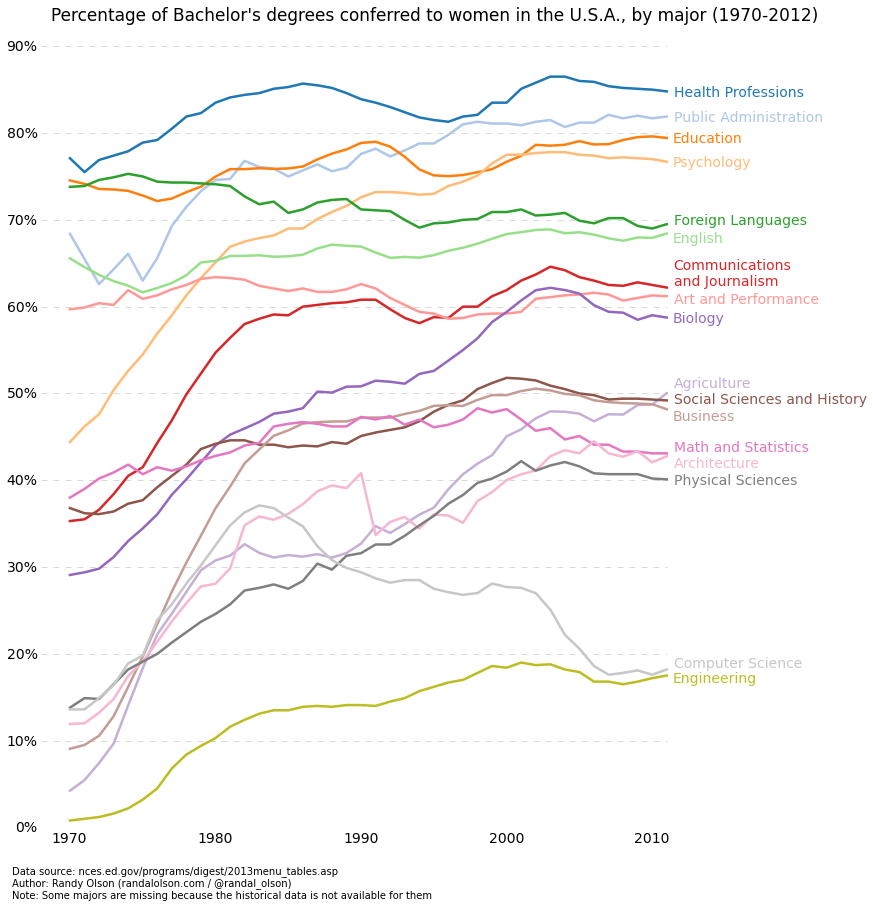
Right on the nose. And in fact, the proportion of women in computer science was tracking with other sciences until the mid-eighties, when it started to dive, while women's representation in other sciences continued to climb.
One of the more glaringly inconsistent observations with Damore's claims.
http://www.npr.org/sections/money/2014/10/21/357629765/when-...
Hmm, Computer Science is most definetly a science (which shares quite a bit with maths as expected). A lot of algorithms and data structures you use under the hood when doing engineering were born as a paper in academic CS sphere.
Of course, most CS graduates don't do science, but actual engineering work. That doesn't make CS any less of a science though, it just means that most people employed in private companies don't do it.
And thus employment of CS graduates should be compared with employment of Engineering graduates, except in the case of Academia, where it ought to be compared with other sciences.
You explained it yourself. It was initially a science, and in the 80's it became engineering and now, a get-rich scheme. Each era attracts a different set of people.
I mean, whatever propensity to mathematical-logical thinking, or being interested in working with things not people, we attach to software engineering, aren't these qualities useful even more when doing math and physics?
Lots people from math and physics have jumped over and become decent, some even great, software engineers. Not many software engineers have successfully switched over to math or physics.
So if gender is not so much an issue for a successful career in, I don't know, algebraic topology (math) or quantum field theory (physics), it surely should be less of an issue in software engineering ...when talking about whatever effects there may or may be at a biological level. So if it's not such a big issue in academia, the problems in software engineering must be more about what kind of workplace culture has grown around in software engineering, not the proposed underlying human biology.
Ezra Klein argued[1] that this is really a fear of the opaque power that software has in our lives. We know that software and algorithms run the world, and that only a few people will ever even see the algorithms, let alone understand them afterwards, and yet they determine so much of the world around us. This leads everyone to fear that the wrong sort of people (for whatever definition of "wrong" you hold) are putting their thumb into the algorithm.
This is why math and physics aren't getting the same level of attention. They don't decide what news articles get viewed and what don't. They don't decide what companies can advertise to customers and what companies are beyond the pale, etc.


Did math and physics communities already have their internal crisis/debate on these things, perhaps a decade or two ago? Or have they been able to cope without lighting such a fire?