Interestingly, South Carolina produces most of its energy using nuclear already... It is too bad the broad public perceives nuclear as a 'risky' energy source. It is in fact the safest energy source we have ever developed, in terms of deaths per kilowatt hour. Its just that when something goes wrong, it goes REALLY wrong. That makes more of an emotional reaction in the general public than the scattered and sporadic deaths in other industries, in which there are sadly many, many more. So, it seems it is hard to get support to invest in newer, safer technologies in the industry. I do understand the short term economic incentives. Nuclear is expensive to build. However it is very cheap to operate, and relatively environmentally friendly. It takes long term planning on timescales of many years, and looking at safety data rather than focusing on the disasters on their own. Neither of which humans are any good at.
The one thing that turns me off nuclear power is how to store nuclear waste. The collapsed storage tunnel at the Hanford site this year is an example of how poorly this can be done. The waste will remain dangerous for thousands of years. How do you build a storage facility that keeps it contained for that long?
>Its just that when something goes wrong, it goes REALLY wrong. That makes more of an emotional reaction in the general public than the scattered and sporadic deaths in other industries, in which there are sadly many, many more.
I don't this explanation really holds true. For example, there is a single failure with a hydroelectric dam [1] that has killed more people than have died as a result of all nuclear-power related deaths, and in more spectacular fashion.
I think it has something to do with the expense and scale of nuclear power, but also something to do with nuclear energy being a thing far outside the natural experience of most people. Nuclear power is also connected to nuclear weapons, which, understandably, has a strong negative connotation to most people.
Better science education might resolve some of the emotional problems connected to nuclear energy.
All that, and Chernobyl. I was a kid when it happened, but it affected most of Europe, (the radiation ended up going all the way to Sweden and Italy). It is hard to measure the cancer rates due to it, but the numbers are significant.
" (The 95% confidence levels are 27,000 to 108,000 cancers and 12,000 to 57,000 deaths.) In addition, as of 2005, some 6,000 thyroid cancers and 15 thyroid cancer deaths have been attributed to Chernobyl. That number will grow with time."
Nuclear power failure has the power to create a wasteland of its surrounding for millennia, that's why nobody wants them on their backyard.
Where are you sourcing these numbers from? The WHO says "up to 4000 people could eventually die of radiation exposure from the Chernobyl".
I also have a new quote for nuclear talks:
> Alongside radiation-induced deaths and diseases, the report labels the mental health impact of Chernobyl as “the largest public health problem created by the accident” and partially attributes this damaging psychological impact to a lack of accurate information.
You mention Chernobyl, the worst nuclear accident in human history, today, 30 years later, Chernobyl sits at the heart of a wildlife haven. What is more alive and supports more species, Chernobyl or Manhattan?
"According to the World Health Organization in 2011, urban outdoor air pollution, from the burning of fossil fuels and biomass is estimated to cause 1.3 million deaths worldwide per year and indoor air pollution from biomass and fossil fuel burning is estimated to cause approximately 2 million premature deaths.[14] In 2013 a team of researchers estimated the number of premature deaths caused by particulate matter in outdoor air pollution as 2.1 million, occurring annually"
No one I know is opposed to renewable energy, but advocates really do everybody a disservice when they try to argue that an intermittent power source without storage is the reasonable replacement for base load power. As Bill Gates said in an interview "…They have this statement that the cost of solar photovoltaic is the same as hydrocarbon’s. And that’s one of those misleadingly meaningless statements. What they mean is that at noon in Arizona, the cost of that kilowatt-hour is the same as a hydrocarbon kilowatt-hour. But it doesn’t come at night, it doesn’t come after the sun hasn’t shone, so the fact that in that one moment you reach parity, so what? The reading public, when they see things like that, they underestimate how hard this thing is. So false solutions like divestment or “Oh, it’s easy to do” hurt our ability to fix the problems. Distinguishing a real solution from a false solution is actually very complicated."
Natural gas will be cheaper than renewables + utility scale battery storage for only so long; as soon as natural gas spot market prices spike, renewables and storage are deployed, creating a downward price spiral, which natural gas generators can only defend against for so long.
Natural gas might be as bad in terms of climate change as burning coal due to losses of methane during production/transporting, so it would be great to eliminate its use. Unfortunately we are far, far away from having grid storage that could accommodate only having renewables. Grid storage has been worked on for generations and even so, right now, the U.S. has about 24.6GW of grid storage, 95% of which is pumped storage hydro. That is a very tiny fraction of what would be needed.
Has there been consensus on whether renewables can power our society and industry on their own? Or for that matter generate more power than we currently need to drive further progress?
For a while the amount of energy is certainly a question. If it takes 100 gigawatts to produce a solar panel, but that panel only returns 75 gigawatts over its usable lifespan (including maintenance), then that's not a good look.
Even if solar generated 1.25 watts per watt to contruct/transport/install/maintain, it still isn't enough.
Now if solar is at the point where it was generate 5 watts per 1 watt, we're in business.
Come on, knock out being disingenuous. Science experiment territory? California and Germany have so much solar generation, they're having to take active measures to deal with the supply. And solar PV manufacturing capacity is only growing each year.
That article shows a graph indicating that Gas is taking over for the lack of coal plants, and wind/solar are plateaued.
People want a high return on their energy investment to power modern society.
I'm sure solar will get better, and I encourage the fledgling consumer market and small-scale deployments to improve the tech, but it's not ready today, and the longer idealists keep peddling the idea that it IS ready, the longer we accelerate global warming.
> Better science education might resolve some of the emotional problems connected to nuclear energy.
Persuasion is a science that has been perfected by religions/cults, magicians, marketers and sales people. Scientists, mathematicians, economists, and policy makes don't wield that weapon very well.
You can spit accurate + well researched stats that argue your case until you are blue in the face, but not everyone listens to polite, well researched Oxford-style debates. You are competing with entrenched interests like oil and gas lobbies, doubt purveyers who have purchased professors with grants, the wild imaginations of Hollywood, and the association of "nuclear" in the minds of people who lived through the Cold War.
Well, that hydroelectric dam was built in part as a flood control measure, and effectively ended up being rebuilt a few years later to put a stop to the repeated flooding that occurred without it. It simply wasn't the same kind of tradeoff.
Actually it is NOT cheap to operate a nuclear power plant after it is built. That is why nuclear plants in Illinois and New York have been bailed out recently and why utilities in other starts are looking for similar bailouts. These utilities could not profitably operate existing nuclear plants in the current market. I totally agree that nuclear power has a much better safety record than most would believe and that nuclear power is a great low carbon electricity source, but it is not a cheap power source. Maybe modular reactors can compete sometime in the future, but we really have no idea until some are built and operated.
> Actually it is NOT cheap to operate a nuclear power plant after it is built
I would argue that the innovations in rival energy sources have made it comparatively expensive, but the cost was largely established when the plant was built (likely in the 1960s - 1970s). In other words, it was cheap, but the fact that nuclear requires such a massive outlay to build the facility means that nuclear is a very long term financial gamble and assumes that a variety of other energy sources don't fundamentally change their cost curve (like oil and natural gas did in recent decades).
It's only "cheap" as long as you can outsource the long-term costs, like for waste storage or in the case of a disaster.
As is, these plants are barely profitable, imagine they'd be forced to set funds aside for clean-up operations in case something goes really wrong, talking about real funds here that would make an actual difference and not some token amount. They don't do that because they know it would totally ruin their bottom line but by any metric they should be doing exactly that because it would be their mess that needs to be cleaned up when something goes wrong.
These costs are very real and in the case of catastrophic failure can be so high that even major economies are struggling to pay them (like Japan has been).
And it's not like we have any good ways to hold anybody responsible when something actually goes wrong.
The responsible company can just declare bankruptcy and have somebody else deal with the costs and long-term ramifications of the clean-up efforts aka the tax payer.
Most of nuclear waste should not called that. The more radioactive something is the more energy production capability it still has. Only a lunatic puts that stuff in caskets and digs caves for storage, and doesn't reap that. If the spent fuel was re-used correctly, we could run all the humanity's toys with it for several hundred thousand years without breaking any sweat.
... And that brings us to those costs. There are parties that benefit from causing the costs to ramp up. So they have tried to find out ways to do exactly that, and prevent the good cost reducing innovations from reaching even testing so they could be mass adopted some day.
It is widely known that we have knowledge of vastly safer reactor types, but we haven't been able to even get permits for full scale test runs. We know that there are several things about the fuel cycle we could improve, but we have to stove the best stuff away. We could actually go and fix some of the old installations, and their design features, but we are not allowed to do that either. Probably we could drop the price of nuclear power to a fraction (say, 1/10th?), but it is not politically correct to talk about that publicly. And so on, and so on.
> If the spent fuel was re-used correctly, we could run all the humanity's toys with it for several hundred thousand years without breaking any sweat.
And here we go, the fabled magical Thorium reactors.
There are many reasons why we don't do this, one of them are engineering constraints because molten salt is very corrosive as such maintaining a reactor like that is a real pita.
You should also be aware that, contrary to popular belief, even Thorium reactors can be used to produce fuel for nuclear weapons, it's not impossible to weaponize U-233, after all this process was used to produce the fuel for Operation Teapot in 1955.
And lastly: The only reason why thorium reactors have such a great "safety track record" is that we barely build any of them, our sample size is way too small to make any useful statements about this.
We have roughly 435 commercial nuclear plants in operation, with another 63 being built [0]. There have been around 20 major nuclear accidents over the years [1]. In contrast to that, there are only around 15 Thorium reactors [2], imho that's not a big enough sample size to make any statements about the actual failure rates, especially when you consider that none of these 15 reactors are run on a commercial basis.
For all purpose and effect, Thorium reactors are just an attempt to "rebrand nuclear" to get rid of the horrible nuclear track record and public reputation. Even if we'd go full Thorium we'd still need some reactors to cycle uranium for the Thorium reactors to actually work. In that regard, it's not really a solution but just another excuse for keeping the problem going.
Actually no, he's not talking about Thorium reactors, he's talking about Breeder Reactors I believe, which will allow the fuel to be recycled over and over until it's virtually exhausted of all it's radioactivity.
I think that's what he is talking about. I studied this 30 years ago in primary school, so I might be off, but that's what I remember.
It's actually quite cool what other reactors are capable of and the amount of fuel we waste with existing commercialized types of which were designed to produce weapons grade plutonium as a by product, so efficiency wasn't valued over the byproduct of plutonium.
I don't know the situations in Illinois or New York, but the fuel costs are obviously very low for nuclear power. PG&E says in regards to the Diablo Canyon power plant:
>...At 2.78 cents per kilowatt-hour, DCPP’s average
production costs are lower than all other forms of electricity, but are higher than the national average of 2.19 cents per kilowatt-hour for nuclear power
France gets a majority of their power through nuclear power and has lower rates for electricity than its neighbors:
>...France enjoys one of the lowest electricity prices in Europe; at 14.72 euro cents per kWh, the average cost of electricity in France is 26.5% cheaper than the EU average (20.02 euro cents per kWh).
I would apply some scepticism of some of those numbers until the plant gets seriously into the end-of-lifecycle decommissioning. Particularly when one looks at how the San Onofre cleanup cost is being estimated and who is paying. (4.4B.. which doesn't seem like it was set aside from the rates being paid during the lifetime of the plant...)
> Its just that when something goes wrong, it goes REALLY wrong.
Not only does it go wrong, we have absolutely no way to stop it. It's literally out of our control.
I was a supporter of Nuclear, though Fukushima taught me a very important lesson.
When things went bad there, we literally stood back and said "well, damn. There is nothing we can do" and watched it melt for weeks and weeks. Nobody could go in, and we had no robots that could go in and do a thing. It was lucky it's close enough to just pump endless water into it.
Then a few weeks later the experts said "oh, all that highly contaminated water is going straight into the ocean. We wondered where it was going".
As it were the Japanese had elderly people volunteering to go in, essentially committing suicide.
It's also worth remembering that at Chernobyl there was also nothing we could do - other than force people to commit suicide by going in where it was deadly.
That won't fly today.
While the chances of things going that wrong are very low (it's only happened twice, maybe three times in history) I think the consequences are too great to justify it. We can't even control it when it goes bad!
This seems like cherry picking and the innate human bias at play. Given a big enough disaster, there isn't anything anyone can do as it unfolds. And spectacular failures stick in our mind. Here's some non-nuclear disasters that happened that people could only watch:
* Taum Sauk hydro pump-storage collapse
* Duke Energy's 30k+ tons of coal Ash spill into the Dan River
* But that was tiny, try Kentucky's 306 million tons of coal Ash spill or Tennessee's 525 million. People can only stand and watch that unfold, no modern robot is going to stop that either.
* Gas pipes in San Bruno, New Jersey, and Colorado exploding, killing families instantly
* Deepwater Horizon and the Valdez. Again, not much to do but stand and watch as it unfurls.
I could keep Googling more but every source of energy has its gigantic catastrophes where no amount of human bodies or robots will save the day (well, I guess a large enough pile of bodies would plug a hole in a collapsing dam).
In all of your examples, a few hours or days later people could wander right into "ground zero" and begin cleaning/re-building or whatever.
No so with nuclear. The impact is so much more serious when radiation comes into play.
> Valdez
Actually thousands of people were mobilized to contain the spill then clean up afterwards. It would have been a much better outcome if they didn't try to hide/downplay it for the first couple of days.
Yes, and radiation can be serious. But nature knows how to deal with high levels of radiation (see Chernobyl's flourishing ecosystem) after a period of time, same with any other disaster. You as a human could go into some moderately radioactive areas since the civilian limits are set so extremely low below the non-stochastic effects, and maybe not have much more of an elevated cancer risk than if you went to the hospital and got an MRI or PET scan (which is unregulated in terms of legal dosage limits).
Just because radiation causes different constraints on cleanup than oil on a large ocean or arsenic in the water table or issues in a space rocket means it is morally worse? That's the part I fail to understand, so long as the engineering continues to behave ethically behind all the systems in their design and construction and retrofit.
Adding to this - there seems to be a lack of observable damage from nuclear accidents apart from self-imposed evacuations.
Literally no-one died at Fukushima. It is the only energy disaster I know of where no-one ended up dead.
This is strong circumstantial evidence that we are being too safe, because we implicitly accept a few deaths when things go wrong in, eg, coal (pollution & extraction deaths), solar ( mainly in installations not in operating), hydro (big-time risks).
Going from 1 death to 0 deaths on this scale is a huge marginal cost. It almost certainly outweights the benefits.
EDIT: We haven't had a solar disaster yet, but coal & hydro disasters happen and can be very bad indeed.
I agree. Anywhere there's a dam, people will drown in it. In fact, if it's close enough to a town and people like to drink then we'll see many more deaths in the winter since it looks like you an skate on it---but can't.
You have a strange definition of "local" for Exxon Valdez/Deepwater Horizon. As well as "temporal", too. 20 years later species haven't recovered from the Valdez spill (unless you ask Exxon). Deepwater Horizon was also a very prolonged event, it took "forever" to cap the damn thing. 1 billion+ tons of coal Ash spilled across the USA didn't just disappear over a day either from some small city corner.
The only reason why nuclear sticks so easily is because of the magic word "radiation". It's easier to be scared of it than sit down land learn that it is all a natural physical phenomenon, even if it originated from a man-made isotope. It's difficulty arises from the stochastic (quantum) nature of it's interactions.
Lastly, reactor designs have significantly improved since 50 years ago. New reactor designs I saw coming out of Westinghouse could lose all power and pumps and still use natural convection and reservoirs (elevated pools) within the containment to prevent any sort of critical event leading to meltdown. Imagine if we were stuck with the coal technology of the 70's. I would prefer modernizing the nuclear fleet if possible, which does include decommissioning old reactors, and closing the fuel cycle loop in a way that is proliferation resistant (some sort of pyroprocessing) unlike UREX.
Look, I'm pro-nuclear but 'if only everyone were as knowledgeable as me' is a losing communications strategy. seriously, why do you expect people to trust the engineering in a nuclear power plant when clever people can't even get the financing to work or the construction ot go smoothly?
My point isn't "be as smart as me" and I do apologise if my tone is coming across that way. My point is "get educated on the issue" which seems reasonable to me (the tone of which I guess can also be misconstrued as negative, but I mean it in a constructive and positive manner).
I know you mean well and I do feel your frustration. But to use a phrase from political scientist Brian Caplan, people are 'rationally irrational' about this (as in public choice theory): it's very hard to really assess the risk factors properly, and given the potential downside risk and the existence of alternatives they decide not to bother.
>closing the fuel cycle loop in a way that is proliferation resistant
Isn't simply using a non-PUREX reprocessing method sufficient? Realistically, a "nuclear club" nation like the US/France/GB only needs to ensure that the reprocessed fuel contains enough non-Pu239 isotopes that any attempt at a bomb with stolen Pu would necessarily fizzle. The fact that the nation itself could (theoretically) produce Pu239 via the process and cause "proliferation" seems far fetched in the absence of the Cold War level rivalry that was the original proliferation impetus. Warheads are expensive. Nobody who already has a bunch of them already is really interested in making more.
>...I was a supporter of Nuclear, though Fukushima taught me a very important lesson.
You missed the important lessons from Fukishima.
A major power plant suffered about the worst possible catastrophe that it could have through a combination of incompetence by the plant and its regulators. For all that, the highest estimates of death due to the evacuation are less than the deaths that come from a day of burning coal (when the coal plants don't have an accident). What about other power sources? Coal/gas/hydro all have much worse records than nuclear:
The lesson I got from Fukushima is that, if we have a reactor, we need to take care of it. I think Fukushima was neglected because people didn't like it. I see this as more of a political issue. The lessons learned summary[0] hints at this.
You can't really say "it's the safest kind of energy of all - except when you don't do the right thing, then it's scary" because the chance that people are going to do the wrong thing has to be an inherent part of any risk analysis.
Nuclear might be safer than coal and oil but coal and oil are established and nuclear is marginal most places. More people might die falling from roofs installing their solar panel than die from nuclear power "done right" but hey, if they'd installed their solar panels right, they too wouldn't have died either.
But finally, renewable allow relatively incremental development - you can gradually add solar panels and wind-generators and see if the investment pans out. Nuclear requires vast gobs of investment and you only learn if it's a good idea, provides good total positive returns, over a long time frame, just as you're expected to store your pollution over a large time frame.
So nuclear's prospects don't look good, don't seem like they should be good, etc.
Has it, though? Keep in mind the difference between "expensive" and "a lot of money". Nuclear costs a ton to build and a ton to decommission, but in between is a very long period of nearly constant very high power production.
New-built nuclear costs around €5.3b (Finland[1] and France[2]) to €9.3b (UK[3]) per installed GW, and France, Germany and UK estimates €300m, €1.4b and €2.7b (respectively) pr GW installed to decommission. That's €6-€13b/GW total + operating costs -- and those costs will come down as (if) we start ramping up construction and learn to avoid the cost overruns and get experience decommissioning plants.
New-built offshore wind costs €3-4.7b/GW[4] -- and these prices are set to go up, as the easy sites for installation are running out. Capacity factors are only around 50%, so already there offshore wind is roughly on par with fully loaded nuclear (which has capacity factors of 90+%), and that's without counting decommissioning, extremely high operating expenses and the extra infrastructure and pollution required to deal with the unreliability of wind (typically, gas plants), and, most severely, the expected lifetime of ~25 years[5] compared to 60+ years for nuclear.
One minor quibble though, as offshore construction procedures improve, and get cheaper, it looks as though more sites are becoming "easy." And in the US, off-shore wind construction hasn't even really begun.
Nuclear is also similarly "non-dispatchable" when compared to wind; nuclear has to be run at maximum capacity in order to get to those numbers, just as wind's energy has to be used to get to its numbers, and neither of these follows the demand. So both nuclear and wind require other dispatchable resources.
Though it's gas plants at the moment, it seems very likely that battery storage will take over quite soon from gas plants. In many markets, peaker plants are already more expensive than battery storage. As batteries get cheaper, and more technologies (like flow batteries) mature, gas's days are numbered (except perhaps for combined-cycle gas turbines).
I also can't share your optimism about nuclear construction costs going down. The numbers you are citing already are best-case scenarios, of well-managed projects without huge cost overruns like what happens in the US. The promise of the AP1000 reactors which were just abandoned in South Carolina was that it was a modular, consistent design, implemented around the world. The cost savings for that have not materialized. Meanwhile, the tech curves for wind, solar, and storage technologies have had more than a decade of proof of declining costs. Even in "modular and reusable" designs, every nuclear plant seems to be a one-off, due to the massive scale.
> One minor quibble though, as offshore construction procedures improve, and get cheaper, it looks as though more sites are becoming "easy." And in the US, off-shore wind construction hasn't even really begun.
Offshore construction procedures aren't going to improve by a ton. There is half a century of intense offshore experience in the oil sector, and two decades of experience building a lot of off shore wind. Even with that, prices has stabilised at a very high level. Yes, there is low-hanging fruit in the US, that is correct, but the total potential (miles of coast) is very limited.
> Nuclear is also similarly "non-dispatchable" when compared to wind
Strictly speaking, yes, but it's non-dispatchable in the opposite direction, if you will. It's much, much more efficient to have nuclear covering the base load in the grid, and then having some gas to deal with peak loads, whereas for wind or solar, you need alternative sources to cover nearly the whole installed capacity (a cold, cloudy day with little wind). But yes, if you were to get to 100% nuclear, you'd need a good (if smaller) storage solution, as with wind and solar.
> The numbers you are citing already are best-case scenarios, of well-managed projects
Both Olkiluoto and Hinkley Point C have famously and massively overrun their initial estimates. Optimistic numbers would be those for, say, South Korea or China.
> without huge cost overruns like what happens in the US.
That's going to be true (or solved) for any large, complex project, whether wind, solar or nuclear.
>Even with that, prices has stabilised at a very high level. Yes, there is low-hanging fruit in the US, that is correct, but the total potential (miles of coast) is very limited.
Not quite, offshore wind construction is improving, perhaps because they are focusing on improving that rather than just repurposing oil tech.
> those costs will come down as (if) we start ramping up construction and learn to avoid the cost overruns and get experience decommissioning plants.
Sorry but that's a rather naive expectation. We have plenty of other technologies, which are far more developed than nuclear, and they still end up going over budget quite often.
How long have we been building nuclear reactors? For decades, yet we are nowhere close to "avoid cost overruns", how many decades more of building overpriced and outdated designs do we need to get to that point? And how many Fukushimas, Chernobyls and Three Mile Islands are we prepared to endure until we actually reach this hypothetical point in human history?
We mostly learn from mistakes, but with nuclear, the mistakes are very pricey, not just in economic terms but especially in environmental terms.
> And how many Fukushimas, Chernobyls and Three Mile Islands are we prepared to endure until we actually reach this hypothetical point in human history?
Why are you listing TMI alongside actual nuclear disasters?
There was a reactor meltdown. Containment worked exactly as expected. Not a single person died. If we held the rest of the energy generation industry to such a standard, we'd be living in caves and banging rocks together for warmth.
> Why are you listing TMI alongside actual nuclear disasters?
Because that's where it belongs, just like Kyshtym.
> Containment worked exactly as expected. Not a single person died.
What a convenient claim to make considering the long term effects of the radiation usually show in the form of cancer and a direct correlation can never be made except when doing massive epidemiological studies on the affected populations, which rarely happens.
It's this very same dynamic which allows people to make outrageous claims along the lines of "Nobody died from Chernobyl radiation, it was all just naturally occurring cancer!"
Meanwhile, people in the US are still wondering how and why cancer clusters happen [0].
Look at that map, look the red spots and with a little bit knowledge of the US nuclear industry you will realize what's around that area. What a coincidence? That's what it probably is, just a coincidence because admitting anything else to the public wouldn't really play that well, so coincidence it has to be [1].
Now, I'm no statistician, but to me, it looks like there is... No correlation between the two. Maybe the mundane, unsexy explanation in the article, citing lifestyle choices, smoking, alcoholism, access to healthcare, and poverty as the main factors influencing cancer death.
Cancer valley running through Kentucky has more to do with bourbon, then its non-existent nuclear reactors (It has an enrichment facility in its western part, but that's not where the cancer deaths are).
The new-built nuclear power plants you are mentioning are not finished yet, have huge cost overruns and delays (and that's not finished yet).
The french EPR (Flamanville) for example had many issues (for example, some serious defects on the reactor vessel) and required redesigns while under construction.
Quite frankly having seen it from the inside (I worked on a minor sub-system of this plant a few years ago), I even doubt it will ever deliver a significant amount of electricity to the grid.
Even if construction is completed, it will be quite unique compared to the other EPRs, so I will not be overly confident about learning and be more efficient at constructing those.
The finish EPR (Olkiluoto) played a huge part in the near bankruptcy of Areva (french company providing various elements of the nuclear life cycle, from uranium mining to nuclear waste "recycling") and lead to its bail-out by EDF (which is mostly state owned, so in the end, the tax payer will pay).
The two Hinkley Points EPRs are a huge gamble, and the decision to go through by EDF (builder and operator of the future plants) on this project lead to much criticism, the EDF workers syndicates are deeply against it and the financial director and a member of the board resigned because of it. Given all the unknowns regarding the EPR, at 20 billion euros, it's a really huge risk taken more for political reasons than economic ones.
Also EDF must face a huge overall of all its nuclear reactors as they are nearly all reaching 40 years old. This "Grand Carénage" will cost ~50 billion euros to gain 10 to 20 years for the 58 existing french reactors.
For the decommissioning part, there are many unknows. The old and small Brennilis plant is being dismantled since 1985 with no definitive solution regarding the handling of the reactor vessel. Also there are tons of criticism regarding the future underground storage facility at Bure.
That the not so bright economic situation of nuclear industry in France (nuclear produces 70% of electricity here).
To finish, I'm personally worried by the implication of nuclear energy. Basically, believing in our capacity to manage highly dangerous wastes for several order of magnitude longer than human civilizations exist (let alone individual states) seems overly confident.
Yes, it has. The UK basically had to agree to pay a substantially above-market price for power for the life of the plant to make it viable: https://www.theguardian.com/uk-news/2017/jun/23/spending-wat... (and it's not clear that it's viable even then). As I recall, some US states have had to subsidise their existing nuclear power plants just to keep them running thanks to falling electricity generation costs. This is only going to get worse as renewables drive down the cost of electricity further.
As I demonstrated in my comment, Hinkley Point C, even with its massive cost overruns (and true, nobody knows if that's the final cost yet, but that's the current figure), is roughly on par with offshore wind in cost per installed GW after accounting for capacity factors. It's just that Hickley Point C will have as much capacity as the entire north sea offshore wind fleet (all countries, not just UK), and so the concentrated single number gets very big. And wind is massively subsidised, too, so the subsidy is not an argument in itself.
Most of your points about off-shore wind aren't quite right..
> These prices are set to go up, as the easy sites for installation are running out.
This isn't even remotely true... You can measure the number of offshore farms in the dozens, there are something like 1,500 cities with populations of at least 500,000 - and most of these are close enough to the water to make broad use of offshore wind power. For instance, there's 1 operating off-shore farm in the US right now.
> New-built offshore wind costs €3-4.7b/GW
Like pointed out elsewhere, this is true if you only look at off-shore costs. On shore wind is more like $1,250/KW. Importantly though, it's only true today. We're rapidly increasing the size of turbines and the height of towers. Most of the existing installations used 4/5/6-MW turbines. Vestas has already shipped a 9.5MW turbine. We'll likely see 20MW turbines within 5-7 years.
If you're building a 500MW off-shore farm with 5MW turbines, you'll need 100 foundations, towers, turbines, you'll need 300 blades and maintenance will have to service each one individually. Increasing those to 10MW cuts all of those costs in half (more likely, by 30% or so to account for scale). Doubling the size again has the same magnitude of impact. With 20MW turbines, a 500MW farm would only need 25 turbines and 75 blades.
The other benefit from these much larger turbines is that they'd sit much higher. If you increase the hub height from 100M to 150M or 200M, all of the sudden you're looking at sustained annual average winds approaching 20m/s. The wind shapes shift significantly as you increase altitude as well, so you can go from c=12, k=2 to c=20, k=3.5. This should easily move the capacity factors from ~50% to ~70+%.
> and, most severely, the expected lifetime of ~25 years[5] compared to 60+ years for nuclear.
Nobody serious expects that wind farms will only last 25 years. They'll last in perpetuity as long as their servicing costs stay below the marginal revenue from production. The initial lifetime expectations of nuclear reactors was 40 years, which has been extended for many plants. The same will happen with wind resources for many of the same reasons (high decommissioning costs, the challenges of siting a new generator, proven financial success at that location, etc.).
95% of that cost is due to compliance requirements. 98% of those compliance requirements are 100% bs. If the same requirements were asked of new coal or gas built it would exceed that of a nuclear plant. The average coal plant emits more radiation in a month than the average nuclear plant during its entire operational lifespan. And billions of tons of CO2 for extra planet-killing power.
b) Yes, Nuclear power is heavily regulated and this affects the cost. But that is the world we live in - and the world we build generating capacity in, so deal with it.
Coal plants would not be cheap to operate either if they had to pay for all the environmental damage they actually cause. Natural gas plants... they seem to be a good compromise for now, but we just cannot depend on fossil fuel to meet the electrical needs of future generations.
It is my sincere hope that we continue having a nuclear power industry to maintain the know-how learned over several generations. This would be useful not just for domestic power generations, but e.g. generating power for space stations, lunar/martian bases etc.
Part of the appeal of nuclear operations for the Navy (aside from the prestige) is the lucrative private sector opportunity. You'll see fewer folks going into that field if those private sector jobs dry up.
Although at the current time, low natural gas prices make natural gas plants very attractive, most nuclear plants are closed because of public outcry. A lot of these plants are nearing 50 years old as well.
Per the article, old nuclear plants are being closed because they are not cost-competitive with natural gas. If you're saying they're actually being closed due to public opposition, you should cite a source. Preferably one as non-partisan as the NYT.
You are correct, they are being closed due to financial reasons, not due to public outcry.
However, there is an argument that they should get the economic benefit of being carbon free, something that is granted to solar and wind.
Right now we subsidize two technologies, rather than taxing the externality. It would be far more economically rational to tax carbon emissions, and for coal to also tax the other costs it imposes in non-carbon emissions.
There's currently a legal battle going on to allow nuclear plants to have Zero Emmisions Credits (ZEC) in several states where nuclear plants can no longer compete in the marketplace:
> However, there is an argument that they should get the economic benefit of being carbon free, something that is granted to solar and wind.
They already have the benefit of not having to pay for their long term waste disposal and being bailed out in the event of a critical failure, which is arguably among the biggest long-term costs for nuclear.
Not too long ago German energy companies paid a flat fee of 24 billion Euros to absolve them from any future responsibility to pay for end storage. The US nuclear industry does pay a tax for disposal but that doesn't cover anywhere near the actual costs of storage.
We are talking about materials that need to be stored thousands of years here, a couple of dozens billion Euros (or Dollars) are peanuts in that regard. The timescales are just insane with this stuff and make it very likely that we still gonna have to pay for keeping disposal intact many thousand years after we phased out of nuclear into something we can't even fathom right now.
Isn't that a nice vision of the future? We might manage to get our cheap, clean and renewable energy, but we will still be stuck taking care of very dangerous and expensive waste for thousands of years.
>...We are talking about materials that need to be stored thousands of years here, a couple of dozens billion Euros (or Dollars) are peanuts in that regard. The timescales are just insane with this stuff and make it very likely that we still gonna have to pay for keeping disposal intact many thousand years after we phased out of nuclear into something we can't even fathom right now.
Soon it will be possible to use most of the waste as fuel:
"...Fast reactors can "burn" long lasting nuclear transuranic waste (TRU) waste components (actinides: reactor-grade plutonium and minor actinides), turning liabilities into assets. Another major waste component, fission products (FP), would stabilize at a lower level of radioactivity than the original natural uranium ore it was attained from in two to four centuries, rather than tens of thousands of years"
The worry people have about nuclear waste is greatly overblown to say the least. The amounts generated are manageable and in a relatively short amount of time we can use most of this "waste" to generate electricity. To put it into perspective, no one of the general public has ever been hurt by nuclear waste and you definitely can't say that about coal waste.
Changes in technology have made natural gas cheap. But I think that's temporary - twenty years from now we're probably going to regret shuttering our nuclear plants and will be stuck with coal for at least a decade.
> when something goes wrong, it goes REALLY wrong. That makes more of an emotional reaction
The reaction can be completely rational. It depends on your estimate of the probability of a nuclear accident worse than Chernobyl. Officially it's around 10^-9 per reactor-year, but it's clearly an underestimate, if only because of the unknown unknowns.
Get a more realistic probability estimate, multiply by cost of all real estate in a large metro area, and you can get a pretty large expected loss.
> How do you build a storage facility that keeps it contained for that long?
" It is too bad the broad public perceives nuclear as a 'risky' energy source. It is in fact the safest energy source we have ever developed, in terms of deaths per kilowatt hour."
And there goes the misinformation campaign again.
The issues is not 'deaths per kw hour'. The issue is the unpredictable outcome of a single reactor incident.
How many more do we need to endure? How many more areas becoming radiated for generations? How much more radioactive waster water? How many more cancer deaths?
And how much more need tax payers pay for cleanup before we realize: Let's stop using this energy source.
Let's go renewals.
It's the only sane option.
While the full article is gated at WSJ, John Cochrane and David Henderson write about the lack of quantifying economic costs when it comes to addressing climate change. Their last paragraph:
Climate policy advocates’ apocalyptic vision demands serious analysis, and mushy thinking undermines their case. If carbon emissions pose the greatest threat to humanity, it follows that the costs of nuclear power—waste disposal and the occasional meltdown—might be bearable. It follows that the costs of genetically modified foods and modern pesticides, which can feed us with less land and lower carbon emissions, might be bearable. It follows that if the future of civilization is really at stake, adaptation or geo-engineering should not be unmentionable. And it follows that symbolic, ineffective, political grab-bag policies should be intolerable.
I mostly agree with his paragraph above. But from your link,
"No. Healthy societies do not fall apart over slow, widely predicted, relatively small economic adjustments of the sort painted by climate analysis. Societies do fall apart from war, disease or chaos. Climate policy must compete with other long-term threats for always-scarce resources."
"Small economic adjustments?" How many large scale resources does preventing war or pandemics require? Is chaos a real threat?
Most of what he lists are effects, not causes. Here's an economic question for him: what happens when the area between the Mississippi and the Rockies returns to being an unusable semidesert? (That's not an if. It is all irrigated.)
And I'll just leave this comment here: "As I favor a uniform VAT in place of the idiotically complex income and corporate tax system."
what happens when the area between the Mississippi and the Rockies returns to being an unusable semidesert? (That's not an if. It is all irrigated.)
Here in Missouri, there is actually fairly little irrigation. There's a 1.5 hour drive through rural farmland I take regularly, and I see one irrigation setup on the whole trip. The other irrigation I can think of off the top of my head is just north of Jefferson City, 100 yards from the Missouri River, and that's for a sod factory that turns its fields over every couple of months.
This year the rain has been fantastic. We put up more hay than we ever have. July was hot, as July often is, but the first week of August will be our coolest in memory. If this is climate change, I vote for more of it. b^)
But a large part of that region was known as the Great American Desert before the invention of suitable irrigation. And water is being removed from the aquifer much faster than it is being replaced.
Yes, things that can't continue forever, won't. Eventually much of the Great Plains will be native grassland again. That is its natural condition. The parts of Arizona and California that currently host alfalfa fields will be actual desert again, and the dairy industry will return to the Midwest where it belongs.
Even when being hyperbolic, however, you could move your border west a whole state. I doubt Minnesota, Iowa, Arkansas, or Louisiana are any more worried about the next Dust Bowl than we are. My impression is that Missouri is the driest of the states on our longitude.
His argument is almost tautological, because it is conditional on the basis that the society is healthy.
Societies fall apart over slow, widely predicted economic adjustments all the time, because healthy societies have buffering homeostatic functions.
Once the adjustment exceeds the ability of the society to buffer, the adjustment rapidly moves from the 'slow and widely predicted' bucket to the 'war, disease and chaos' bucket. One might note that this process leaves the society looking healthy until the moment when suddenly it isn't.
Relatively small. Compared to "war, disease or chaos", keeping "the area between the Mississippi and the Rockies" irrigated will be (is) expensive, but it's a relatively small expense.
Decent government. Stable institutions and mostly fair and equitable justice and law enforcement. The US and Europe have their challenges, to put it mildly, but have been fairly successful in averting chaos, and things are going pretty damn well, judging by even relatively recent historical standards.
> But how much do you spend to prevent war? How much do you dump into the CDC?
A lot. So that means that things can be very expensive and still be relatively cheap.
> And how do you irrigate the Midwest once the aquifers get low? Piping desalination water from the Gulf?
I don't know. Perhaps. Or perhaps redirecting water from the Hudson Bay drainage basin. Human ingenuity is pretty great.
> It follows that if the future of civilization is really at stake, adaptation or geo-engineering should not be unmentionable.
Problem: the balance of the planet has been seriously disturbed in largely unexpected ways due to very complex processes.
Solving this problem by a method other than reversing out changes is an extremely risky proposition and is virtually guaranteed to produce unanticipated fallout. Even at the small scale when we try simple solutions to complex problems, they are fraught with effects that are often worse than the problem was.
Climate policy advocates’ apocalyptic vision demands serious analysis, and mushy thinking undermines their case. If carbon emissions pose the greatest threat to humanity, it follows that the costs of nuclear power—waste disposal and the occasional meltdown—might be bearable.
I agree, but I'd also consider myself to be a "Climate policy advocate" with an "apocalyptic vision" so maybe he's conflating different groups for the purpose of argument?
What is the cost of genetically modified foods and modern pesticides? Sure you can imagine B-movies plots of bad things that we can do, but in the real world none of them have happened yet, and even if they do it would be a mad scientist who already has all the knowledge needed to do his evil scheme so this has no bearing on real uses.
> Climate policy advocates’ apocalyptic vision demands serious analysis, and mushy thinking undermines their case. If carbon emissions pose the greatest threat to humanity, it follows that the costs of nuclear power—waste disposal and the occasional meltdown—might be bearable. It follows that the costs of genetically modified foods and modern pesticides, which can feed us with less land and lower carbon emissions, might be bearable. It follows that if the future of civilization is really at stake, adaptation or geo-engineering should not be unmentionable. And it follows that symbolic, ineffective, political grab-bag policies should be intolerable.
If climate change alarmists truly believed what they were saying, they wouldn't be using smartphones, internet or driving SUVs.
The climate change movement is nothing but globalists and the "clean" energy industry exploiting the environmental fanatics to get more grants/money for themselves.
The climate change movement is really the globalist "carbon energy/tax movement". It's a way for the political elite to control world energy use and energy production.
Just like the "priests" of olden times used the threat of "earthquakes/natural disasters" to dupe the masses into doing their bidding ( virgin sacrifices, building monuments, etc ), the globalists are using climate change as a scare mongering tactic to put the world's energy/industry/etc under their control.
If truly the crazy climate predictions are true and humanity's existence was at stake, would we stop mass production of trucks, SUVs? Wouldn't we immediately stop international trade and air travel. After all, container ships are the largest producers of carbon pollution.
>If climate change alarmists truly believed what they were saying, they wouldn't be using smartphones, internet or driving SUVs.
Nearly all CO2 emissions in the US come from heat, electricity, and transportation. "Climate alarmists" drive hybrids or electric cars and have solar panels and
heat pumps. The internet and smartphones are totally besides the point. Not to mention that you're inventing a strawman.
>The climate change movement is nothing but globalists and the "clean" energy industry exploiting the environmental fanatics to get more grants/money for themselves.
ugh, just... fuck off. "globalists". You're a fucking conspiracy hound.
>The climate change movement is really the globalist "carbon energy/tax movement". It's a way for the political elite to control world energy use and energy production.
idiot
>Just like the "priests" of olden times used the threat of "earthquakes/natural disasters" to dupe the masses into doing their bidding ( virgin sacrifices, building monuments, etc ), the globalists are using climate change as a scare mongering tactic to put the world's energy/industry/etc under their control.
go away
>If truly the crazy climate predictions are true and humanity's existence was at stake, would we stop mass production of trucks, SUVs? Wouldn't we immediately stop international trade and air travel.
truth has very little to do with what people believe. I'm sure you agree with that
>After all, container ships are the largest producers of carbon pollution.
You seriously have no idea what the fuck you're talking about at any level. You have made your conclusions and taken zero steps to verify them. Start here: http://www.ipcc.ch/report/ar5/wg2/
> "Climate alarmists" drive hybrids or electric cars and have solar panels and heat pumps.
Except that hybrids, electric cars requires tons of CO2 pollution to create. Not to mention that climate alarmists like dicaprio fly on private jets and have huge mansions/yachts/etc.
But that's not my point? If truly, we are at a human extinction level, why are climate alarmists even driving hybrids/electic cars? Why are they even using solar panels? Shouldn't they give up all these luxuries to save the human species?
No need for that. If you want to discuss this, then fine. If you are going to toss around insults, then I won't respond any further. And it isn't a "conspiracy". It is a FACT. To put the entire carbon/energy system under global centralized control.
> truth has very little to do with what people believe. I'm sure you agree with that
Yes. And the truth is that the alarmists have been proven wrong OVER AND OVER again. The climate change people are no different than the peak oil fanatics.
> Idiot. It's 2.2% of carbon emissions:
The fact that you have to resort to ad hominems shows you have no argument. And 2.2% ANNUAL emission is significant.
> You seriously have no idea what the fuck you're talking about at any level. You have made your conclusions and taken zero steps to verify them.
I'm sure you do. Feel free to run around screaming that the world is going to end. Why are you using the internet or a computer? The world is going to end right? Shouldn't you do your part and try to prevent it?
Except that hybrids, electric cars requires tons of CO2 pollution to create.
As do regular cars. If you're asserting that hybrids require far more emissions to create than gas-powered equivalents, and that that this excess exceeds the pollution saving over their operating lifetime, then cite your sources. Because otherwise it would still be a good idea.
"Comparing an average midsize midrange BEV with an average midsize gasoline-powered car, it takes just 4,900 miles of driving to “pay back”—i.e., offset—the extra
global warming emissions from producing the BEV. Similarly, it takes 19,000 miles with the full-size long-range BEV compared with a similar gasoline car."
Again, do some fucking research before making claims that you know nothing about.
>Not to mention that climate alarmists like dicaprio fly on private jets and have huge mansions/yachts/etc.
He drives a Prius, a Tesla Roadster, and a Fisker Karma. Big houses don't produce more CO2 unless they use more electricity, and he has solar. Flying produces less CO2 than driving, and is required for his job, so he can spend money on things that globally reduce CO2: http://www.businessinsider.com/leonardo-dicaprio-eco-resort-...
And note that there are no subsidies to be gained in Belize from using solar.
>But that's not my point? If truly, we are at a human extinction level, why are climate alarmists even driving hybrids/electic cars? Why are they even using solar panels? Shouldn't they give up all these luxuries to save the human species?
You have two choices if you believe in climate change, and one is much more attractive than the other:
1: Live an awful, shitty life as an ascetic. The majority of the world continues polluting and your suffering is without purpose. Hope that enough of the world embraces asceticism to reduce climate change.
2: Try to convince everyone else to pay just a little more for cars and electricity, because a small sacrifice will totally avert global warming. Your suffering is small, and more likely to attract others to do the same.
>No need for that. If you want to discuss this, then fine. If you are going to toss around insults, then I won't respond any further. And it isn't a "conspiracy". It is a FACT. To put the entire carbon/energy system under global centralized control.
The cognitive gymnastics required to come to that conclusion are incredible. The carbon/energy cycle is under centralized control, because it's attached to the grid. Solar power lets you detach from the grid. All global climate change agreements have been completely distributed and countries are in charge of meeting their own goals. Basically, what the hell are you talking about?
>Yes. And the truth is that the alarmists have been proven wrong OVER AND OVER again. The climate change people are no different than the peak oil fanatics.
Right... could you link me to some proof? Because I already linked a 5000 page report of proof, and I've got plenty more where that came from. The temperature of the earth has changed and is changing. There's no controversy over that.
>The fact that you have to resort to ad hominems shows you have no argument. And 2.2% ANNUAL emission is significant.
Of transport-related CO2, 74% is from road transport. 12% is from airplanes[1]. 2.2% is from all ships. Oceangoing ships are literally the smallest source of concern with transport related greenhouse gases. You are totally wrong.
>I'm sure you do. Feel free to run around screaming that the world is going to end. Why are you using the internet or a computer? The world is going to end right? Shouldn't you do your part and try to prevent it?
My computer, running 24/365, uses 1,300 kWh, about as much as a car driving 1500 miles. The average American drives ten times that. If I can convince one person every six years that they should buy an electric car, I've made up for using my computer. Go buy an electric car.
> Again, do some fucking research before making claims that you know nothing about.
You might want to learn instead. My point was that BUILDING Hybrids/EVs cause pollution. Not that gas powered cars as less polluting. What you are doing right now is building a straw man.
> He drives a Prius, a Tesla Roadster, and a Fisker Karma. Big houses don't produce more CO2 unless they use more electricity, and he has solar. Flying produces less CO2 than driving, and is required for his job, so he can spend money on things that globally reduce CO2
Everything you listed produced CO2. You need fossil fuel to BUILD prius, Tesla, etc. The housing material was made via producing carbon. The trucks/etc used to transport and build the mansions used carbon.
I can't believe you used di caprio's resort as an example of being "green". Wonder how much pollution is generated just to visit the resort.
> 2: Try to convince everyone else to pay just a little more for cars and electricity, because a small sacrifice will totally avert global warming. Your suffering is small, and more likely to attract others to do the same.
I thought we aren't using that word "global warming" and using "climate change"? Also, I thought alarmists have said it is already too late.
>Right... could you link me to some proof? Because I already linked a 5000 page report of proof
You haven't link anything other than a straw man and a silly PR piece about dicaprio.
> The carbon/energy cycle is under centralized control, because it's attached to the grid.
You can't be like this. That's not what I mean by "centralized control".
> My computer, running 24/365, uses 1,300 kWh, about as much as a car driving 1500 miles. The average American drives ten times that. If I can convince one person every six years that they should buy an electric car, I've made up for using my computer.
No you haven't. The pollution is STILL there.
It's funny how you alarmist can't even get your stories straight. "It's too late". "It's not too late". "We need a complete overhaul". "We can do this incrementally". "We need to reduce carbon emissions". "We just need to maintain it at this level".
Listen. I know you "googled" and want to push your agenda. I get that people like you need a religion and it's difficult to accept old religions like christianity. So you cling to "climate change" and it's "revelations" and end of the world nonsense.
Your religion isn't any more valid than christianity. I know you are going to be upset because the truth hurts. I used to be exactly like you. A global warming fanatic. But I eventually matured and left my teenage years behind me.
So worship Elon, pray to him everyday and read the scriptures of the climate change bible. Life will go on. And you will grow out of this silly phase.
Right. You are having some real difficulty with a coherent argument and I'm pretty sure there's something wrong with your ability to... process reality, or something. You remind me a lot of schizophrenics I've met over the years, so I'm done.
This brings to light a risk of nuclear power that's rarely mentioned: that the scale of practical projects is so great that the likely cost overruns and delays make the systems politically or financially difficult to fund. Not to mention the additional risk that when/if a nuclear power station goes offline (whether for maintenance, accident, or some other kind of failure), the gap in energy production is massive. Compare that to solar and wind energy projects, which are typically smaller scale (and can be much, much smaller), built with diverse technologies in multiple locations, in small units. The risks of disruption, project failure, cost overruns, and financial failure are all much smaller.
When we are seeking solutions to growing energy demand and climate change, the likelihood and ease of fulfilling the demand has to be included in the calculations.
Most certainly, and this is what really stuck out for me:
>The nuclear project now accounts for 18 percent of the electric bills of South Carolina Electric & Gas’s residential customers. Santee Cooper, a state-owned utility, has increased rates five times to pay for the reactors.
The costs of mistakes like this are massive!
A failed $100 million storage experiment has little impact. This $9B experiment is a financial disaster. Heads should roll for such poor decisions.
If it was an unreasonable risk (from their information) or incompetence, there's an argument for firing the person. But if they did everything right and the chances of financial disaster where reasonably low it would set very bad incentives to fire people over it.
If nothing else, foreign contractors could be used to build nuclear in the US.
Not holding people accountable because it may look bad is one of the reasons that incompetence festers, and leads to failures like this one.
Westinghouse, by going bankrupt, has been held somewhat accountable, so perhaps my request was somewhat satisfied. I imagine that's little comfort to the utilities rate payers though.
>Not holding people accountable because it may look bad is one of the reasons that incompetence festers, and leads to failures like this one.
By the same token, finding a scapegoat to punish when something doesn't go right leads to a culture of extreme risk aversion in which no decisions are made and nothing actually gets done.
While it may be important to correct the record on the safety of nuclear, if one really cares about the environment, one shouldn't be attached to just one solution like nuclear.
In a political environment where approximately half of the country has been tricked by propaganda to disbelieve the basics of climate science, we can't get attached to expensive solutions like nuclear that require lots of public financial and political support. We need the carbon-free electricity to be the cheapest option, as dollars are probably the only thing that can overcome the anti-climate-change political ideology.
Market solutions are the best option now, and though well-sited solar and wind are the cheapest source of power at the moment, they need to be distributed properly both in time and in geography. Storage and HVDC are the solutions that make this possible. Storage is getting super cheap, and is on the cusp of becoming a universal install with all new renewables. HVDC is getting somewhat cheaper, and other countries are building tons of it. Getting HVDC built does require some political support, because it means getting different grids to interact with each other.
We need to be realistic about nuclear. Refusing to hold people accountable for bad decisions on nuclear isn't fighting against populist posturing, it's just protecting poor decision makers and preventing better ones from taking their place. These utilities have had poor decision makers that have been unfairly biased against renewable energy over the past decade, and are only ever so slowly awakening to the financial realities out there. South Carolina needs utility execs that are forward thinking, understand technology and how its changing, and are not stuck in the 80s or 90s. Only then will they be proper stewards of South Carolin's finances and environment.
Imagine if South Carolina had been building off shore wind, at $9B. They amount of industry that would have been gained off that would have been immense. South Carolina companies would have had the knowledge to build off-shore wind all over the East Coast. And it would be local corporations, not foreign contractors like Dong energy.
We need to get out of the past, and look to the future of technology. Nuclear had its day, and may again in the future, but for the coming decades it is not a terribly great option, at more than say 1%-5% of our energy supply.
When you show me how to safely store radioactive waste for the thousands of years that are required to make it safe, I consider nuclear power as a safe, effective and economically viable option.
If you care about the environment, tell me what would happen to all of the nuclear plants and the nuclear waste, if suddenly all or most of the people on this planet died?
>...When you show me how to safely store radioactive waste for the thousands of years that are required to make it safe, I consider nuclear power as a safe, effective and economically viable option.
Soon it will be possible to use most of the waste as fuel:
"...Fast reactors can "burn" long lasting nuclear transuranic waste (TRU) waste components (actinides: reactor-grade plutonium and minor actinides), turning liabilities into assets. Another major waste component, fission products (FP), would stabilize at a lower level of radioactivity than the original natural uranium ore it was attained from in two to four centuries, rather than tens of thousands of years"
While there are issues with nuclear power, the worry people have about nuclear waste is greatly overblown to say the least. The amounts generated are manageable and in a relatively short amount of time we can use most of this "waste" to generate electricity.
> Right now nuclear waste can and should be recycled which would reduce the amount of waste
But it's not, and even when it was it would just reduce the amount not get rid of. Also it would make the whole nuclear energy economically unfeasible.
".Fast reactors can "burn" long lasting nuclear transuranic waste (TRU) waste components"
From your linked article:
"At present there are no Integral Fast Reactors in commercial operation".
"While there are issues with nuclear power, the worry people have about nuclear waste is greatly overblown to say the least"
If it's overblown why it's not a solved problem already?
Nuclear power currently is not safe, waste storage is a problem, and it's not by any means economical.
Reprocessing is done in various countries around the world though right now it is cheaper to refine new ore.
>...Also it would make the whole nuclear energy economically unfeasible.
The fuel cost is a small part of the cost so I am not sure why you think it would be "economically unfeasible". Over time it will likely become cheaper and as we continue to use uranium, that price will likely rise so the economics will likely shift.
>...From your linked article: "At present there are no Integral Fast Reactors in commercial operation".
Sigh. I was hoping that you were actually interested in having a dialogue and understanding the current state of things and where they will be in a few decades. When you ignore what I write and cherry pick responses, it looks more like you have a deeply held belief and it really doesn't matter what anyone says to you. What I wrote was "Soon it will be possible to use most of the waste as fuel:" - I did not say a 4th gen reactor that could burn waste was running right now. Most of the designs being worked on are generally not expected to be available for construction until the 2020s. Do you have any evidence that we can't store nuclear waste on site until a 4th gen reactor would be available?
>...Nuclear power currently is not safe, waste storage is a problem, and it's not by any means economical.
NOTHING is "safe" the way you define it. Walking across carries some risk, flying in a plane carries risk. The only thing you can do is to compare something it against its alternatives - flying a plane to go across the country is definitely safer than driving. When making a choice you need to worry about relative risk - rather than stay away from airplanes because they aren't "safe". Waste storage from any industrial process is a "problem" - the difference between nuclear and coal is that the industry and its regulators take the waste issue seriously and make sure no one is hurt by it. "and it's not by any means economical." - citation needed. France gets a majority of their power through nuclear power and has lower rates for electricity than its neighbors:
>...France enjoys one of the lowest electricity prices in Europe; at 14.72 euro cents per kWh, the average cost of electricity in France is 26.5% cheaper than the EU average (20.02 euro cents per kWh).
Your original comment was "When you show me how to safely store radioactive waste for the thousands of years that are required to make it safe, I consider nuclear power as a safe effective and economically viable option."
I have given you evidence that your original premise is false - we won't need to store high level wastes for "thousands of years". As I said, while there are issues with nuclear power, the worry people have about nuclear waste is greatly overblown to say the least. Hundreds of thousands of people have died from hydroelectric accidents, literally millions have died from burning fossil fuels, etc - in comparison I've never read of anyone who died from nuclear waste.
Of, they will simply shut down. Right, and they not going to disintegrate within just a few decades.
Even Chernobyl’s New Safe Confinement is designed to last only 100 years. With almost 500 reactors in the world, with 100 years of our disappearance at least some of them would go into meltdown, and destroy most of the life on the planet.. Nuclear indeed is a very environmental option.
You need to do some research. I'm willing to debate points, but nonsense claims like "destroy most of the life on the planet" tell me you are an idealogue with no concept of the orders of magnitude involved in any failure scenario.
Chernobyl and Fukushima were mostly contained by people that were around, yet they still had a profound effect on the environment. Doesn't it make sense that uncontrolled meltdowns at ~ 700 reactors world wide would release so much radiation that pretty much all higher forms of life would die off?
As well as for the other obvious reasons mentioned, it's highly desirable to maintain a mix of energy supply. For both security reasons, technological know-how reasons, and who-knows reasons.
Security: distribution of energy sources, multiple options, no single majority dependency.
Who knows: how long will the natural gas supply last? We can speculate, that's all.
Know how: having a technological mastery of all the best sources of energy, is critical. What's the limit of nuclear power in terms of what we can accomplish with it and how safe we can make it? We don't yet know. That's very valuable technology ground that shouldn't be given up.
We can maintain all of the above without building any new power plants. We just need to maintain all of the ones that we currently have, and have few research reactors.
Well, the key feature is not that they are ignorant of the economics, it's that they have no control over the process, or what decisions are made on their behalf!
When two, incomplete, reactors account for 18% of rates while delivering 0% of the power, the bad decisions were made back when it was thought that gambling even 6% of the electric rate on one resource.
$9B on 2.2GW of generation capacity could have bought 36GWh of energy storage at current lithium ion prices. Match that with solar and HVDC to import wind on regionally cloudy days, and then even if the project "fails" they have some grid capabilities to show. Here, there is nothing.
The cost overruns for these plants were also increased by untested regulations -- that were designed to simplify and accelerate their development. Like all complex systems regulations need to get debugged and they threw a beta release at an advanced reactor design that was already a beta release itself. The regulations wound up needing to be patched which meant that the reactor designs had to change mid-project.
Nuclear energy has a small carbon footprint when compared to fracked natural gas. It is insane to cancel and abandon two reactors because natural gas prices are low.
Doesn't anyone think long term anymore? How much CO2 will be dumped into the atmosphere due to this cancellation? What will be the collateral damage due to the inadvertent release of methane in fracking.
Nuclear power is clean and safe relative to fossil fuel power generation.
Our long-term thinking is somewhat affected by politics. From the article:
President Barack Obama’s Clean Power Plan, finalized in 2015, would have given South Carolina and Georgia credit against their state climate goals for finishing the new reactors, which may have persuaded local regulators to stick with the project. But the Trump administration is dismantling that plan.
A $18B budget buys a lot of solar panels. At the current price of $0.50 per W, you get 36GW. A 1GW reactor has a 80% capacity factor, solar more like 20%, so it is 7.2GW average vs 0.8 GW average for nuclear.
Of course, you need to install those panels, so you might end up with 2GW average output. And no fuel cost and minimal operation cost.
There is a reason solar installations are growing at 100% per year and existing nuclear plants are shutting down. It is economics.
Nuclear plants get something similar. Their liability is capped at $12.6 billion. A meltdown near a major population center would cost a lot more, but they don't have to insure against much of because of that cap.
"It is insane to cancel and abandon two reactors because natural gas prices are low."
Not if, for whatever reasons, it's impossible to build them on time and within budget. It's regrettable for a whole range of reasons, not least that it keeps older, less-safe nukes running when maybe they shouldn't.
Maybe recovering the cost of carbon fuel externalities would change the relative profitability of nuclear. But maybe the way we use nuclear power - the fuel, the safety issues, etc. - is wrong enough that it can't be fixed without a fundamental re-think.
If you're looking decades out, you need to think about all the potential competitors in the energy market. I'm not sure the case building these plants gets any better. Costs for solar, wind, and energy storage are coming down rapidly, and they can be built relatively quickly.
I live in the service area for this power company and toured the construction site last year. During the tour they told us that the reactors were "twins" of reactors under construction in China. In fact, they took regular trips to China to learn from the team there because they were further along in the construction process. I wonder how the Chinese project is coming along.
A lot of people were laid off yesterday and that's a tragedy. But even more tragic is that these reactors were supposed to be the solution for meeting the regions rising energy demands. Now what? There was no plan B.
note - this is a burner account for privacy reasons
"We’ve let our nuclear industry atrophy for 30 years, and we’ve lost the robust supply chains and expertise needed” in building reactors."
This can be said for lots of things. You put it on hold for a generation of engineers, and pretty much need to start from zero again. Imagine all the knowledge lost, as tradecraft is not recorded.
I see a lot of technocratie on this site bemoaning the dying of nuclear. We've tried for 70+ years and have as yet not succeeded to use nuclear as a financially feasible energy source. Anyone trying to argue against this please answer this:
Why has a nuclear facility never been able to be fully privately insured without government backing?! The answer is simple: nuclear is too risky as a technology such that even some of the largest companies in the world are unwilling to take the risk.
Nuclear is failing in the US currently because we have historic low natural gas prices. They spent 9 billion dollars on these plants. They didn't give up because of insurance. They gave up because they can't outcompete fossil fuels.
Nuclear has been "failing" for decades. The TVA plant that recently came online was started 43 years ago.
Nuclear has a long, storied history of costing multiples of estimates at every stage -- building, operation, decommissioning, etc. And as the GP mentioned, black swan events ("it couldn't possibly happen...oh it happened well that's not a true Scotsman") are so enormous that it needs government to take the liability.
The original budget was 5 billion. I am curious what all changed in the design to make it triple (they still had many billions left to complete) the costs over the budget? was it crappy budgeting in the first place? bad project management? huge changes in requirements after Fukishama?
Gas has actually been this cheap before, and for a long time so. 20 years ago oil cost less than a third than it is now, and yet then fossil fuel prices weren't an issue.
The real reason is deeper than that. Nuclear is simply put very very expensive and has a high risk attached to it.
Back then lots of politicians were willing to steal from taxpayers and ratepayers because of some nebulous idea that we needed more nuclear weapons and nuclear power was somehow related to that. Now, that's less true.
It is easy to talk software developers into nuclear. In the software world, if you have bugs, you fix them in the next patch, as they are discovered.
In the nuclear reactor engineering world, a failure (as the result of a single bug or engineering oversight) can result in a 60 year clean up project, make $100B in farmland unusable, and other problematic outcomes.
It is difficult to comprehend the sheer magnitude of difference.
>We've tried for 70+ years and have as yet not succeeded to use nuclear as a financially feasible energy source.
All forms of energy are highly subsidized. Wind, solar, nuclear, and fossil. The actual market forces, true costs and externalities are completely opaque, for all of the above.
Generally, from these conversations, I see anti-nuclear folks cheering for nuclear to go away and pro-nuclear folks voicing the opposite. Nothing new to see, here.
For one, I would like to see better control over project planning, estimating, and execution. I would also like to bring on-line newer technology that includes passive cooling etc. I do believe that those technologies will allow for higher margins of safety, which will eventually reduce the cost of operation.
> We've tried for 70+ years and have as yet not succeeded to use nuclear as a financially feasible energy source.
Nuclear is used widely. It is definitely a feasible energy source, by definition.
It is becoming financially infeasible because of cheap natural gas. The same is happening to coal.
> Why has a nuclear facility never been able to be fully privately insured without government backing?!
For something to be privately insured, there needs to be a statistically significant data set. We don't have that for nuclear incidents. There just aren't enough of them.
A quick google Search states that there are 449 currently active reactors. Pair that with 50+ years of mass usage, and we have a pretty large data set that should be more than sufficient to calculate the risk.
And as I stated previously: gas and oil are historically not low at all. They are only low compared to 5 years ago.
Nuclear is reallly expensive and risky. That's why it's failing.
Downvoting for stating facts on postings about Nuclear is HNs standard modus operandi. I wish more people on HN had lived through Chernobyl. They wouldn't lap up the cool-aid quite as enthusiastically then.
> If carbon emissions pose the greatest threat to humanity, it follows that the costs of nuclear power—waste disposal and the occasional meltdown—might be bearable.
This assumes that the costs are paid by the same group of people. The people who live within range of a meltdown might consider the threat of a meltdown a much larger threat to their future than the threat of a much more evenly distributed disaster. Alaskans didn't feel personally threatened by the partial meltdown at Three Mile Island, but there certainly were New Yorkers who felt affected.
Also, "pose a threat" on the time scales of (Nuclear Power plant lifetimes and climate change) is as much about perception and values as it is objective fact. Different people and societies are likely to perceive different levels of threat from different sources. For example, rural Americans who fear ISIS and terrorism are least likely to be directly affected by it or to have actually seen it in person (excluding those individuals who sign up to be shipped to the place where those are actually existential threats), yet they overwhelmingly value policies which prioritize defense against terrorism over defense against climate change.
Discussions of nuclear power accidents and climate change generally should (but don't) include {probability, impact, and duration}. A nuclear power incident is likely to be low probability, high impact (within a state-sized region), and quick. Climate change is likely to be a high probability (of unknown effects), wide ranging impacts, and affecting many different regions of the world over a long timescale (perhaps longer than a lifetime).
Unfinished nuclear power plants are not uncommon and for anyone in Washington State, the Satsop plant near Olympia is worth a visit. The massive unfinished concrete containment buildings and cooling towers are awe inspiring, and on a quiet morning the place feels almost like some ancient monument. But then again, I'm a romantic.
Are there any technical solutions solving the nuclear waste storage problem yet?
Before following the HN crowd and becoming pro-nuclear-power, I'd like to understand what problems it is leaving to our children and their children and so on.
I have almost zero confidence in the humans involved. Operations, waste disposal, financials, turf wars, transparency, accountability, whatever.
Humans ruin everything. Even in my own (very low stakes) work as a programmer, the problem is rarely the tech, its the humans.
Whenever someone floats an idea, I wonder "What's the worst that could go wrong?" Solar panels becomes landfill and the silicon fabs become superfund sites. vs Chernobyl, Fukushima, Hanford Nuclear Reservation, proliferation, dirty bombs, etc.
Correct. The problem is that the fuel cycle involves stages where you have large amounts of plutonium sitting around for long periods of time.
Ironically enough, it's also mastery of that fuel cycle that enables the neutralization of weapons-grade material. France has mastered this cycle, and they're one of a few nations who are capable of reprocessing nuclear weapon primaries.
We (Britain) built the THORP plant to reprocess into mixed oxide fuel. It was billions over budget, seemingly difficult to operate without causing a stream of minor nuclear accidents, and was never commercially successful. We closed it. Carter-era politics is the least of the problems...
Yeah, you can increase the safety of handling nuclear waste material, decrease its volume, increase its long term stability, and lower its surface mobility by turning it in to a glass-like material
http://www.sciencedirect.com/science/article/pii/S0022311513...
What's the plan for warning future civilizations away from mercury, arsenic, and other long-lived toxic waste? The current approach for those things is to dump it in a suitable landfill or similar, and let it be. Nobody seems worried about what happens when some future civilization discovers it thousands of years hence.
Maybe. But I find it really weird that people constantly wring their hands over a few thousand tons of nuclear waste because it remains dangerous for ten thousand years, yet pay almost no attention to millions of tons of chemical waste that remains dangerous until the end of time.
I realize people can't worry about every single thing, and worrying about one thing doesn't mean other things aren't a problem. But at the same time, I see lots of people say that nuclear is worse than fossil fuels because of the waste problem, which makes no sense to me at all.
Man... I don't even care about "the millennials" who were born like 10 years after me.
Those privileged 8017'ers can get a new planet with their alien buddies if they don't like the Nuclear waste on this one. It's not like those fuckers leave their data plane and transubstantiate into physical reality (go outside) very often anyways.
Despite this however, I also recognize Nuclear is failing because of the Central Planning fallacy :( Instead of small, modular, flexible modules, we have one giant plant. I think we need to scale down, not scale up.
* = as in, if we're every visited by aliens their ships won't be powered by windmills :)
From an environmental perspective - I have always felt the failure to adopt nuclear power was a result of environmentalists that undervalued global pollution relative to localized pollution. Of course the safety concerns whether or not they are actually warranted may be just as big or more so the real culprit in the lack of nuclear dominance, but given the costs of switching the grid to solar and wind (the costs are as much the slow roll out as the actual dollars), nuclear seems reasonably priced. Cleaning up our atmosphere is going to be one hell of an endeavor.
I have to give the two utilities credit for pulling these projects. Sure they wasted $9 billion, but it would have been easy for them to keep building given the large amount of money and time already spent on the project. By cancelling the project, they avoided passing another $15 billion in costs onto rate payers. With this $15 billion saved, they can buy a hell of a lot of wind, solar, and batteries.
As a project management professional, I have to wonder why these project so-often fail to meet their objectives of cost, scope, and schedule? It makes you think that there have been so few of these projects, in the past 40 years, that any "lessons learned" from former projects are unavailable. Plus, the duration of such projects probably causes loss of knowledge via retirement of the smart people.
If you want to make these projects work, I would recommend spending much more time on planning and give project control to the project managers. My guess is, that since this was a "state owned project", they took a typical "state run" mindset, which always displaces the liability of incompetence and failure onto the endless bank account of the taxpayer.
Were the new molten salt reactors that require no cooling source ? Or were they the same old westinghouse models that require external cooling (and external power) and have the capability of melting down ?
Citation? Or are you a nuclear or mechanical engineer?
I like to have a little humility that maybe folks splitting atoms and designing incredibly complex and redundant machines to control borderline critical reactions for massive power production aren't all lazy / idiots / shortsighted / unimaginative.
And under that assumption, maybe they're doing the best they can under the current regulatory scheme and economic organization and we should cut them some slack and give them respect for the effort they put into what they do.
Nuclear just can't succeed as long as every reactor is a custom job with unknown costs. Companies like NuScale are trying to fix this by creating modular plants with predictable costs. It is unfortunate (especially for my hometown of Pittsburgh) that Westinghouse didn't pursue a modular design for it's latest AP1000 reactors.
The cancellation means there are just two new nuclear units being built in the country — both in Georgia —
while more than a dozen older nuclear plants are being retired in the face of low natural gas prices.
So what is going to happen when gas prices skyrocket?
If it's anything like Australia, the high gas prices will cause electricity prices to skyrocket and then conservative politicians will blame it on renewable energy.
Then they'll attempt to put more nuclear plants in, then gas will plummet again and they'll abandon those plans and then gas will skyrocket and they'll make new plans and then gas will drop and
Which, once again, shows why nuclear is an economic disaster. The extremely high capital costs, and the long times from conception to completion means that it's very difficult for it to profitably (after adjusting for financial risk) compete with fossil fuels, which can be ramped up or down based on their costs, or renewables, which while also predominantly capital driven, can be brought from idea to pumping electricity in a fraction of the time.
"Nuclear" is not an economic disaster. "Nuclear politics" is, and has been since the technology first appeared.
We have the technological capability to build perfectly safe, high-performance reactors that spit out low-risk waste products (or no waste products) for far less than the cost of any current/planned project.
What we don't have is politicians with the balls to push through the political minefield that come with it.
At current technology levels and known reserves, there's about 85 years of natgas. And it just keeps getting cheaper to produce and known reserves keep expanding far faster than it is consumed.
The only way gas prices could skyrocket are political caps on production or a cheap way to export natgas across the oceans explodes demand.
For better or worse, the regulatory environment ensures that "old technology" is the only thing getting built on a production scale. So yeah, it is a problem.
Since every plant is essentially a one-off * , the economics are doomed to be terrible.
Honestly, the UN should just annoint a multinational nuclear conglomerate composed of any volunteering existing nuclear companies. Standardize designs, share R&D costs across all, then use UN-approval for non-proliferation or assistance with waste disposal as the market carrot.
It's a bit crazy that for things like space and nuclear technology we're burning so many resources (physical and human) reinventing the wheel in 5 different places, and telling smaller countries they just can't be trusted with wheels.
* EDIT: Did some background reading and apparently this is one of the features of the AP1000 and its NRC certification. It's now certified to be built again as long as the design is not modified. Not sure if this was standard NRC practice, but the phrasing and context make this sound like a somewhat new approach.
You're seriously making the claim that NASA is more productive than the commercial entities blowing its doors off with launch technology, with tiny fractions of NASA's budget? I can't even imagine how you got there.
I'm making the claim that, f.ex. Africa would be happier if there was RAND technology transfer of basic spaceflight technology under the auspices of the UN, rather than having to start from zero because they're not part of the club of 3 with pre-existing manned spaceflight programs to crib from.
well my take away was, don't start a project unless the design is understood. I am all for nuclear power but a utility company should not be the breaking ground for new designs that are untested and not fully understood.
If so, they the federal government should guarantee backing of a pilot plant/upgrade so that we don't end up with these fiascos
In my opinion this article is completely wrong. There were problems with many early reactors. Now there is much exciting design work on fission reactors especially using Thorium and fusion options are showing promise. If you look at energy source development over the long term then nuclear power is looking exceptionally strong now. If anything keeping older iterations operating beyond their lifetimes would be a sign of stagnation.
How is this article "completely wrong"? It is basically reporting the actual fact that new nuclear reactors are being abandoned because they are too expensive.
How is a nuclear comeback more closely related to old reactor shutdowns than new reactor designs? For a real example of energy generation being abandoned look at dams which have no new generation of potential replacements causing discussion.



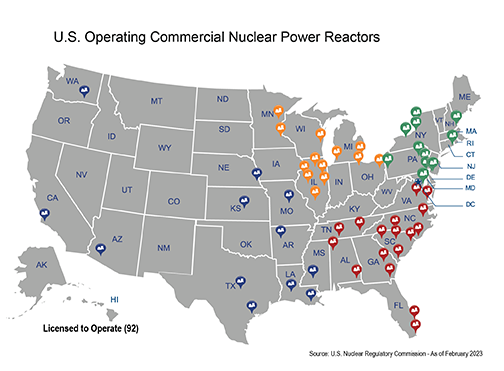
The one thing that turns me off nuclear power is how to store nuclear waste. The collapsed storage tunnel at the Hanford site this year is an example of how poorly this can be done. The waste will remain dangerous for thousands of years. How do you build a storage facility that keeps it contained for that long?