Well, in accordance with tradition I will now lay my thoughts down and be down-voted into oblivion for it. VR will flounder. I was a VR evangelist from 2012 to around 2014. I owned a DK2 -- I followed every shred of VR news like a fanatic. And what I learned from being so involved with VR was that it is not ready for mass adoption and probably never will be. People in the VR community drastically underplay nausea and discomfort. The main flaw is that if you move in the virtual world but not in the real world, your body does not like it. Thanks to head tracking, you can move the camera wherever you can move your head without sickness because the movement in the real world and virtual world are the same. But if you want to move around in any greater capacity than that without making 50% of people sick immediately, and perhaps 80% sick after just a few hours, then you have to do full body tracking. We are talking about 3/4 of games, easily. Games where you are a character and you run around in virtual space.
Even if you do full body tracking in your home, you are going to be extremely limited. You'll be running into the boundaries of your play space constantly. Those tricks of perception that allow you to walk along a curve instead of a straight line and thus never hit a boundary require very large amounts of space, especially if it is done in a way that is not detectable at all by the user. "What about omni-directional treadmills?" At this point I think we are getting crazy. Not only are you buying a hugely expensive VR headset, but you are setting aside a huge space in your home and buying a fucking gigantic omni-directional treadmill. Plus, the treadmill also does not provide the bodily acceleration required to prevent sickness because you are stationary relative to the earth while you use it.
And all of this is assuming that VR headsets reach a place where we have full FOV, perfect resolution and extremely high refresh rates. And VR headsets that have all of that will never be affordable unless they become popular. And they probably won't because of the reasons that I have just explained to you.
The one thing that I think has the potential to make VR popular is monitor replacement. Other than that, when I look at the future of this kind of technology I see AR. Not VR. I am sorry Rift fans, it was painful for me too.
> We are talking about 3/4 of games, easily. Games where you are a character and you run around in virtual space.
Then don't make those games for VR.
This might be cliche, but VR is not just a new accessory for an existing platform. It's a completely new platform. It needs new content that fits it -- shoehorning existing content into it will generally suck. Wandering around Skyrim sounds cool but will not work. Sorry.
As an example I've tried a lot, sim games (car, plane) work really well with VR. If there clearly is a cockpit around you and a seat you are sitting in inside the virtual world, your brain is fine with you sitting in your comfy chair.
Of course, not everyone will enjoy sim games. However, I'd be willing to bet a lot of money that there are and will be more new games that fit VR well. These will probably include entirely new genres of content that are not compelling or interesting on a monitor but work well on VR. Conversely, some genres will never translate well into VR.
This 100%. From my experiences with VR, the "character moving freely in the world" paradigm never works. As you point out, developers need to rethink the type of software they're putting out for these platforms.
I think games where the player is static is a good place to start. In addition to simulators, I could see god games, rail shooters and puzzle games all working well in VR. Even a game with restrained movement like a slow-paced mech shooter or old-school first person RPG (think Ultima Underworld) could turn out great. Making the player aware of the dissonance between the virtual and physical worlds is the immersion-killing poison that VR game developers must avoid.
Finally, I'd like to make note of the many non-gaming applications of VR that could turn it into a compelling platform. The platform has tons of potential in fields such as art [1], manufacturing [2], education [3][4], health care [5] and the list goes on. VR can be used to enhance these applications but not if it's treated like a cheap gimmick.
If VR flounders it will be because developers failed to tap into the vast market of VR software waiting to be unlocked. The key is imagination.
Exactly. I'd go so far as to suggest a new term, since "Virtual Reality" seems to bear such a terrible burden of near-complete immersion in some practically unbounded realm with total mobility and Holodeck-like possibilities. Instead of virtual reality, think about virtual presence. VP, if you will.
What are some really cool situations in which you can simply be present and be completely immersed? When I refocus my perspective this way, I think about being at a movie -- in a movie. Maybe I'm the gunner in the Millennium Falcon. Maybe I'm just a spectator on a nearby ship. Or maybe I'm sitting in a sports arena, as if really at the game, watching it and taking it in in a way I can't through my TV alone. Maybe I couldn't afford tickets to the Radiohead tour, but I can buy a virtual seat at any of the worldwide tour venues and see the concert with those crowds. That seems really fucking cool. I want to do that. I want to do that right now. And I don't need to run or jump around when I'm there. All I want to do is sit, and watch, and listen, and be present. And be immersed.
Whenever people think of VR, their thoughts immediately turn to gaming, and then they get disappointed when they realize that VR Skyrim or VR Grand Theft Auto (or what have you) isn't in the cards anytime soon. Instead of thinking about awesome scenarios where VR will fall short of the status quo, we should think of fun scenarios where VP will be a big step up from the status quo.
> Instead of thinking about awesome scenarios where VR will fall short of the status quo, we should think of fun scenarios where VP will be a big step up from the status quo.
Does anyone have links to actual examples? The Rift dev kit has been available for a while now. Developers should have gotten past the 'VR makes too many people sick' phase and started looking at new ideas. What are these new ideas?
Personally I'm a little disappointed that most of the hype around VR has been explicitly focusing on the gaming aspect. The non-gaming applications of VR are much more exciting to me. I want a meditation room, where I can sit on a stormy mountain to think. I want to program in a virtual room with monitors on every surface, and pieces of code fixed in space, where I move to the code instead of the other way around. Maybe it'll work and maybe it won't - its impossible to know until the hardware gets good enough to try.
I think the meditation/therapy angle is going to be a big one. Being able to get away to a happy place of your choice, maybe with a guided breathing exercise, could be very powerful.
VR has been around since the 60's, and has not "unlocked" anything noteworthy.
Sure, this "round" of VR might be the best yet graphically, but it still hasn't solved any of the problems that prevented the original 1960's implementations from taking over in storm.
These being: No "AAA" support, too few games, too expensive of devices, motion sickness, and more!
It's almost like folks think this is the first time VR has come to market... "imagine all the possibilities!" - the same promises time after time after time again. What makes this iteration anything different?
Maybe some folks have high hopes due to the Facebook stewardship - I don't mean to burst anyone's bubble, but Facebook has been anything but a good steward of Oculus.
They have not used their size or bank accounts to convince "AAA" studios to embrace VR, nor have they subsidized Oculus purchases to lower cost-of-entry for consumers. About the only thing they have done is go against all of their initial promises to not "Facebook-ify" VR[1] and turn the thing into yet another extension of the Facebook Social machine.
> The platform has tons of potential in fields such as art [1], manufacturing [2], education [3][4], health care [5] and the list goes on
VR will ultimately do nothing for these fields. AR advances will ultimately be what these industries end up embracing. You lose far too much environmental awareness when both eyes are staring at a narrow-focus screen without peripheral visibility, etc. AR allows the user to work and behave like normal, only their vision is augmented with additional useful information. It's less intrusive and disruptive, and has very few of the issues that plague VR.
AR is already widely deployed and in mass use. Any HUD is a form of AR (this covers everything from airplanes to cars to robots to google glass, camera viewfinders, etc...).
> it still hasn't solved any of the problems that prevented the original 1960's implementations from taking over in storm.
So much progress has been made with VR since then. A lot of problems have been solved.
Motion sickeness has been solved - when your motion 1:1 matches that of your virtual body there is no problem. Where there is a mismatch, there can be a problem (for about 30% of the population who are sensitive to this). So informed developers know how to create experiences that induce no sickness.
Regarding no AAA support / too few games - they are working on it. There will be over 50 games usable for the Vive at launch. There are some pretty big name games, like Elite Dangerous. Google, Valve and other big names are working on/have made stuff.
>What makes this iteration anything different?
Because it's actually at a point where it's usable now. Mobile phone popularity was one of the things that made this wave of VR possible as it drove forward the technology used.
>VR will ultimately do nothing for these fields.
There are VR applications that are currently for those fields mentioned, for example Tilt brush is generally received very well by artists and creative people.
I believe VR and AR will converge somewhat. VR has a headstart, and AR will adopt many of the technology, tools and techniques that VR uses. The Vive has a camera and can do limited AR, as can most mobile VR headsests.
I agree, that for a lot of applications - especially work-related then AR is better.
But when I game, I don't care about peripheral vision, I want to be in another world. Ultimately I want a headset that can switch between AR and VR modes.
>AR is already widely deployed and in mass use. Any HUD is a form of AR (this covers everything from airplanes to cars to robots to google glass, camera viewfinders, etc...).
I would nitpick this.
Regardless, I don't see anywhere near the level of give a shit for AR that there is for VR from the press and investors.
I agree too. "3D" had another push a half-decade ago in theaters and on TVs, and by this point it's reasonable to call it a failure. VR is much in the same vein: it's inconvenient enough to our lives that we're more likely to justify getting away from it than going to it. The Visicalc moment should either have happened by now or be right on the horizon. It hasn't. The demos are still basically reliant on the same kind of "spectacle" elements that 3D movies use, and the track record there is bad for franchise media - that is stuff that sells tourist tickets for theme park installations, but not repeat visits from loyal fans.
But AR, AR stands a chance. It is not hugely different to our existing uses of media technology - one more screen, in a different location, supplementing the existing experience. And it has good cross-over into VR for the remaining experiences that do work well in immersion mode. That might buy VR time to develop gradually for a few decades, like silent film. There are some things that are worth exploring with VR, but the tech really needs to be in mass adoption first.
As an indie gamedev myself. I can think of dozens of potentialial games that'd likely work well in be and not on monitor. And don't require physical movement and can be done sitting with swivel chair. Having the limit of not being able to run around may be disappointing to some. But any limit just forces us to innovate and achieve greatness thru new paths.
There are several instances in last 150 years where a patent or some other restriction caused others to innovate around a restriction and the end result was far superior because of it.
We're talking about big-budget "AAA" games, which drive console and pc sales alike. Excluding them, immediately destroys any notion that VR may become anything more than a niche product and go fully "mainstream".
> As an example I've tried a lot, sim games
I enjoy these games as well, but recognize their market appeal is very narrow. These games don't drive sales of consoles or PC's.
> I'd be willing to bet a lot of money that there are and will be more new games that fit VR well
Unfortunately this is unlikely to happen until VR becomes mainstream, which it probably will not for the reasons listed in the GP post. In order for a studio to take the enormous risk of developing something entirely new, they need as close to a guarantee as possible to get back at least their investment. With VR poised to be nothing more than a niche product, this becomes a huge risk.
Now, maybe Facebook and their deep pockets could subsidize development of these games (effectively pay "AAA" studios to natively support VR), but that doesn't appear to be happening... otherwise they would have done that before the flagship product launched, and "AAA" studios are not in a "release cycle" at the moment (which tends to be October-November for the really big "AAA" projects).
Again, you're looking at this from the perspective of what the industry looks like now, not what VR enables. AAA games are generally of a certain type now, but that is not a universal law which will remain true forever.
> you're looking at this from the perspective of what the industry looks like now, not what VR enables
VR has been around a long, long time. I know, most folks say "but this time it's different", but in reality it's plagued today by the exact same issues it has been plagued with all along.
No "AAA" support, too few games, too expensive of devices, motion sickness, and more!
> AAA games are generally of a certain type now, but that is not a universal law which will remain true forever
Essentially, it is. These are the games that grab people's attention, have grabbed their attention, and will continue to grab their attention. Nobody is going to spend $600+ to play Bejeweled in VR... but they might to play CoD, Fallout, Battlefield, GTA, Skyrim, etc. All are "AAA" titles, and all could offer a new level of immersion with VR - but none support VR natively (and they had plenty of opportunity to do so before launch).
What hardware was there "all along" for consumers? As I understand the latency and tracking problems have just now been solved with the latest revisions of oculus/vive. You can't say it failed in the past because of X and Y external factors when the product itself wasn't even a thing.
I enjoy these games as well, but recognize their market appeal is very narrow. These games don't drive sales of consoles or PC's.
Well, they don't drive PC and console sales, perhaps in part due to the limitations of the existing platforms.
Driving and especially flying games suffer more from the limited point-of-view. I'm often switching to the 3rd-person view to get a better handle on how my car is placed on the track.
For combat flight sims, one of the UI staples for the last 20 years has been showing markers on the edge of the screen to indicate the current target. You spend a lot of the time in those games without your enemy in view, which, frankly, stinks. But that's the limitation of the current platforms based around a monitor / TV. There have been hacks to help with this, but they aren't that great IMHO.
VR could really help these types of games have a much broader appeal, because of the immersion.
I would imagine that Command & Conquer-like games could be a good fit for VR as it requires overview where you'll usually have to scroll in cases where you'd otherwise just lift and eyebrow.
I could also imagine a Window Manager where every window is placed in a large (huge) sphere that surrounds you and your chair (you are stationary in the middle). You could turn you head to see and interact with windows that are nearby or you could zoom out and rotate the whole sphere by using some shortcut or other device (maybe an ergonomic mouse with a ball on top of it [1], such that the sphere around you rotates in the same direction as the ball of the mouse). You could still map virtual desktops to a zone on the sphere (or perhaps just create virtual spheres). With some handy keyboard shortcuts I could imagine this to became quite awesome. Especially for programmers that use many windows at the same time.
I don't understand if your head or your entire body rotates: if it's your head I can tell you that is not e good idea. I have bad neck just with 3 monitors...
At present I have my own small business creating VR experiences, I've managed to do about Euro 80k in business in the last six months. I have three large clients and have probably personally ushered more that 2,000 people through the Oculus based experiences at trade shows. Perhaps 1 in 100 people "bug-out" of the experience within the first 30 seconds. One executive I work with won't put the Oculus on anymore to approve work, he instead gets colleagues to try it and gauges their opinion.
However, it's been a learning curve avoiding 100% nausea inducing experiences. Certain camera moves and experiments have made me so ill I had to sleep it off for a few hours. So in my opinion, it's not the display tech, it's up to the experience of the application developer to know what works - and what will make you seriously ill. It's a strange job actually, programming that will make you sick if you get it wrong. :-)
At present, the big problem as a developer with a business like my own is that we can't get headsets. There is no VAR program. I feel that Oculus & HTC doesn't take developers of business applications seriously, or at least, I don't have any contacts there.
I've been involved with VR since the VRML hype of the dot com boom and the technology has come so incredibly far - my sense it that it will continue to progress and become a new display technology that's pretty much on everyones desk.
I'm working on non games VR applications too but my background is in the games industry and contacts from my games past have made it easier for me to get my hands on early hardware. If you don't have those contacts it's definitely harder to get an 'in' but I can tell you that Oculus is interested in non games applications it just hasn't been their focus for launch.
Feel free to email me at matt@virtuallightsoftware.com - I'm interested to talk to other people working on non games VR applications and may be able to help you with some contacts.
> Well, in accordance with tradition I will now lay my thoughts down and be down-voted into oblivion for it.
I downvoted you because of your snooty "ugh, I'm going to be downvoted just for posting my opinions" crap. Either post your comment and join the discussion or don't. Don't beg for upvotes.
I genuinely apologize. I love the HN comments and I wouldn't want to muddy them with stuff that people find distracting. In my defense, I was simply referring to the fact that whenever I voice this opinion anywhere on the internet it is not taken well because of the amount of enthusiasm in the VR community. I was not begging for upvotes. I will try to do this less often.
I know what you mean. Every time I say "the visual quality is really much worse than you'd expect" people downvote me to hell. But those pixels remain very very chunky.
It's a small distinction but I think he's actually saying don't downvote if you disagree, not asking for upvotes.
For another point of view, I personally appreciate the heads up that the opinion being voiced is believed to be unpopular so I can be careful to ensure conclusions I draw are informed ones since there are a variety of easy to make fallacies associated with unintentional groupthink.
I think nowadays all the different types of disclaimers are all the same, and how receptive audiences are just depends on whether the audience read something similar or not 10 pages ago. It's weird.
Sure, but ironically a different kind of unintentional groupthink happens in this case. Some people read "I'm going to be downvoted" and...consciously or not...want to upvote it.
Ignoring "minor rule violations" is how major rule violations start slipping through. Internet communities are only as good as the vigilance of the members allows.
Strict enforcement of the rules can kill internet communities. We are not robots. We make mistakes. We can consider context. We can forgive. We can consider the spirit of the law as well as the letter.
These 'rules' are not black-and-white orders handed down from on high. They are guidelines shared with us. We are free to disagree with these rules, to follow or ignore the rules, to enforce the rules or not, and to face the consequences of those decisions. We are thinking and reasoning beings associating freely.
The question shouldn't be, "Was a rule violated?" The question should be, "Does enforcing this rule in this instance help achieve our goal?" In this case, I believe I could make a compelling argument for both sides; but I am not convinced that thinking in absolutes will achieve our shared goal.
Fair points. There are definitely a lot of use-cases beyond ones that require moving around your body though: Zuckerberg's talk of court-side seats sounds pretty neat. For parents that can't get a baby sitter, or just don't want to spend a thousand bucks, getting to see a Warriors game virtually, from court-side, does sound appealing. I found the least nauseating experiences to be ones where I'm sitting in a spaceship, flying around. Perhaps enough of these types of experiences will carry the platform long enough for people to be willing to dedicate more of their home space to more advanced equipment.
Your comments about nausea are interesting, because I am a sailor and I know about motion sickness a little. I know that some people never get it for instance, and I know that I do get sick but only really on the first day of the season or whenever the movement first starts - normally I am ok for the rest of the year if I stay a lot of time on board. Very few people will be sick all the time, but I have heard of people who get sick all the time and still go sailing because they do enjoy something after all (meh, I don't think I would)
I am not a sailor, but I've done some offshore work for companies like Heerema and other offshore oil companies. I don't get sea sick, ever.
However, I get sick trying to play games with my google cardboard. Nasty, nasty feeling and it takes a good hour to feel normal again... Not a big fan of VR after a few sessions of sickness. I don't think I will play it more to "get over it" either.
I've had the same experience and it made me wonder, like the OP, about the overall future of VR.
But still I'll hold out, and still I'll try :)
Hopefully higher response and faster refresh rates with quicker and more accurate tracking will evidence the difference between Caraboard and near-term future VR.
I have a decent amount of off-shore sailing experience in small yachts, and like you, I never get sea-sick.
I haven't tried VR yet, but I was hoping my apparent immunity from motion sickness might carry over to a nice VR experience. Now I'm not so sure it will.
I would like to go sailing, but don't because I get motion sickness easily (I can prevent it though by 1) keeping my eyes fixed on horizon and 2) taking dramamine). Do you think using techniques 1 and 2 I'll be able to manage symptoms of motion sickness when sailing? Is dramamine popular in sailing circles to prevent motion sickness?
AFAIK, dramamine is still pretty popular for sea sickness. It's what I use if I need it. Like other antihistamines, though, it makes me really groggy so that may be the effect as much anything. Other things I hear people using are Scolpamine patches and just wristbands; no personal experience in either case.
I find being on deck and actively engaged helps me a lot too. For this reason, I suspect that I wouldn't be particularly bothered by VR but I've never had an opportunity to check it out thoroughly. You get to just sitting and going to yourself "I will not get seasick" tends to lead to problems.
as ghaff says, dramamine is used by many though I think the side effects can be harsh. I've heard good things about the patches and especially using a smaller dose (cutting the patch in half) to reduce the side effects. I've also heard that it can take a while for the drugs to pass through the blood/brain barrier and therefore its useful to actually take the drugs the day before you go on board. We have a different drug over here in general use in the UK (Stugeron) which is cinnarizine which is an antihistamine. I am dubious about the pressure bands but then I have used them and was not sick and when I took them off I didn't feel very good for a while so perhaps they do something I don't know.
I know of many people who join a sailing club and sail all size boats in the evening/weekend races but never really go out into the sea - for some of them, the whole social scene at the sailing club afterwards is important, perhaps some of them because its actually pretty exciting to be sailing in close quarters in that way. Some might do it for nausea related reasons I don't know. I am more of a cruiser though, I like to spend some weeks on board poking around in little coves, etc.
In my experience of sea sickness, I may feel funny the first day and not want to eat or drink, then (especially if cold and bumpy) would be sick overnight or the next day - then I would be feeling strange for a day but mainly I think because I was low blood sugar and dehydrated but I would eat some, then the next day I would be ravenous but having bowel problems probably because the food I ate the day before was having difficulty digesting as my stomach had been cleansed. after that I would be fine. Also around the 4 day mark (I have done a 29 day passage) you become much more attuned to the movement of the boat, you become much more comfortable with everything swaying around, you have started to tidy away all the bits and pieces that keep falling on the floor or clanking in the lockers and the whole experience can turn very pleasant.
I think people work out their own method for dealing with sea sickness, but I think that often its just denial that its happening and trying to stave off the inevitable (lying on a bunk down below, clutching the bucket works well). If you work out a technique for vomiting (head well back, mouth well open) that doesn't leave any residue washing around in your sinuses then thats probably best. I always feel better immediately after getting something out, though I pity anybody else around as I can't silence the hideous choking sounds. In order to treat the secondary problems I have some high sugar high caffeine drink handy (flat coke) and some high sugar biscuits (gingers are great - supposedly ginger is good for nausea too) and keep getting it in. I don't care if it will come out again in 2 minutes because you absorb that stuff into your blood pretty quickly, and you can eat healthily once you get over it.
Doesn't have to be awful. The collective wisdom is to stop immediately if you start to feel ill. Trying to push through will not go well. Eventually, most people build up a resistance to motion sickness ("VR legs"). Bonus is that this motion tolerance carries over outside of VR. Several VR users have reported being able to read in the car for the first time!
There are plenty of really amazing non-nausea-inducing applications of VR - and especially AR.
So what if traditional games don't map 1-to-1 with VR? It's an entirely new medium, and we've barely begun to work with it. Hell, even "traditional" non-VR games are still a very new medium.
I really think EVE Valkyrie is going to be the defining game for the beginning of this round of VR. Any sort of sim game is going to be a perfect fit for VR, and I'm sure there's games we haven't even thought of yet that will get released and really make the platform shine.
Most of your negative points are valid, except for this one: "VR will flounder"
Your sentiments echo detractors of revolutionary inventions such as automobiles (eg. there are no paved roads, it breaks down too often, there are no gas stations, ...) and even the iPhone (e.g. there are no apps, it's too slow, the keyboard has not tactile feedback, ...). What you have in common with them is that you treat temporary obstacles as permanent unsolvable problems while overlooking the long term potential.
As a counter argument for your omnidirectional treadmill point, this is much cheaper, takes up a lot less space, and has already been released: http://www.virtuix.com/
It's like with 3D movies, now we have 4k LCD TVs that support 3D glasses. But how often does one watch a 3D film at home or at a cinema? Beside Avatar and a few Pixar CGI movies, most weren't that great (often filmed in 2D and rehashed later for 3D).
Virtual reality glasses are ready (and were ready several years ago, but quite heavy with two CRT monitors in the helmet), but many people are sensitive to motion sickness - so this will be less popular than 3D glasses we know from 3D TVs/cinema. Plus it is more expensive. Certain games lend themselves to VR like racing/space games, were you sit and can move your head. But many other traditional games feel strange, at least for new users and sensitive individuals.
Augmented reality (Google Glass, Hololens) is further away and not ready yet. It will take 3-5 more years until we will see the first consumer products. At the moment the graphic quality is low and the POV is far too small - the graphics overlay area is very small. Some games lend to that technique, but many others won't be that great if you always see your own walls as background.
Perhaps autostereoscopic displays can be theoretically used by multiple people simultaneously, but it's not how the 3DS is currently implemented. The original versions of the 3DS required the player to keep the screen at the right angle to get the 3D effect; without doing that, it's just a blurry image, much like taking off the 3D glasses at a movie theater. The New 3DS (yes, it's actually called "New 3DS") has built-in face tracking so the display automatically adjusts to the eyes of the SINGLE person it believes to be playing, which is much more convenient, but still not perfect as it can lose track sometimes and takes a little jiggle to get back into place.
On both devices, any time more than one person is looking at the screen, the display has to be set to 2D mode or it will be blurry for at least one person.
Nintendo also puts a disclaimer in place that states 3D mode should not be used by individuals under 7 years of age. From what I've read, this is just out of an abundance of caution and there's no real evidence that the 3DS's autostereoscopy can harm developing eyes.
I was talking about autosteroscopic displays. The 3DS was just an example, and the only one that general public may have seen. And yes, the new 3DS uses eye tracking and is meant for one person. But there are professional displays that can be used by a group of people (even without any eye-tracking).
Similar disclaimer probably are on VR headsets and 3D shutter glasses.Such 3D technology with a fixed focus is probably a bit more problematic and sensitive persons get motion sickness.
The thing that stood out to me in following the community around Oculus over the same period of time was how consistently insiders responded to complaints that it just wasn't quite there yet with statements that it was the next version of VR that would really blow you away. The one that people could actually get in their hands at any given moment was never the True Realization of the ideal. That was always just a little bit farther down the road -- conveniently distant enough that you couldn't actually put it to the test.
DK1? "Oh, that's not REAL VR, real VR is DK2."
DK2? "Oh, that's not REAL VR, real VR is Crescent Bay."
Crescent Bay? "Oh, that's not REAL VR, real VR is the Rift consumer release."
Now we actually have the consumer release. And what's the message? "Oh, that's not REAL VR, real VR includes controls like Oculus Touch." And so the can gets kicked down the road another few months.
The continual response to underwhelmed users with "oh, you just wait till the next version!" made the whole thing start to feel less like a revolution-in-waiting and more like a faith-based enterprise. True Believers can help a company through the hard times, but they do not a mass market make.
Pretty sure people will agree that the Vive (which includes touch controllers and room scale tracking) is "Real VR" -- if the Vive fails to deliver amazing experiences, then yes 2016 VR is a dud.
The Oculus CV1 by not including hand controllers, and secondarily by having a limited tracking range, while amazing visually, is a very stunted experience when it comes to really being able to deliver good made for VR content. The Oculus Touch controllers are amazing, and can't arrive fast enough.
Well if your comment gets buried I do want to note that your perspective at least sounds reasonable, and your personal experience is worth extrapolating to a more broad experience or market potential. I've got my reservations about the 'revolution' that VR will be able to bring in the mainstream sense. I think the physical discomforts you mention are absolutely worth noting as a caution.
I'm not saying it's a great correlation, but some of the excitement regarding VR reminds me of other fancy, tech-oriented entertainment innovations that sounded interesting, but didn't quite pan out. Specifically the one where the movie audience was supposed to be able to have an effect on the story[1].
>"In another year, you'll see the pistol grip plus a seat with gyroscope motion control," Mr. Bejan said. "Two years after that, it will be virtual reality, with the goggles and gloves." (1993)
The purpose of mentioning such a whiff is as a reference point for my personal belief that people tend to like their entertainment simple and relatively easy to access. Great advancements in tech and media - successful ones/profitable/etc - seem to have been more about delivering traditional content in an 'easier' method of convenience. Netflix didn't revolutionize the business of making films, but rather the distribution. People are funny when it comes to art, no doubt.
Well I think the reference you're citing is more about the length of the film - 3 hours and 45 minutes - moreso than the fact that it's in Technicolor. A closer parallel would be comparing Gone With the Wind to a Michael Bay Transformers film, in that almost 3 hours of cinema is typically hard on the viewer, and moreso when there are tons of visual explosions and loud sounds that wear down on an audience.
I love THX theater sound. SDDS. All of them. However, those tools can be very much abused by certain practitioners, and that's not the tech's fault. Basically I think that improvements are welcomed but gimmicks never last. Is VR a new gimmick in the grand context of entertainment? We're about to find out it seems.
> Well I think the reference you're citing is more about the length of the film - 3 hours and 45 minutes - moreso than the fact that it's in Technicolor.
It's both – if the film had been in black and white, the comment would not have been made, nor if the Technicolor portion of the film were shorter (e.g. in The Wizard of Oz, which the reviewer had seen some months prior).
I'm fairly confident that the VR headsets of today are equivalent to the bulky brick-size cellphones of yesteryear – the utility they provide to the early adopters is more than enough to offset their cumbersome nature right now, but in 10 years' time everyone will want one, and they'll be priced much more competitively.
...or the production quality might degrade to the point of bursting into flames, like those $XXX self-powered scooter boards, which dampens the appeal.
I get horridly and painfully seasick, others don't. Most that don't were "raised on the sea". I suspect younger generations could adapt to VR the way my generation adapted to the spatial awareness required for 3D gaming.
On a side note, this makes me think VR could possibly be used therapeutically to "cure" motion sickness. Something like the 3D gaming tutorials in early 3D games.
I strongly disagree. Yes, nausea is a big problem but there are a lot of scenarios/games where you don't need locomotion or can comfortably work around it (warping, a cockpit of some sorts etc.).
Also we might be closer to solving the eye vs. inner ear discrepancy completely rather sooner than later. Samsung is working on a headset that stimulates your vestibular system to make you sense motion & acceleration:
http://www.theverge.com/2016/3/14/11220836/samsung-etrim-4d-...
A lot of Vive games are solving movement by a combination of 1-1 mapped in the limited floorspace, combined with teleportation. It sounds like it is a pretty much nausea free solution.
Yes, I've demoed this type of locomotion with a Vive. Teleportation is the de facto method, and causes no sickness. Try this in games like The Gallery, Budget Cuts, etc.
Yep, Vive devs all agree that 1:1 motion solves nausea, that's why it is a main Vive's feature. I think, I've heard it in the round table video on valve's youtube channel.
I watched half a dozen vive videos and I've never seen anyone complain about nausea. In my opinion the biggest obstacle is the lack of games or at the very least a killer app that justifies the pricetag.
If the VR marketplace is going to depend merely on gamers who don't get sick, then you are spot-on - this will be a failed business model. But just as early PC tinkerers couldn't imagine what would be created when it went mainstream, we too lack the imagination to see what people will do with VR. The good news is that we won't have to wait long now that hardware is getting out into the wild. There are MANY applications that don't require moving around or that only require moving around in a small space.
you're right on all of this, except I disagree with your conclusion that VR is not close to being ready for mass market adoption. I was getting my PhD in VR before dropping out to start a YC backed company in 2011. It wasn't glorious at the time, I would just say I was pursuing a PhD in Computer Graphics so that people didn't write me off immediately. I am really happy that VR is getting a lot of attention, but the entire focus is on general purpose headsets which will likely not work due to two main reasons.
-The virtual world needs to match the physical world, if the haptic feedback isn't there, it is extremely discomforting and the closer you get in visuals, the worse the sickness will be.
-Headsets take too much set up, anything that requires you to deal with that many cords is going to eventually collect dust. I loved playing games in 3d using nvidias shutter eye glasses, but even that was too much set up to continue using for 6 months or longer.
All this is true, but I think there is still a huge opportunity for VR in the near future. To get it right, people need carefully crafted experiences where they can match the virtual world with the physical world using haptic feedback. You could use headsets or not, you can also just use stereoscopic monitors or projectors in a carefully crafted experience. I can envision an arcade that let's you play a 5v5 robot fighting MOBA, with the monitors not right up on your eye, but surrounding your cockpit. You can have visual acuity matching the real world (retina displays). You can match every physical stimulus with real world stimulus.
There is a certain niche of games that will be great in oculus-rift-style VR. Your comment reminded me of these two articles about a game where the main character is sitting down and thus, you do not get that kind of sickness:
> The one thing that I think has the potential to make VR popular is monitor replacement.
I don't see it as a good monitor replacement technology. In limited applications, such as for AutoCAD and 3D design, I can see it as a good option. It would be very useful for 3D visualization or model examination. But for normal, every day, web browsing / computer use, I don't see VR to be very viable. Goggles with high res screen and AR are going to happen, and are going to be very useful. I can see the day where your cellphone will also be your laptop, and you just connect goggles to it to do some work. But that's not VR, that's just evolution of cinema goggles.
I do agree though that VR does make a lot of people sick, including people who have been flying FPV drones with goggles for a while. There is something about completely filling your field of view that just makes people sick if it doesn't track just perfect, and matches to your vestibular system. There are efforts to hack the vestibular system to make you fee what you are seeing, but it's a little scary, and I think many people would be creeped out by electrodes and such connected to their heads.
I also had been following VR closely. Studying what happened to photography cinema or radio we can predict VR as the new media having a great success over time. Today VR lacks media designed for VR.
Right now, VR is opening to thousands or tens of thousands of people, probably millions, including creative, smart developers and artists. Before, patents made VR limited to a handful of people.
Artist will adapt to VR limitations like they did to cinema. Someone had to invent travelings, or cuts, and blendings. At first, cinema was just theater.
Do you know that if you record video without motion stabilization for some time people experience nausea and disconfort?
That is the reason virtually every film uses steady cams or rails or tripods with panning on each axis.
That you can't replace reality totally with VR does not mean that VR is not useful with their limitations.
We had been using VR in our company for CAD for a long time now, and for this application is extremely useful, better than anything else.
No doubt they will discover great new applications for VR even within their limitations. Artist will learn how to minimize their drawbacks just like they do in radio, cinema, or TV.
I've personally demoed the Gear VR to about 70 to 80 people, and in my experience nausea/vr-sickness is a problem for a tiny minority of people (maybe 2 or 3 out of 70 or 80 for properly designed experiences). With the consumer version of the Oculus Rift, that should be even less of a problem, due to the higher specs.
Much more of a problem is physical comfort of the headset itself. After the novelty wears off, few but the most dedicated want to stay in VR for extended periods of time, or even bother with putting the headset on anymore. Headsets are just too bulky and uncomfortable. Even regular glasses are too much of a hassle for a lot of people. VR headsets have the uncomfort of regular glasses multiplied by a hundred.
I don't think VR will fully take off until you can experience VR with something as comfortable and unobtrusive as contact lenses. Until then, it will remain a novelty or used for purposes where it really does not have much competition, like tele-surgery. There are some other niches where people will likely use a headset, like to play an occasional game or for videoconferencing, but then they'll take off the headset and go back to monitors for more mundane tasks that don't benefit from immersion, like word processing, web surfing, etc. Even for movies, current headsets are a bit too much, when you could just as easily watch a movie unencumbered by the bulk.
That's not to say VR isn't impressive. It is. I was blown away by it when I first experienced it, despite being spoiled and knowing what to expect by watching videos and reading about it. There's nothing like the real thing, though. But eventually all that wears off, and then you have to deal with the day-to-day choice of whether to put on the headset again.. and that's where I think for now headsets are too uncomfortable for regular, casual use.
I have limited, hands on, VR experience. However, last week I went to the California Academy of Sciences, and they had this show called "Impact" going on.
Due to the way their spherical projector in the planetarium is setup, it takes most of your field of view. That particular show had a camera that moved smoothly, but seldom in sudden movements. Instead, it had would accelerate to a given speed, and that gives you the impression you are moving.
I though it was a little bit disconcerting for the first couple of minutes, then I adjusted just fine. My wife was sick for half an hour afterwards. Her son was so-so during the show, perfectly fine afterwards. The feel is exactly as you described, you feel that you should be moving, but aren't.
That was an eye opener for me. I didn't think that a stationary display would ever make me feel anything (I used to be a flight sim fan, and nowadays I play a lot of Elite: Dangerous).
I haven't reached any conclusions about VR tech yet, other than it is probably not suited for my wife.
I worked at a museum with a planetarium. The way it was explained to me was that if the stars move — as far as your brain's visual processing is concerned — you must be moving. After all, the stars are fixed points of light; they never move unless you are yourself spinning in some manner — except, of course, in a planetarium.
We also had a flight simulator; but with that, the movements of your body mostly matched the movement of the plane (you couldn't feel forward/backward acceleration, i.e., acceleration on an axis perpendicular to your chest, as otherwise, you'd be actually moving around in the building). This never made anyone sick. The planetarium, however, regularly made people feel ill, and occasionally I'm told, actually lost their lunch, whereas nobody ever lost their lunch in the flight sim AFAIK.
It's interesting to see games for the HTC Vive tackling this problem by forcing players to be static, or move around the environment with a sort of point-and-click style teleport.
From what I've seen, players pick it up fairly naturally and it doesn't seem to impede gameplay. The major drawback would be that games need to be designed specifically with this in mind.
I don't quite understand it when people say that VR won't succedd but AR will. They're two points on a single technological continuum. One will enable the other. If AR does massively take off, all of that tech will benefit VR. Alternatively you can view AR as just a special case of VR, where display of the real world is passed through and where there's more sensing of the real-world environment for use in constructing the virtual parts of the environment. In that sense, VR is just a step towards more general AR; in that case the VR tech benefits AR applications.
Why do people insist that it can only be one OR the other? The technology is all converging to the one point. In fact I'd argue it's mostly the same technology. It's irrelevant as to whether it's AR or VR applications that break the technology into the mainstream. Once it's there, both AR and VR will have broken through.
I'm a mountaineer. Feeling ill at altitude isn't the same as motion sickness. People can die of HAPE - it's not something to brush off and say, "humans can adapt". The great majority don't at high altitude. That's why you see tourists on Everest with oxygen masks and dexamethasone in tow. It's not to be a little more comfortable, it's to be a little less likely to be dead.
I also get motion sickness for weeks on end. Trying VR isn't exactly appealing to me, but I'm pretty sure I'm not going to die from it.
I grew up on a sailboat - other than feeling weird for the first coupla hours after sailing, it wasn't a big deal.
That is all true, but you are assuming the content created will always try to have full body movements, or that people will always want to move around. It's like complaining about movies when they came out because they were not 360", or didn't have colors, or didn't have sound. Some of these came in time, some turned out not to be required.
What I think will happen instead is that the content created for the Rift (and others) will be shaped by what the medium does well. Games like driving or flying simulators play perfect well within the limitations of most HMD devices, and actually shine in comparison to the current alternative (monitors). To me this is just one of many examples of things that work better in the Rift than anywhere else.
You're absolutely right about flight sims. They are definitely the least sickening non-stationary experiences. The reason that not being able to move around is such a big deal in my eyes is because that is what I always fantasized about. I think that first person experiences are what most VR fans fantasized about. But you and many other people in this thread have made the very good point that VR can create new genres. Genres that are well suited for VR.
I've too been very enthusiastic about VR (supported the original kickstarter in the 1st hour it went live) and have had a little bit of an awakening after the initial enthusiasm. When Team Fortress 2 came out with Rift DK1 support I installed it and immediately realized that would NOT work. It was instant nausea, and it was not fun in any way.
But other people realized the same. Since then, indie and amateur developers (as well as some professional ones) started properly exploring the medium, instead of just trying to re-purpose content. There's many new subgenres better fit to VR that are emerging and, I believe, will get more visibility. The vast majority of those are "seating" experiences, but still ones that can easily blow people away, and continue to amaze me to this day. Which is just as well - getting a new blockbuster FPSs every month was starting to get boring.
VR won't be for everything or everyone but it'll be great for what it does well.
I remember when TF2 first rolled out support for the DK1. Good times. It was magical. Although most people reported that playing as the scout was not a good idea.
flight sim isn't really that great with VR HMD because you can't see the buttons which you need for more realistic controls. With a HMD you are limited to only the joystick + throttle combination which don't have enough buttons for a fully simulated cockpit.
I'm a big fan of how the Vive is approaching VR. I think Budget Cuts is a great example of what's possible with VR if you're willing to take these problems head-on and treat them seriously rather than ignoring them and just slapping VR onto normal games.
I also think there are many games where room-scale tracking is entirely sufficient with no need for any artificial locomotion. Strategy/RTS games are a great example. Just walk around the map. When you need to move further than you can, just move the map itself. Easy. You could even make the map into a hologram, so that rather than walking on it you're walking in it, with it floating at waist height. Now you don't even need to bend over to interact with it.
Absolutely agree on the nausea front – Windlands (controlled via a trackpad and swinging from tree to tree) takes a lot of getting used to.
Experiences designed around the limitations of room scale VR with tracked controllers, though, address that issue pretty effectively. I've spent hours playing Fantastic Contraption on the Vive Pre, and it's an amazing and immersive experience.
VR also makes 2D content much more cinematic in nature, despite the (for the moment noticeable) reduced resolution. And the resolution will likely be the first thing to improve in the next generation of headsets (using foveated rendering to reduce the onus on graphics cards)
I own a DK1, and agree with you on a lot of these points.
I would add that while first-person shooters universally made me sick to my stomach within about 5 minutes, flight sims generally never did. My guess is that being seated in a virtual cockpit and flying around seems a lot less wrong to my vestibular system.
Unfortunately, the flight/space sim market is a rather small one within gaming as a whole. Though it does tend to be one full of people generally more willing to buy dedicated sim hardware than most.
The DK1 is just awful in comparison to the DK2, though. Positional tracking and reduced latency of the DK2 improve the nausea situation a whole lot. I haven't had a chance to try the CV1 yet, but it's supposed to be an equally big jump.
I got a DK1 a few years back and was ridiculously excited to try it out. I had blocked out the whole weekend to mess with it. I tried it for under an hour, took it off, and didn't use it again for a week. It made me nauseous and gave a killer headache. My wife and brother had similar experiences -- both expected to be thrilled and have difficulty putting it down, but both ended up keeping their distance after the initial experience.
I haven't tried any other VR devices yet (skipped the DK2), but I look forward to demoing the CV1 at some point. Since Linux support has been killed, it will probably be a while, whenever I get around to building the separate free-standing Windows machine I've been intending to get for the last year or so (with dual-boot, I find I boot up Windows once a year, or twice if MS is lucky that year; I just have too much stuff running on my primary workstation to let it go powered off for very long).
> People in the VR community drastically underplay nausea and discomfort.
You must have never tried the HTC Vive, I never had any of these problems with it. Limited amount of space as well, as long as your game doesn't move you everywhere around.
I'm better at reading in a car than my parents are. I bet the next generation who grows up with VR headsets around them will adapt and not have any of the nausea feeling we currently have.
I have my doubts that you're part of a generation that has evolved the ability to read comfortably in cars. I get nausea reading in a car but I don't think my dad does.
Came here to post about this. The elephant in the VR room is that porn, both recorded and semi-interactive 3DCG, is easily the most immediately interesting use of the technology to the vast majority of consumers. It's also a huge part of why everyone lost their shit when Facebook bought Occulus, as early adopters feared that Facebook would either implement a closed platform or track what "applications" people used.
What about a full experience like the Vive? Yeah I know it only does roomscale, but it should prevent a lot of the nausea you talk about. I think it would work out well, you would have "rooms" like old school adventure games that you mess around in, and then kinda hit go north, south, east, west etc to go to another area.
I have a heard time seeing how that wouldn't be flat out amazing. I'm not a huge fan of the Rift, which sounds like your experience is based on. But SteamVR looks really good to me.
Other than SteamVR, I see mobile VR being where it really hits. I think roomscale + mobile VR will work out together. The Rift should and will die, I'd hope for all the reasons you mentioned.
The rift and VR in general have strong parallels with steering wheels for computers from a market standpoint.
The racing games actually drive console and pc sales, at the very least GT does. At the same time, it is a normal game with the controller, and a fantastic experience with a good wheel.
The best racing game/sim IMO, called iRacing fully supports all wheels, and it has a profitable service.
Some people like you may not know about it, not being 'mainstream', but that is not really needed for the product to be successful and to have a rabid fanbase of active subscribers.
So, if steering wheels are a product with good margins, and also, making games for them is profitable which it is, then the same will apply for VR.
Maybe not for home users but I think for military training, rescue training other such applications those could be viable. I don't see anything wrong with this technology being professional/luxury first then becoming more affordable to regular users.
We had a DK (or maybe DK2, don't remember) as well and yeah we played with it but I ended up not liking it. The resolution was too low, I could see individual pixels and it was like looking through a screen-door. We played with it for a while, ran some demos, everyone had fun. Then put it on a shelf and hadn't touched it since.
> The one thing that I think has the potential to make VR popular is monitor replacement. Other than that, when I look at the future of this kind of technology I see AR. Not VR. I am sorry Rift fans, it was painful for me too.
VR/AR as monitor replacement is actually the application I'm most excited about personally. I'd love to see a Google Glass/Hololens type device that functions as a wireless Miracast/WiGig monitor and nothing else, which could hopefully bring the product into the realms of affordability.
Will that not be fatigue issues with this? Ignoring the actual weight of the headset, isn't it really bad/tiring on the eyes to be constantly focused at the same distance?
That's definitely true for VR headsets like the Rift or Vive. I was thinking more along the lines of the Google Glass/Hololens form factor, which probably won't pose any problems with respect to weight.
In terms of focus, I don't think it will be much different compared to using stationary physical monitors since those usually stay at the same focal distance as well. The Glass/Hololens form factor only occupies a tiny part of your field of vision, allowing you to freely look elsewhere as you see fit (and AFAIK the Hololens, at least, has the ability to simulate different focal distances).
I'm picturing this as more of a supplement to physical monitors as opposed to a complete replacement in a typical workspace setting. What really excites me are the possible applications of something like this in mobile (an always-on, wireless second screen/HUD for your phone that takes voice commands or some other new control mechanism, for instance).
Give the HTC Vive a try. I played with it in a reasonably sized room and it was a lot of fun and there was no motion sickness to speak of. It does positional tracking. The tilt brush app is amazing.
I do not own a Rift, but I do fly FPV quad-copters using video goggles. There is no binoccular vision, no headtracking and the FOV/resolution are pretty limited.
I have never experienced ANY nausea and I'll do flying sessions several hours long (though I do take the googles off repeatedly inside that window.)
Given my experience with sea faring ships, I doubt that I am one of those who will not get nausea, so why is my use case not a problem? Is the nausea just due to an uncanny valley of which my setup falls short?
Most video glasses have quite a small field of view... Are yours the same? So it's kind of like seeing a screen floating somewhere in front of you, whereas with the vr headsets you basically can't see the edge so it's a lot more immersive.
I expect that's the main reason you don't get nausea.
If it is indeed the FOV that makes the difference, this implies a potential solution for when a game needs to move the camera independently of your body: limit the FOV as the camera moves.
> Plus, the treadmill also does not provide the bodily acceleration required to prevent sickness because you are stationary relative to the earth while you use it.
I didn't really get this point. So what if the treadmill is stationary relative to the Earth ? And what do you mean by "bodily acceleration" ?
I honestly do think the "omni-directional" treadmills would solve all the problems you bring up here. And it doesn't even have to be that big.
Thanks for editing out your suggestion for me to "read a high-school physics textbook." The earth is the frame of reference when considering free body diagrams of objects moving around on its surface for all practical purposes. Neither the treadmill nor the person using the treadmill moves with respect to the earth and therefore no bodily acceleration is experienced by the user. In the virtual world, however, the user does move and bodily acceleration is expected. Therefore, a treadmill cannot alleviate the problems caused by acceleration mismatching.
Thanks for taking the time to reply to my comment - I still don't understand your point. It's as if you're saying, "because the treadmill (or you) don't move with respect to the ground, you don't experience movement."
If this were the case, you wouldn't be able to exercise on a treadmill since no energy would be spent (Energy = Force * distance), where distance would be 0 in your argument.
I think the difference here is that the treadmill moves you, vs you moving yourself. Even still, there are machines that can move using the friction between your feet and the treadmill surface - and they are starting to make their way into some of the local 24-hour gyms.
I'm not arguing with your point that "VR will flounder", but I just want to keep everything honest. And honestly, your physics doesn't check out.
Yes, this is only about physics for me too. My physics does check out though. If you are in a car and it accelerates from 0 to 30 mph you will experience the symptoms of acceleration. For example, an object that is hanging from a string in your frame of reference, such as a fuzzy dice hanging from the mirror, will appear to move backwards on its own. Try holding the fuzzy dice while running on a treadmill. I guarantee you won't see anything like that happen. Because you are not accelerating.
In your argument, your string and fuzzy die are not measured with respect to the surface of the treadmill, which is the frame-of-reference you should be considering. If you think of it this way, then yes, your fuzzy die will "lean forward".
You absolutely do experience acceleration when you're on the treadmill, how do you think you go from 0 mph to 5 mph ?
With respect to the ground of the earth, then there is no acceleration horizontally. With respect to the surface of the treadmill (which is what you must now consider), then yes.
Just think of exercise. I challenge you to run 100 miles on the treadmill and not get tired.
I don't think you understand the arguments people are making.
Your inner ear does not experience any acceleration in your example, which is what is required to avoid sickness. What's happening relative to the surface of the treadmill doesn't matter, the acceleration of your inner ear does, and that's not changing.
Is your head accelerating while you're on the treadmill? I've never seen a treadmill where that happens, the whole idea of a treadmill is running in-place.
The most common VR treadmill-ish device I'm aware of is the Virtuix Omni: http://www.virtuix.com/, where your head is clearly not accelerating.
What are you picturing when you claim your head (and hence inner ear) is accelerating on a treadmill?
I'm starting to understand yours and everyone replies. I think what I had in mind is that I'm accelerating relative to a point on the treadmill, and therefore my entire body is accelerating. I can't wrap my head around the fact that we're still considering the ground as the frame of reference.
I know that the treadmill moves on its own, but what if I push the surface of the treadmill to make me move forward. Wouldn't I not know the difference between a sidewalk and the treadmill ?
The ground as a point of reference isn't really relevant, it's your previous position that matters (new position relative to your old position). Acceleration requires a change in trajectory, and no matter what the treadmill is doing, if you are not changing your trajectory you are not experiencing acceleration (ignoring the effects of gravity).
Thanks for taking the time with me. Acceleration for me is a change in a velocity - isn't that what is going on ?
Velocity is a change in distance, and to me it seems there must be a change in distance - since there is energy being spent (we're "traveling" as we run, while putting in the force of our feet against the treadmill - each step is an "acceleration" forward).
> Acceleration for me is a change in a velocity - isn't that what is going on ?
Yes that's what it is. But you aren't changing velocity when you start running on a treadmill. When you are on a treadmill your velocity is the same as a person standing still on the ground next to you. We may talk about you 'running at 5 mph', but this is just a casual way of talking unless you're doing a physics problem. In reality, your legs are moving in a similar way as if you were running at 5 mph, but your velocity, relative to when you started, is zero the whole time.
> it seems there must be a change in distance - since there is energy being spent
If you stand still and flap your arms you're spending energy aren't you? But you're not going anywhere. Next imagine running on the spot. Still spending energy but not going anywhere. Next imagine that on a treadmill. Still spending energy, still not going anywhere.
> we're "traveling" as we run, while putting in the force of our feet against the treadmill
Here's another way to think about it from scratch that may help.
You are running forward, going at 5 mph. The treadmill underneath you is going backward, at 5 mph. Your actual velocity is therefore 0, because the two cancel out.
When you run on the ground you are running forward at 5 mph, the ground is staying still, so the result is actually 5 mph.
People casually say that your velocity on a treadmill is 5 mph, but really they mean that you are moving your legs fast enough that you would be going 5 mph, if the treadmill was't working in the opposite direction against you. If you were doing a physics exam you would be more careful with your terminology and you would say that the velocity of someone on a treadmill is 0.
> each step is an "acceleration" forward
No, each step forward on a treadmill is compensation for the treadmill going backward. All of the progress forward that step gives you is used up balancing out that the treadmill is going backwards, and there is no acceleration.
I guess what I don't really understand is how I can tell the difference when I'm blindfolded.
If I am undergoing the same force with my feet on the treadmill than I do on the sidewalk, how do I really tell the difference ?
I know since the treadmill is moving on its own, I have to "walk" to keep up with it, but what if I could move the treadmill backwards as I walk ? (The force of my steps make the treadmill move, rather than the rotor machine?)
I understand I don't move anywhere with respect to the ground, but if I undergo the same motion that I do when I'm walking, how is it that I am able to tell the difference ?
If I can literally make the treadmill move under me just by walking, how is it different from walking on the sidewalk ?
Sorry - I'm just really baffled, even though I believe everyone. Could someone just ELI5 me ?
Do you understand that when you accelerate in a car the dice moves toward the back of the car, so that the string leans backwards?
This happens because the car moves forward, but the dice wants to stay where it is. So it kind of gets dragged. This is a fundamental property of the universe we live in, called the first law of motion, and I can't explain that further as nobody knows why the universe is like the but it is.
Do you understand that this doesn't happen if you hold a fluffy nice on a string and run on a treadmill?
This happens because the dice wants to stay where it is, and it is staying where it is, so nothing happens. Whatever you legs are doing beneath the fluffy dice is irrelevant.
Your ear effectively has a tiny fluffy dice on string inside it, and tiny hairs that feel whether or not it is leaning backwards. You don't need to see or feel anything else to sense this, and it doesn't matter what your legs are doing. That's why the treadmill and your eyes don't matter. Your legs are running on it but the little dice in your ear knows what is really happening.
That is how you know that you are really accelerating.
And, going back to the original point, is the whole problem. There is no way to poke this fluffy dice to fake the sensation of acceleration, as it is sealed inside your head.
The fluffy dice in your head thing is obviously not quite true, but it really isn't that far from the truth.
You can do an experiment to understand this better (or at least prove it to yourself). Get a glass of water and half fill it. Get in a car and get a friend to accelerate somewhere legal and safe. The water will slosh to the back of the glass. This is like the dice. Now get a treadmill and turn it up high. Put the glass of water on the skateboard. Lower the skateboard on to the treadmill while it's still running. The 'acceleration' here will be huge as the skateboard will go from 0 to whatever mph instantly (it's not really acceleration, that's the whole point). The water will not slosh (if you put the skateboard down carefully).
Thanks, I think I finally get it - and the experiment would definitely confirm your point.
How does our inner ear chooses to uses the ground vs a point on the treadmill as it's starting point? I keeping wanting to think that I'm in motion with respect to a point on the treadmill.
What if your inner ear were located on your feet ? Would you then not be able to tell the difference between treadmill and sidewalk ? Your feet are actually traveling in the same motion on the treadmill as it would the sidewalk ?
You are born onto the earth, so your reference point starts as the earth.
In reality the earth is moving through the solar system, so your starting reference point is in motion already.
If you get into a vehicle and start moving at speed relative to the earth, then that vehicle becomes your new reference point when the speed becomes stable.
When you step onto a treadmill your speed relative to the earth, your previous reference point, doesn't change, so the reference point doesn't change. If someone were to drag the treadmill behind a vehicle with you surfing on it, then it would become your reference point.
It's confusing to talk about your inner ear being in your feet because they're in a running motion, so they're being shaken up all the time. They'll experience constant acceleration and deceleration relative to the earth as your foot goes back and forward in a running motion. If you had little dice on strings in your feet you wouldn't be able to tell what was going on with them as the dice would be flapping all over the place.
The point is that for your inner ear, there is no acceleration when running, or not, on a treadmill. Your body isn't moving relatives to where it started, so your inner ear doesn't detect the same equilibrium changes that would align with your visual perception - https://en.wikipedia.org/wiki/Inner_ear#Equilibrium
Sorry, you're right. After reviewing your comments and debating long with my best friend (what are best friends for, anyways), I finally see my flaw. I didn't consider the inner ear not accelerating whether or not the treadmill below you does. everyone who has tried to set me straight.
See my replies to the rest of the comments. The point is, you have to use the surface of the treadmill as your frame of reference. Then, it's obvious that your body has moved relative to where it started.
1) Start running on a treadmill
2) Jump directly sideways off of the treadmill
3) Experience 0 acceleration because your velocity parallel to the treadmill is basically 0.
Note, I think treadmills can work for VR, I'm just here for the physics.
Also, for my third edit, upon re-reading all the comments in this chain, it really seems like we're all agreeing. Just talking about different effects.
you can only do this if the surface of the treadmill is an inertial reference frame. ie. a person running at constant speed vs a person on a treadmill at constant speed is functionally equivalent.
However, the moment you want to stop or change speed this no longer works - in the real world your body needs to accelerate, while on the treadmill the treadmill accelerates and your body does not. This is because the ground remains an inertial reference frame during the acceleration, while the treadmill surface does not.
Plus it's expensive both the goggles and the hardware it takes to run the software that takes full advantage of said goggles.
And that's also without the sense of touch, smell, balance, temperature etc. So it's only slightly better than watching a film in 3D and way more expensive.
Sure, it has limitations but do you not see any applications of VR besides games? I'd hazard a guess that the vast majority of games are not first person shooters, or ones that require you to control the movement of a character.
To second your arguments, from a pure business perspective, VR would be already growing its user base and showing pretty nice retention rate if it was any close to be something people really want.
I think what you're talking about is tolerance, which is going to be different for everyone. The same could be said about being on a roller-coaster for several hours.
I feel that AR has even more applications than VR, although honestly when both will be sufficiently advanced they will merge. VR will eventually be AR with the external (world) "signal" turned off.
I think VR and AR slot into the same use cases Mobile and Desktop currently occupy, with AR eventually being the lightweight, transportable solution and VR being the more capable but less mobile counterpart. At least for the foreseeable decade(?). For instance, I think input methods for (Desktop-powered) VR will advance much more quickly than input methods for AR and that will be a major factor.
I agree with the merging in the future, but for the next few years consumer VR will be upfront. It will be 2+ years for consumer AR to really happen, even with meta and magicleap out there. The super small field-of-vision (FOV) on the hololens currently makes it dead in the water at the moment, and it looks nothing like the videos purport...
I thought about that, but if you do the math the resolution is far too low. Maybe after a few generations it'll be a viable replacement for a multi-monitor setup.
But really, per-monitor is too limiting. This really screams for a window manager that is aware of the display medium, and allows stashing of windows in a virtual desktop space. In a way, old Linux/BSD window managers like TWM and FVWM with their ability to have unconstrained (or very large) desktop spaces that you can move the viewport around is the paradigm we might want (with the addition of zoom).
When you compare VR to multiple screens, you also have to consider that with multiple screens you have the ability to see things happening in the peripheral vision, and react to changes or alerts. Switching from one screen to another is just a matter of shifting your eyeballs and focus, which humans can do extremely quickly. With VR, you are shifting your entire head by a rather large amount, and using a significant amount of energy to do so. Also, if you look at the way people usually work at a workstation, you will see people move their head, stretch their neck, etc. Our eyes can naturally compensate for that. For instance you can move your head from side to side to stretch the neck without having to loose focus of the screen. With VR, that's not going to be possible. Plus, with any slight head movement, your entire screen view would be constantly shifting.
Basically, what it comes down to is that we would need an eye tracking VR experience, not just head tracking, to make it useful as a screen replacement. Of course, I see the day when very high resolution small goggles would be something you put on and use in combination with your phone as a laptop replacement. Kind of the Ubuntu idea of a phone that can run desktop software. But that's different from VR. High quality goggles and AR is the future. VR? Not sure, the application is just too narrow, and from my conversations with die hard gamers, many of them just don't really like it for now.
The point is that since the Rift's 2160 x 1200 screen is so close to your face the pixels are further apart in your field of view. You're very far from Retina levels of smoothness. Small details, such as small text, will always look grainy.
I guess the question is how small does the text need to be? When zoomed in so it takes most the view, you essentially have the equivalent of a ~40" screen right in front of you. Would that entire viewspace being a single terminal offer enough fidelity? If I could just turn my head to see a second terminal of similar size for secondary info (such as build error output, viewing a log, etc), then I think that might be sufficient.
It's worth noting that I think trying to approximate current desktops or monitors in a VR environment is entirely the wrong way to go, as it's an abstraction of an abstraction, when we now have the ability to get closer to the source that the initial abstraction ever could.
That is, we have multiple windows, or multiple displays with windows to approximate our ability to have multiple things in front of us. But we don't actually look at both things at the same time very often. That is, we might examine two separate papers, and have one in each hand, but we look at one at a time. Having two documents or terminals open in separate windows/displays but both visible is a way for us to approximate this on a display. We have both visible at the same time so we can physically look back and forth between them easily. With a VR display, we might want a view like that, but when interacting with an item, it will likely be zoomed to fill 90% of the visible space, as that's how we generally interact with things in real life. When we don't, that's because of other limitations that prevent it, or because we need to split focus for a specialized task.
Personally, I would love to have a VR system that presented windows/screens of apps in a 3x3 grid (or more likely a 3x3 cross, a center item with items at the four cardinal directions), where the center item was zoomed to 90% of the display or so, but I could look around at the others, and could rotate vertically or horizontally to center (focus) a new item. This would be the "active" applications/views, and other things could be stashed to the side. It might start as a single item, expand to 2x1, items, then 3x1 (so I can look left or right), then 3x1 with one above, then one below, etc.
Possibly the sheer real estate available could compensate. I wouldn't use it for e.g. graphic design or the visual parts of web work, but grainy terminal text or web content could be made more legible by just using more of the field of view and blowing everything up by 2x or so.
If you make the text big then you'll always be moving your head around, which is slower and more tiring than just moving your eyeballs. It's like sitting too close at a movie theater.
I did the math a couple years ago, at 4K (next gen?) things get reasonably useful (similar arc resolution to early 90's VGA monitors), and a 8K, you'd get pretty close to the arc resolution of looking at a 1080p screen everywhere you look: https://docs.google.com/spreadsheets/d/1pOx0Jcy6tpMGLxmPYX8n...
I think it's more about the experience around it than a one to one swap. The end goal would be something where when you swivel your head/chair 90 deg that you see a different "bank" of monitors and that the response time is so low that it's preferable to doing some keyboard command to flip over to another screen on your physical monitor.
Apparently you need 1 real monitor for each 'virtual' monitor.
>The latest version (0.9.5) now supports multiple monitors as long as they are connected to the same GPU as the Rift. i'm working on adding support for multi-GPU and Optimus configurations. Multi-Monitor is only available in curved mode at the moment but I'll add support for flat mode at some point too.
> I think the resolution is still too low for most text-based work
I used a headset with 2x 800x600 screens, but a narrower field of view; I would imagine that the arc spanned per dot is similar to the Rift, and I found it quite usable for text-based work.
> How is that any different (functionally) than making new desktop spaces in your windows manager?
In theory you can add N number of monitors to your desk and simply look at each one. Being able to simple turn your head and hook is a huge win over multiple, virtual desktop spaces (otherwise why would you buy an additional monitor?).
So a dynamic way of adding and removing monitors form your setup. Too bad this one doesn't quite work that way and wouldn't work as well (especially with, as you said, a huge clunky device strapped to your face).
Yes, that's what I was imagining (literally spawning new monitors in the viewspace) but this simply isn't that. Also with Oculus you need to have the physical monitors to support it (for now):
>The latest version (0.9.5) now supports multiple monitors as long as they are connected to the same GPU as the Rift. i'm working on adding support for multi-GPU and Optimus configurations. Multi-Monitor is only available in curved mode at the moment but I'll add support for flat mode at some point too.
>The latest version (0.9.5) now supports multiple monitors as long as they are connected to the same GPU as the Rift. i'm working on adding support for multi-GPU and Optimus configurations. Multi-Monitor is only available in curved mode at the moment but I'll add support for flat mode at some point too.
You also need a computer to run the Rift. So unless you're cool looking like this (http://i.imgur.com/1HMnJoc.jpg) then you'll need a desk to put that on.
The screens sound like a limitation of Windows, I don't think Linux will mind. About the desk, I don't see why you can't plug this in a laptop, apart from the fact that laptop GPUs aren't powerful enough yet.
He said on reddit that all you need to to is plug in cables or DVI-to-HDMI adapters to "fake out" your graphics card thinking monitors are attached, but physical monitors are not required.
Would love this to build a 'situation room' for the more expansive projects I work on. Sometimes inspiration comes when all the project graphs, tables, photos etc are presented in a way that I can just look from one to the other of the tens of key pages with a head movement (previously accomplished with pinboards)
Is anybody actually using this for some serious work?
How easy is it on your eyes compared to regular monitors?
Doesen't your neck hurt if you wear Oculus for longer periods of time?
How is reading small text compared to regular monitor?
Dammit, thanks for throwing a monkey wrench into my VR excitement. I just started having neck issues recently. These headsets probably aren't too great for my neck, especially first generation models.
If it's the weight of the headset you're worried about, try hanging a rope from the ceiling with the headset at the end, at the exact height of where you'll be using it. Think of the tennis ball hanging in many people's garages. The weight of the headset will be handled by the rope and you can just rotate naturally.
If it is an issue I'll consider that, although that's another cord limiting range of motion. There's a good chance I'll be able to handle it for short periods of time (less than an hour) without too many problems. I'm more worried about down the line when my neck is likely to get worse.
Yeah thats my use case as well, but i m holding off to the second version which should be more ergonomic. We need to start inventing portable/wearable keyboards
How would you type? Xbox controller? Leap motion table tapping? Without the ability to input effectively it's a negative hit on productivity for multi monitor use.
A room full of movies playing is fun, until you see through it.
Why wouldn't you just track the keyboard, and superimpose it over your virtual desktop when needed? You would want something to track keyboard position and orientation, and your hands. The winner at that point is the ability to phase different aspects of your workspace in and out of view at will, or extra contextual information based on your task, such as an overlay on the keyboard for shortcuts in the current application.
I'm hoping to try this approach with a digital piano keyboard. Will it be usable if I can see the keys but not see my hands? I'll find out. (I'm not a very good player, I can play without looking at the keys but I still need to glance at them, e.g. when changing position or playing a wide chord)
edit to note: I do have a Leap Motion, and I'll try that, too, but right now my plan is to use it above the keyboard as a gesture controller rather than facing down at the keys. Lots of experiments to try. :)
A leap motion integrated into this to show your hands might work really well. At some point we'll know what's required for a good environment like this, and have software that supports it all. For now, it's new territory.
Doing virtual tracking would be ideal but neither the Lighthouse or Constellation protocols have been published (you could tape a Vive controller to the keyboard if you wanted to simulate that)
Yeah, something that tried to do a visual mathcing of keyboard and hands and only showed those when you looked down would be idea for data entry (but looking down to see reality has other uses).
No, I'm talking about representing your real keyboard, in it's correct relative space, in your virtual space, so you can correctly use it in reality. If there was a front facing camera on the VR set, you would just pass the image of keyboard and your hands through when in that entry mode, but without that you approximate the keyboard position and the position of your hands (with extra hardware, or a leap motion, etc), and represent them correctly in VR so they can be used as expected.
Ah, I see. Yeah, that makes sense. Doesn't seem necessary if you touch-type, but definitely useful for everyone who doesn't. You'd have to accurately represent your fingers, too, at that point, and with a lot of accuracy to match the user's proprioception.
(By comparison, you definitely want a representation of a controller or wand or similar manipulator in-world, so that you can position it spatially.)
if you are a touch typer this is a non issue. I've typed a bunch of rift on and if I really have to see something I just peek under. With that said though there are some projects out there where people try to track fingers on a keyboard with camera or leap motion so you can see they keyboard and type in vr.
This is my main use case for VR right now, and having owned a DK2, the resolution being too poor to clearly read text is a dealbreaker, and that's before the screen door effect is brought in.
The DK2 is 960 x 1080 per eye, CV1 is 1080x1200 - a modest increase at best. An extra 120 vertical and horizontal pixels just isn't enough.
I have not, but I have tried a DK2 and a Vive. Good enough quality for games, yes, but I think it's pretty clear that most will not want to be reading text on a virtual monitor for very long.
My CV1 just arrived. Resolution is adequate for gaming, but it's a long, long way off from being usable for text-based activity.
In a world where moving from a standard-resolution to a retina resolution for programming was a major eyestrain relief for me, I can't see VR catching up for another decade at least (though I'd be happy to be wrong.)
I've never used a VR headset, but I imagine that most of any discomfort would come from the headset's fitting closely around the face to block out ambient light. I'd think a true addict might instead just use a loosely-fitting non-light-blocking headset in a completely dark room.
Still no updates concerning the touch controllers.
VR is awesome to use and I've played a lot in it, but you need specific controllers to take fully advantage of it. IMHO, VR paint is still the best experience you can have, you need more than a xbox one controller to enjoy it though.
Seconded. I've been lucky enough to try the Vive Pre with the Trials of Tatooine demo, Rift Crescent Bay + Xbox controller on a seated experience, and Rift + Touch on a standing experience. Vive was far and away the most compelling for me. I don't know how to describe it other than being dropped into a fictional world. Being able to walk around R2D2, kneel and examine the landing strut of the Falcon, having to physically lunge forward a few feet to deflect a blaster bolt with my lightsaber, actually gripping said lightsaber hilt in my hand and being able to bring it up to my face and inspect it, it really felt like I was there. My only major complaint is that I couldn't stop grinning/laughing, and that pushed the headset up on my face enough to leak in light. Just having a headset and a controller does not at all compare, even with the limited walking space. It's the difference between looking through a porthole and scuba diving.
Disclaimer: I'm definitely onboard with motion controllers in general, and would hesitate to definitively say that Vive > Rift+Touch without trying more things for both of them (that being said, I cancelled my Rift preorder and do have a Vive on hold right now). The subject matter of the Star Wars demo was much more compelling than the Rift+Touch demo I tried, which I'm sure influenced me subconsciously. But the main things that I consciously noted during both experiences:
1. Better tracking in the Vive. I dropped an arrow on the ground in the Touch demo (a longbow shooting game) and the controllers lost track of my hands when I crouched on the floor to grab it. It was really disorienting to be "grabbing" it and have the game have no idea where my hands were, sort of like when you're in a dream where your body just refuses to move how you tell it to. I had to just give it up and stand, wait for my "hands" to adjust to the right position, and then reach for another one at eye level. Similarly, I kept having to reach a little farther than I was expecting to to actually pick anything up despite being able to see my "hands" in the game. It was like all the distances were just a little off from reality. I'm a lot shorter than the average person (5'), I don't know if that contributed or what. In the Vive demo the controllers always felt 100% 1:1, even when I was whipping the lightsaber around, crouching on the ground examining R2, etc. Tracking did not even surface as a concern at all to me there, felt exactly like my body.
2. Freedom of movement in the Vive demo really made me feel like I was in the world. I could easily walk around, kneel, stand, and was encouraged by the experience to lunge and flail around, like I said. It felt like I was there in the desert 100%, free to do whatever I wanted. I did trigger the transparent Chaperone grid, and felt a little annoyed when it happened, but I trusted the grid to save me from hitting a wall, and the demo's layout encouraged my movement well enough that most of the time I forgot that I couldn't run off into the sunset if I really wanted to. Most of the interesting things were within six feet of me so in general I forgot about the limitation and just felt like I was there. In the Rift demo I felt very constrained and was concerned about hitting anything IRL. It was a longbow shooting game, with me stuck between two parapets. IRL there was a TV displaying what I was doing for the benefit of the people behind me in line. It was positioned in the space between parapets in the game world, and I was super concerned about headbutting it accidentally as I leaned forward to try and see over the wall. No Chaperone, so even though I was trying to be careful I almost did hit it and the woman giving the demo warned me to step back. In the game there was also a bow rack right next to me, and I felt nervous about tipping it over, too (this is silly, as it's not real--just goes to show how immersive the experience was).
Leap Motion has a very limited FOV and has no buttons. Tracked controllers like the Vive's right now can be tracked anywhere around you, even if you're not looking at them.
"If you pre-ordered, you’ll get an email when your order is being prepped (1-3 weeks prior to shipping) and then another one when your payment method has been charged and your Rift is on its way."
I ordered mine about 5 minutes after the order form opened on the first day of availability but haven't yet received this email, nor has my card been charged. At the time of order my ship date was still March...is this slipping now?
Check your spam folder or promotions tab. If you ordered within 5 minutes you almost certainly got the "1-3 weeks" email. Based on recent tweets from Palmer, the first pre-orders are targeted to start shipping Wednesday, so I assume cards will start getting charged by Tuesday or Wednesday.
I went through their forums, I have an order number of 26xxxxx, apparently some people in this range have received the emails, but most haven't from the looks of it. Oh well, I guess I'll get it in a couple weeks :(
The serials seem to have started at xxxxxxx23xxxxx. I'm not sure how serial they are after that, but that puts things on the high-end estimate at hundred of thousands, not millions.
My biased opinion: VR is going to be huge, but it won't look that way for at least a few years while things mature (especially when 90% of the content is just improving games that could have existed on a 2D monitor).
Just off the top of my head, it has the potential to disrupt:
* Television and movies. Imagine an Imax theater in your house. VR is really the obvious solution here IMO. We just need to give it a few years while the screen resolution ramps up.
* The office. Obvious one - virtual desktops. Less obvious - remote working. This hasn't worked as promised yet, I suspect because remote interactions aren't immersive and interactive enough. Skype calls are ok, but I'd love to just stand up and "draw" something on a virtual board with other people. I can see VR making this much more possible.
I find eating and drinking, while difficult, to be far more satisfying when i'm in virtual reality.
It is, in a way, a coordination of 3 identities: the virtual me sitting in a theater, the physical me clumsily making a mess of his face, and the internal ego sitting back judging both of them. It's a pretty easy way to get an out-of-body experience.
Also: if you can manage to replace your friends with cats, I find they are much more proactive about interacting with me when i'm in VR.
I predict a lot more "augmented reality" VR headsets in the future.
All they would have to do to enable this would be to put two low-latency cameras on the front of the VR headset and underlay their outputs to each of your eyes, while "projecting" a virtual 80 inch screen on the wall in front of you.
My Gear VR has something like this, because the Note 4 has a camera. I am able to watch the camera in "passthrough" mode, and I can actually walk around the house with my headset on. It's pretty laggy, though, and isn't 3D, because there's only one camera. There's a lot of room for improvement, but I can see the potential.
The HTC Vive has a camera in front. It's very limited right now, but it's very likely that future headsets will feature an AR-mode that'll enable you to still see the real environment around you.
> Interact with friends and family also watching at the same time
A virtual cinema will let you do this with them, wherever they are. Once Netflix launches a VR app, they'll take care of the movie delivery and syncing, so you'll just pop on a headset and be sitting next to your Dad who's on the opposite coast. Hell, I can see that being a killer app for ESPN.
Not unless they add cameras looking at your lips and eyes. Just being able to see a body with a head in VR is not the same as sitting next to my dad who's facial expression I can see.
I work with pointclouds using active shutter glasses on an ASUS pg278q, which is gorgeous 3D at 2560x1440. I tried one of these and I found it a disappointing experience. I could see all of the pixels, and I didn't like having a thing on my head. VirtualBoy all over again.
Was this DK1, DK2, CV1, or one of the internal prototypes. Because the experience of using the later ones vastly exceeds DK1 & 2. Also, you have to be doing the right experience. Many things suck in VR, but the right one (like TiltBrush or The Walk) is mindblowing
I've tried the final hardware and thought the pixels were fine, but the engineer next to me (15 years my junior, with eyesight to match) thought the pixels were unacceptable. I think it'll be another hardware generation before everyone agrees the pixel size issue has been put to rest.
Yes.. I can generally read smaller and further print than others around me. I can also see the pixels on that 2560 x 1440 monitor, but for me the difference with the Rift was that I felt like I could see the dark spaces between the pixels... felt like looking through a window screen. I did just get my first 4K monitor though and it's the first time I don't see pixels when I'm working. It's lovely.
If you were using a DK1 or a DK2 that's not really comparable to the consumer Rift. One of the downsides of Oculus mass producing dev kits is many people assume the dev kits were "the Oculus Rift", but the Oculus Rift actually just came out today and is a totally different beast.
Ah ok. Could have been any of these. I was at NASA JPL and someone was showing me their work. Looking around certainly was a new sort of immersion which I hadn't experienced before.
If you tried a prototype, the resolution was much much lower than the final hardware. The final resolution is 2160x1200, and while still not as good as your pg278q, it's much better than it was.
I'm not sure what version it was. This was at NASA JPL earlier this month and someone was showing me their work. However my understanding is that the final version is 1080x1200 per eye. Your 2160x1200 is adding the two together. My monitor is 2560x1440 per eye, at 72hz each (144hz total). What I don't get is why the existing fantastic 3D technology is barely used at all.
It was a hot topic a couple of years ago, when Oculus just started, but now when VR devices are everywhere (starting with simple cardboard and on to something more sophisticated) it's not really the time to be "selling a dream", is it? The real question is how exactly is it different from the competing products, and I'm not sure I've heard the answer. To be more exact, what exactly justifies a huge gap in prices between Oculus and something more, uh, Chinese.
Oculus are committed to high fps/low latency (the displays are 90 Hz with low persistence) experience and won't settle with anything less. You get stuff like timewarp [1] and other technical solutions that reduce latency and provide an accurate and smooth experience.
Not to mention having some industry heavy hitters such as John Carmack and Michael Abrash on their payroll.
The only real competition they have is from the HTC Vive and Playstation VR. HTC Vive is their direct competition, but I do believe Playstation VR will probably sell better due to its price and huge install base (every PS4 owner).
While yes, the PS4 is slower than high-end PCs, developers will have an easier time tailoring the performance of their games to one piece of hardware. PSVR owners should expect PS3/XBOX360 level graphics on a PS4 in VR.
I don't think Cardboard even really counts as a competitor. Its head tracking is extremely primitive and basically non-functional with severe drift, frame rates are bad, games are overwhelmingly simplistic, etc.
I suspect the Gear VR is a lot more comparable to the current Rift without Touch controls. After all, I believe many of the Rift launch titles are actually Gear VR ports (but of course not the high profile ones like Lucky's Tale, Eve: Valkyrie, Chronos, etc.).
That said, there are still major differences. The Rift for instance has much better tracking thanks to its external camera. The camera allows drift to be corrected constantly and also allows positional tracking of the headset throughout a room. There's little reason to take advantage of that latter ability right now without the Touch controllers, though.
Thanks to modern smartphone displays, the Rift will not actually be higher resolution. However, I expect it'd have less pronounced screen-door-effect (SDE). And of course, being powered by a high-end PC, it will be able to play games like those I mentioned above that a smartphone just can't power.
The bottom line is that I think right now the most compelling VR experiences by far involve motion controllers, and those are only available on the Vive. I think the Rift will become a much more interesting device later this year when it gets its own set of controllers.
Gear VR has special sensors built into it, which interface with the phone, so you aren't using the phone's built-in accelerometer or gyroscope. Samsung has also put special effort into the rendering pipeline when in VR mode, so it has much higher priority than other processing. That's why it only works with the high-end Samsung phones, and not their lower offerings or other manufacturers.
I haven't gotten to try any myself, but I've read that the Gear VR has gotten the latency down below any noticeable level. So the main differences are more minor, like positional tracking and the FoV. And of course, that with an Oculus/Vive you're only limited by the power of your PC, which can be much better than a smartphone.
In some ways the oculus store could be that differentiator, but then that would lead to vendor lock / device wars which would be a shame more generally.
Almost all the Chinese headsets are Google Cardboard-style devices (technically, while most of them are compatible with Google Cardboard, they are technically off-spec since to be certified, the devices shouldn't have headstraps... [1])
There are one or two AIO units like the ANTVR, but they are just as terrible.
Soon people will be able to easily access/compare the high-end sets vs the Cardboard-class stuff and this sort of confusion will seem silly (in the way that comparing like a $0 Tracphone to a Samsung S7 or Apple iPhone 6S)
So here's a list of some of the differences:
* Tracking: None of the off-brand devices have positional tracking (the Oculus Rift, HTC Vive, and Sony PSVR do). This is pretty key to having a good VR user experience (both for immersion and comfort), the GearVR actually does ok for rotational-only w/ high res IMUs and good head & neck model, but positional is much better. Almost all the Chinese knockoff devices use the phone's IMU which not only suffers from drift, but typically sample at 100/125Hz vs 1000Hz - in practice (and you can compare it running a GearVR in native mode vs in Cardboard Mode w/ a disabler), the tracking is pretty terrible and makes me sick in minutes. There's of course no sensor fusion since there are no sensors to fuse and there's lots of additional path-latency that's optimized out of the better systems
* Display/Rendering: Currently, high quality VR requires low persistence OLED displays. GearVR (new Samsung flagships have modified tcon firmware to support this), PSVR, Vive, and Rift are the only guys with this built in. The higher the refresh, the better - GearVR is at 60Hz (ugh city, especially on the periphery and w/ bright colors), Vive and Rift are at 90Hz, PSVR is 90Hz or 120Hz. Motion-to-Photon (M2P) latency should be <20ms. Cardboard devices might be lucky to get to around 50ms to 100ms (Android also has poorly synced audio on top of video). The optimization for latency is non-trivial and you can find out lots and lots on this topic watching various technical talks on YouTube if you'd like. The other big thing that none of the knockoffs have is any sort of timewarp/reprojection.
* Lenses: at best you'll get off-the-shelf biconvex, but more commonly terrible planoconvex lenses. The high end headsets are actually using custom multi-element aspheric fresnel (Rift) or dual-fresnel (Vive) lenses (not sure what the PSVR is using, but it looked quite good, better than the Vive). None of these are particularly cheap and the lenses themselves cost more than the entire BOM of any of the Chinese knockoffs. These are better in just about every way you want to measure a lens - abberation, sweet spot, contrast, sharpness, fov. The Rift and Vive also have two physically separate panels that allow for physical IPD adjustment.
* Ergonomics - weigh distribution, straps, facial interfaces are all generally what you would expect from a $5-20 piece of cardboard/low-cost plastic. The Rift gets bonus points for designing for comfort
* Software - Another huge difference is in the SDKs/APIs available - the high-end sets have proprietary APIs that provide HRTF 3D audio, tuned rendering pipelines (working directly w/ GPU vendors, etc), better engine plugins, and dev relations/first-party content. They also have stores that allow third party developers to get paid. You'll just never see the majority of the experiences created for any of the high-end headsets on the Chinese knockoffs.
I want it (an HTC vive actually but it doesn't change the point of my comment), but my big problem is the price.
The thing is almost $1k (we still don't know the price for Oculus Touch), then you need to add the desktop that can run games on it, so let's say $2k now. Then since I had laptops for years now I need to buy a monitor, a keyboard, a mouse, etc... That adds up.
I wonder how much I need to pour into the setup to be able to run VR.
You can go really cheap: AMD 8300+$40 mobo/stock cooler +500w psu + gtx 970 + generic mouse/keyboard/monitor + $30 case + 8GB ram + $20 SSD and come out around ~$600.
For an upgradeable Intel solution with a decent SSD/HDD, 16GB of ram, huge case, and a hybrid water cooler: ~$945.
In my situation, I bought a 980ti, Corsair 750w PSU, GPU/CPU hybrid coolers, and new case. It was around ~950, but my older 2600k is keeping up with the times. I'm also doing neural networks/Vive game dev. I really wanted to wait for Nvidia to relase their Pascal line before buying a video card.
That makes my jump into VR/AI cost around 2k (~1000 PC components, ~900 Vive). Yet, a long awaited upgrade. My 4850 video card is from 2008 and could still play current games in lower settings/resolutions.
Side bar: because my GPU wasn't a reference board the hybrid cooler would not mount. I had to hacksaw my brand new card's heatsink and zip tie the fan back to it for the VRM/ram cooling. Anxiety was an understatement. Luckily, the 980ti idles at 75F now and maxes at 120F (from idle 120F/max 180F).
You could do this, but it's still a lot of money for most people to shell out in addition to a VR headset. Most people use laptops, so now they would not only need a desktop but a sufficiently powerful one.
These solutions here are on the low end. Will they still be able to run new VR games in three years? That's another barrier. If I'm shelling out a bunch of money for dedicated PC for my VR headset, I expect it to run new games for at least five years.
On top of that, all of these solutions require people to build their own PCs. Most people don't do this. So the more relevant question is, how much will it cost a consumer to get an off-the-shelf PC that can run all of the launch Rift games?
I'm waiting at least a few years before trying VR. I don't have a desktop, and if I got one just for VR, I would want to make sure the VR solutions are really mature and must haves. Nothing today is anywhere near there, and I expect most consumers feel the same way.
It may be that VR doesn't take off until there are good Playstation and Xbox VR solutions that work right out of the box.
> Will they still be able to run new VR games in three years? That's another barrier
This is one of the biggest problem actually, glad you mentioned it. You can spend a big load of money, but if you get some lags in games in a few years then VR is down the toilet for you.
That's a pretty reasonable price point for early-adopter hardware (think "new Macbook with USB-C port"). Some people in the space I've talked to say that the Oculus isn't expensive enough -- the components don't "wow" enough to make the early adopters want to build stuff with it.
If you want something cheaper, there's always Google Cardboard...
I think you're missing my point. I want it. I'm the early adopter. I don't want Google Cardboard, I want HTC Vive. But the price of the full setup right now is going through the roof. I'd be interested to see how much people are spending on average.
Doesn't sound like cbhl is missing anything. You think it should be cheaper, others think tech this new should be even better and cost more. You just don't fit the early adopter group; wanting it doesn't make you an early adopter. You need to be willing to pay a lot more to be in that group.
An early adopter is someone who wants something enough to actually acquire it. The middle market is full of people who want things earlier but spend their time and money elsewhere. To be cutting-edge it's not enough to just know about something and like the idea.
This does mean that early adopters tend to have more discretionary income. It is unfortunate, but unavoidable.
The earliest cell phones were horribly expensive while also being huge, heavy (think briefcase with a cord; succeeded by holding a large, thick book against your ear) and laughably unreliable. But, those early purchases paid for the R&D to put tiny, cheap, reliable cell phones in the pockets of half the population of earth today. That's the way tech works, but people still feel the need to complain every time someone new comes around.
I don't really agree with that. If HTC Vive or Oculus want to make this happen they have to sell enough units, this mean their "early adopters" circle has to be wide enough. That's what I say when I call myself an early adopter, I think a lot of people are like me, Oculus/HTC Vive need us to put money into this for it to work, but a lot of us won't because of the price.
Or let put it this way: if I'm not an early adopter, then their early adopters are too few to make VR a success.
Definitely possible. The cheaper an advancement in technology (all else equal), the better that technology is and the larger the number of willing buyers at all stages of market adoption.
The advantage the PS4VR headset has is you don't have to buy or upgrade anything if you already own a PS4, you just need the headset, camera and (optional) move controllers.
Farlands looks a bit like "Spore for Rift" :-) I am glad to see they are shipping. And it definitely provides an example of a project I didn't think they would be able to ship from Kickstarter being shipped. Congrats to the Rift team!
I think VR would be marvelous in bringing classical entertainment - opera, theatre - available to all.
Call me silly but for me the most effective uses of 3D in movies have been single actor static shots where the 3D has emphasized their performance to lifelike qualities.
VR could be a great new way to enjoy a whole bunch more than "high brow" entertainment, too.
Everyone could see what it's like having "front row" seats at a basketball game. Or hovering above the action.
Player perspectives and other "moving camera" tricks might not work, but that's not how we currently enjoy a lot of live experiences anyway.
I'm also unbelievably excited to see what the geniuses at Disney / other major entertainment studios can accomplish. [NB I don't just think Disney will excel here, but if you don't find Disney World magical...]
> Everyone could see what it's like having "front row" seats at a basketball game.
More realistically, you'll get nosebleed seats on a basic subscription, and courtside if you pay a premium. I don't see why businesses wouldn't apply typical pricing arrangements to VR, even if there's no scarcity involved.
While there's always an enticing option to make more money, I don't think it makes sense in this scenario: your cynicism seems unwarranted.
For one, that doesn't match up with current media [you don't generally pay for better camera angles, you just pay to see the game].
For two, it's most likely going to be somewhat expensive [in space and technology] to set up a VR recording rig [see g.co/jump for a baseline].
Finally, media always capitalizes on advertising. "Sitting" in the front row seats doesn't mean you won't have ads during breaks, and they'll be even more convincing/all-consuming in VR land. [as a post from a16z says, in VR, your default state is belief.]
Just got mine in the mail from the kickstarter promotion. Really cool thing that they sent this to all the DK1 buyers.
First impressions are that it's certainly far more professional-looking and refined than the DK1, but that goes without saying. Clearly the QA guys have done well, the Oculus setup app is really nice and it appears they're trying to build a Steam clone of sorts.
A bit delayed finding the latest NV drivers - "Geforce Experience" is a dog that takes 10 minutes to do anything (seriously, how did this pass QA?), and the main nvidia.com site just forwards to a broken akamai link on download. Ended up having to grab it from a guru3d link.
Given that Linux gaming is perpetually 3-5 years behind Windows/console gaming, I'd say 3-5 years is probably a good bet for it running in any sort of usable capacity (i.e. more than a tech demo someone reverse engineered to prove it's possible).
Before you down vote; I'm really not being snarky here -- games on Windows typically run 30-40% faster on the same hardware than they do on Linux [1] because there just isn't the market there to make it worth doing the optimization.
> games on Windows typically run 30-40% faster on the same hardware than they do on Linux
Typically many game developers have no clue about Linux programming either. So poor performance doesn't surprise me. When developers know what they are doing, performance is good (example: http://knockoutgames.co).
Also, OpenGL is a major mess for several reasons (barely compatible implementations not complying to the standard and so on).
Now there is Vulkan however, so VR developers should have easier time with it.
> Typically many game developers have no clue about Linux programming either. So poor performance doesn't surprise me.
But ultimately, this is a weakness of the Linux platform.
Most games today are cross-platform, so there is a core set of assets and code that has to remain the same across every platform to ensure the game plays the same way. This means that (for right now, anyway - Vulkan was designed to help with this situation) most hardware-specific workarounds/optimizations have to be done in the drivers -- and there are LOTS of them. Game-specific things like "run this shader code, but this model of card has graphical bugs when features x, y and z are active together so stealth disable feature x" or "this card supports this transform algorithm but its output is inconsistent with the version we developed it with, so disable it for this hardware" happen at the driver level. Same thing happens on consoles, but they usually have more direct control over the hardware so console developers have gotten used to this type of driver optimization.
This optimization doesn't happen on Linux (or Mac for that matter), so any games that get ported are just unoptimized.
Wouldn't that happen if you're running the proprietary drivers? I thought in general the proprietary drivers are built from the same core codebase across multiple platforms -- once you've gotten past the WGL, GLX, etc. bindings, and you have some system call for getting data to and from the card, the rest of the driver should be basically the same across platforms.
And similarly the games themselves are the same across platforms, apart from their end of the WGL or GLX or whatever bindings. So anything in the driver that says `if (!strcmp(name, "Portal 2"))` is going to be equally applicable regardless of whether it's a Portal 2 compiled for Windows, Mac, or Linux.
It's certainly a weakness of the all-free-software subset of the Linux platform (at least on Nvidia or AMD), but that's not the only option.
Overall i'm not agree with statement, but what he was talking about is that Windows drivers have tons of hacks to optimize certain D3D code paths that used by most games and sometimes even fully replace whole shaders with GPU vendor one.
Why wouldn't those hacks happen on Linux? I guess the reason is that they're specific to Direct3D and not OpenGL, but for those games that do OpenGL on Windows (which I think is somewhat common), wouldn't the same hacks be present in the Linux OpenGL drivers as the Windows OpenGL ones?
OpenGL is actually not all that common on Windows anymore -- D3D is more performant, and having a a DX11 compatible card isn't as big of a hurdle these days. Also, the big engines all support both for cross-platform reasons, but most devs will default to D3D on Windows because it's more likely to work consistently across various permutations of hardware/OS/peripherals (IMO this is more because Windows sucks; but Microsoft is well versed in the very specific ways that Windows sucks so they can work around them).
: When I say "Windows sucks", I'm just talking about the complexity inherent in dealing with a consumer operating system designed to run on arbitrary 3rd party hardware. APIs like DirectX/Direct3D provide an abstraction layer that make the complexity more manageable; and they have a benefit in that they are provided by Microsoft.
Of course they would and that is reason why I don't agree with the statement. Even AMD had profile for Valve games that improved performance on their blob and Nvidia had several different profiles some of which come from Windows drivers: to be exact one for id Software games that was always using OpenGL on Windows.
Of course there is open source drivers that will likely never support game-specific optimizations since for them codebase quality and overall performance is more important than few tricks that make specific games faster.
They present on Windows because gpu (driver) vendors choose spend tons of their money to make them happen. And they spend their money exactly why? Because they see their profit in Windows pc market.
I would argue that Linux Vulkan support from Intel/AMD/NVidia is likely aimed more at Android than traditional Linux desktop distros.
Also, the whole point of Vulkan is to move these card-specific optimizations outside of the core driver while still letting games use kernel space to interface directly with the hardware (and doubtless platform vendors will put an abstraction layer on top of that like Metal on iOS). So the whole situation I'm describing has been a huge pain for a long time, but things are starting to get better.
There's no indication I'm aware of that Oculus/Facebook is interested in supporting Linux. Your best bet will be using Wine, but that requires both the Rift games and the Oculus display server to work in Wine, which is a tall order. But it's something we're looking at.
We aren't talking about random forums. Most of them aren't focused on technology or gaming technology as an example. So it's not unexpected if they are (like here).
I'm really excited for VR, but I think what we need is a larger field of view to feel truly immersed. I'm anticipating StarVR and other higher FOV systems.
When those drop, I predict VR will really take off, and people will start spending large amounts of time in virtual reality.
I think it will be great for education and remote work. And that's about it.
Education, scholarly or vocational. You could see the lines of force or the right kind of widget.
If there's some good actuators and video stream thick bandwidth then you can get experts to work out in the sticks bringing medicine or education (see above). Imagine working on simulated patients that react far better than a donated corpse.
Heck, it might even be good for treating PTSD or other psychological treatments.
UK is definitely one of them, and there's a support page listing them. Preordered mine within some 20 mins of it opening and no problem shipping to a London address.
Interesting that there is no mention of the weight of the headset. Has anyone used the Rift for more than an hour straight? Is there head/neck fatigue?
I've used my DK2 for hours on end (perhaps to the tune of three hours or so? You lose track of time playing in VR.) will no noticeable neck fatigue. Some of the best times I've had is driving around Europe in Euro Truck Sim with my force feedback steering wheel.
One of my least favourite parts of Euro Truck Sim 2 is the difficulty of glancing left and right at a T-intersection. Far too often the game spawns a vehicle in the direction you just checked, and then you have a collision once you pull out. Quick head checks in goggles sounds like a big improvement, as well as the feeling of being inside an actual cabin.
I've been eye'ing the truck sims myself (along with racing and flight) for when I get my Rift in May. Glad to hear someone mention good experience with a trunk sim!
The Rift CV1 weighs 470 grams (this includes headphones). The DK2 is 440 grams.
The Vive is 555 grams.
So the CV1 is very light compared to the other headsets. A pair of over the ear headphones will add 100-200 grams to the other ones. It is also said to be much better balanced and thus doesn't feel like its hanging off the front of your face like the DK2.
In my experience the weight alone is not particularly useful for predicting head/neck fatigue. A lot of weight, properly distributed is far less fatiguing than much less weight poorly distributed.
Haptics makes VR real. In the 1990s I did VR systems for SAIC and later one also for Disney. At SAIC we had effective force feedback (haptics) and the effect was awesome.
The best I can find is this support ticket[0] (Google Cache[1] since it's current redirecting me to a login page) linked from the initial pre-order announcement[2]. The countries are:
* Austria (available as of February 2016)
* Australia
* Belgium
* Canada
* Denmark
* Finland
* France
* Germany
* Iceland
* Ireland
* Italy
* Japan
* Netherlands
* New Zealand
* Norway
* Poland
* Spain
* Sweden
* Switzerland (available as of February 2016)
* Taiwan
* United Kingdom
* United States
The lenses project the image plane such that your eyes focus as if they were looking at an object about a meter away. It doesn't cause the kind of eye strain you would get from trying to focus on something an inch in front of your face; most people's eyes can't focus that closely to begin with.
It does cause the kind of strain that looking into a light bulb might cause, not considering the focal point. But this is probably similar to using a desktop monitor.
I got a chance to try out the Gear VR last week, and I was pretty sold on the whole VR thing. But I was really disappointed to find out the Rift required a $1000+ dedicated gaming rig to support it. IMO if Oculus Rift wants to really take off they need to figure out how to become a standalone piece of hardware.
Vr will founder, but i think it will be due to augmented reality stepping into its shoes and taking over before vr really got a chance. AR can do everything vr can, and more.
> Has anyone announced plans for a VR-capable Steam Machine?
This is basically a non-starter until the video driver situation on Linux gets resolved.
The core of the problem is that AMD/Nvidia only produce optimized drivers for their cards for Windows (and presumably the consoles who source from them). Those optimizations provide such a significant speed boost (~30-40% in real-world usage) that trying to do VR without them is going to be difficult, at least until the first few generations of VR drive demand for exponentially more powerful video cards. Of course, the drivers are optimized over the course of years by tweaking them to work with specific games, so until there are more games being released on Linux, they won't get the opportunity to optimize the drivers.
So it's a chicken-and-egg problem: the drivers aren't optimized because there aren't any games, there aren't any games because there is no demand, and there's no demand because the performance sucks and the driver situation is hella confusing. Valve is trying to work on the demand/supply side with SteamOS, but everyone on both sides is kinda hesitant unless the driver situation gets resolved.
Right now, Steam Machines are just a convenient way to order a gaming PC without a Windows license. Everyone I know who has bought one ended up installing Windows on it within the first week and just running it in Big Picture mode.
I game on Linux. Haven't touched a Windows PC for gaming in about 5 years.
It's true many games underperform in Linux, and I don't play the latest AAA games, so that helps. Still, many games are very playable. I've played and enjoyed Portal 2, L4D2, Insurgency, and of course many platformers and indie games on Linux, so the situation isn't that dire. I own a large collection of Linux games from Steam, Humble Bundle and GOG.
It's possible Linux is still not ready for the Oculus, but it's not hard to use it as a gaming platform either. I repeat, the situation is not that dire.
> It's possible Linux is still not ready for the Oculus, but it's not hard to use it as a gaming platform either. I repeat, the situation is not that dire.
Well, that's why I said Linux is 3-5 years behind Windows rather than say it's impossible to game on Linux (which obviously is not true!)
VR systems like the Oculus are going to remain a AAA feature for some time to come, though. You know how AAA games usually don't have a Linux port, or if they do it's a year later? This will be like that.
IMO the way to look at the Oculus is as a $2000 console. It's first-generation tech, which means it will eventually get better and cheaper, but for now it's only for the people willing to pay early adopter prices.
You seriously overestimate "driver optimization" importance for modern games. Optimizations are of course important, but in most of cases it's not more than 5-10%.
For instance Nvidia proprietary driver without any special optimizations can easily achieve 50-80% of Windows performance depend on game in Wine which translates D3D9 API calls into OpenGL.
There is also Gallium3D Nine state tracker that usable on AMD open source drivers which is implement D3D9 natively on Linux. It's can easily achieve 80-95% performance in some cases and this is with very limited number of developers.
I think you just proved my point. No company would want to support this setup for the small number of users on Linux. It might be possible to support something narrow like SteamOS, but most of the times D3D wrappers end up failing as a porting strategy (see Final Fantasy XIV for a recent example).
I don't argue with fact that Linux isn't first class gaming platform, but your argument that driver optimizations have anything to do with that is wrong.
Ran well? Pixel count only went up 25% for the CV1, but Oculus and Valve are both pretty set on consistent 90 FPS as the performance you need to make it convincing and less likely to make users hurl on their keyboards.
IIRC the actual rendering resolution is even higher than the screen's so that it can go through its distortion for optics to a final image without upscaling anything, so consider me very skeptical of an integrated GPU handling it satisfactorily.
I say this as the owner of a 2011 MacBook Air (Intel HD 3000), which definitely can't maintain 60 FPS in modern games at its native 1440x900 resolution (half the pixels of a Rift) even with the other settings turned all the way down.
HTC/Valve claim to be working on SteamOS/Linux support, but it won't be ready at launch. I don't think Valve has given up on SteamOS yet, so there is reason to hold out hope. I had to install Windows for the first time in almost a decade for the Vive :(
I think they do care about it. The guy in that support thread said they're working on it just earlier this month. I think that's at least a step up from "maybe someday."
I'm in the Oculus pre-order queue, but still don't have a viable PC. I think some of the pre-release Oculus headsets would run on a Mac. Is it a complete no-go with the production builds?
1) They stopped updating the mac SDK, so probably not.
2) Even if you could get around the above, I would strongly recommend against running the Oculus on underspecced hardware. It won't just look worse -- if your framerate is low enough the judder will make you physically sick.
It's just their store and games they funded not going to be on Mac. There still other VR SDKs like Valve's OpenVR that likely will soon work on any OS with Oculus.
Of course it's won't happen in few days, but it's will certainly appear before official support.
It's not quite that simple. Oculus devices require a server process, which is closed source and Windows-only. Games talk to the server process, which talks to the hardware. OpenVR abstracts the hardware access APIs so games can be platform-agnostic, but it's still built on top of the server process. It's possible someone could build an open source reimplementation of the Oculus server process to run on Mac/Linux, but I think that's unrealistic.
A more likely option is to run the Oculus server process in Wine, and this is something we're actively looking at. (If you're a game/VR dev and interested in doing Real Work to support the Rift or Vive on Linux through Wine, send me a mail.)
Oh, I didn't know they fully dropped this "osvrd" support together with Linux SDK and it's irreplaceable. Looks like I'll need to wait for some other device to buy...
Windows 7 introduced the DX11 rendering pipeline, which the Rift uses. It's essentially required for no-delay rendering. (Which is even easier with DX12 - be glad it's not Windows 10 and up!)
Is OpenGL really that far behind the curve now? I remember a long time ago it performed much better for me on some games (I'm talking Half Life 1 days here), but in the 15 or so years since then its pretty much fallen off of my radar.
About the time when DirectX 10 and Windows Vista happened (2006-2007), the OpenGL ARB was having some political difficulties, from what I understand. OpenGL 3 was originally supposed to be a massive improvement like DirectX 10 was, but it eventually came out years later in a massively trimmed down form. The OpenGL standard has since caught up, more or less, but performance is in DirectX's favor, and has been for at least 10 years.
My understanding is that Vulkan does NOT deprecate OpenGL, at least not for most use cases. Vulkan is a lower-level API that OpenGL can be implemented on top of, much like Gallium3D. As such, much development will continue in OGL, and only lower-level tuning will require the use of Vulkan.
> Vulkan is a lower-level API that OpenGL can be implemented on top of
Well you could do that, but the higher-level graphics APIs use fundamentally different abstractions which need to be awkwardly translated into a format that the GPU expects.
If you put an OpenGL wrapper on top of Vulkan, you lose most of the performance benefits.
> My understanding is that Vulkan does NOT deprecate OpenGL, at least not for most use cases.
It's clearly deprecate it in case of games and even more in the case of VR since you need high-end hardware that all support Vulkan.
For other games and low/middle-end hardware you simply don't want to use OpenGL for cross-platform game since it's total mess on Windows thanks for Intel, AMD and Microsoft. So it's only usable on Linux / OS X and this is why PC game developers don't use it.
Based on my (admittedly sesame street) understanding, DX12 wasn't a 'slight' perf improvement over DX11 (which was already industry-leading) but drastic one.
They've said they'll work on Linux support after launch and OS X if Apple manufactures a computer powerful enough (which they literally do not right now). But Windows-only seems par for the course for serious computer games.
The gadget is not that heavy, and the little weight that it has is well distributed.
You don't get a headache, but depending on what kind of content you're playing, you can get nausea due to conflicting sensations in your body (your eye thinks you're moving, your body doesn't feel it, etc). Some people get it more than others. It's similar to being in a boat.
But you can get used to it fast, and again, it depends on content.
I love the technology behind it. But it's going to bomb.
Here's why: Look at any picture of a person using the Oculus Rift. How does it make you feel? To me, the feeling I get is one of creeping anxiety and future shock. It looks like that person is withdrawn, isolated, sucked into a private world that we cannot access. And vulnerable too; unaware of their surroundings. If you want people to part with their money you have to make them feel engaged, optimistic and so forth. It's gonna bomb.
> It looks like that person is withdrawn, isolated, sucked into a private world that we cannot access.
If only there was global network where we can participate isolated communities while most of people around us don't understand why we sucked into that so much... oh...
People been saying the same thing about advancements for a very long time. There's always a reason why the next technology, especially one that introduces behavioral change, is going to fail.
You severely underestimate the number of people who'd love to be one step closer to their waifu/husbando or at least one step further away from reality.
It will succeed. Even if for what many people would consider "the wrong reasons".
It's interesting to note that I don't get these feelings when I see someone using the Vive, standing up and moving around with the motion controllers. They're just as detached from the surrounding world as someone seated and stationary with the Rift headset on, but somehow the creepiness of that detachment is all gone, perhaps because you see how they are physically engaged with what they're doing.
(I'm sure the same will be true of someone using the Touch controllers whenever they launch later this year, provided they allow one to walk around some.)
I agree that their marketing promo images aren't great, especially that awful Time magazine cover photo, but to jump to the conclusion that its' going to bomb is extreme.
People are behind this. This type of immersion is going to have the same affect as the Wii first did, only this time the whole entertainment industry is investing in it.
I might be wrong.. like I said it's just a feeling. But people make purchasing decisions with their limbic system not their prefrontal cortex. My limbic system reacts with too much anxiety to those images. Yours might not of course.
With regards to the wii, the wii is exactly opposite to the Rift since the way the controller is set up it's a perfect party game system, and encourages social interaction.
Wow, I got downvoted! That's not a bad thing. It's communication. So here is some more upsetting information: I think that there is some cognitive dissonance going on here. I predict that many people (not everyone) here have two contradictory thoughts right now: a) O.R. is cool and amazing from a technological perspective, and b) I am not going to buy one. I predict further that the dissonance will be resolved by thinking that it's too expensive, that it has some flaw ("resolution is too low") or something else, so that they won't have to face the real reason they didn't buy it. Which is that it makes them a bit uncomfortable.
Probably because twice you said "It is going to bomb" instead of "I think it is going to bomb".
It may very well bomb but probably more so because of high cost and lack of "killer" games. I've never heard someone say that the images give them a feeling of anxiety and to be honest it's never crossed my mind. I frequently do have anxiety but if anything VR looks like a way to escape from anxiety and real-world instead of something that causes those feelings.
Nothing about VR makes me feel uncomfortable but maybe less technical people don't understand it's just a screen strapped to your face. Now self driving cars? That makes me uncomfortable...


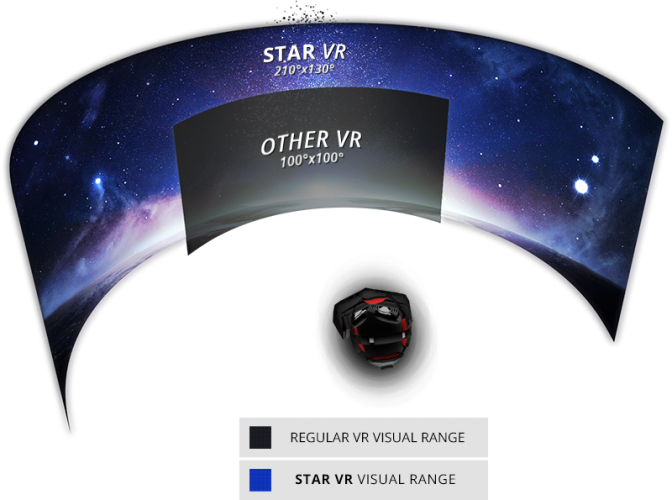
Even if you do full body tracking in your home, you are going to be extremely limited. You'll be running into the boundaries of your play space constantly. Those tricks of perception that allow you to walk along a curve instead of a straight line and thus never hit a boundary require very large amounts of space, especially if it is done in a way that is not detectable at all by the user. "What about omni-directional treadmills?" At this point I think we are getting crazy. Not only are you buying a hugely expensive VR headset, but you are setting aside a huge space in your home and buying a fucking gigantic omni-directional treadmill. Plus, the treadmill also does not provide the bodily acceleration required to prevent sickness because you are stationary relative to the earth while you use it.
And all of this is assuming that VR headsets reach a place where we have full FOV, perfect resolution and extremely high refresh rates. And VR headsets that have all of that will never be affordable unless they become popular. And they probably won't because of the reasons that I have just explained to you.
The one thing that I think has the potential to make VR popular is monitor replacement. Other than that, when I look at the future of this kind of technology I see AR. Not VR. I am sorry Rift fans, it was painful for me too.