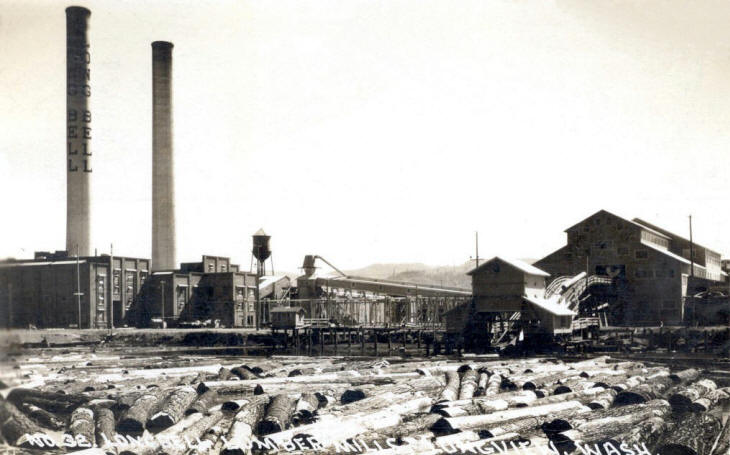
I've been looking for an hour for an image to post here, it is a end-on view of the long bell sawmill log drying facility. The logs are so large that it takes a while to realize the scale of the image, the people are tiny compared with the logs. Just a few hundred years ago large parts of the US and Canada were covered with forests of giant white pine and other trees that are now a rarity. With 'giant' I really mean giant, logs 5 meters or more in diameter were not exceptional. Unfortunately I haven't been able to locate the image, the closest that I've found is this one, which gives you a tiny little taste of what was lost:
Those trees must have taken hundreds of years to grow so wide. Chopping them down for wood would never be sustainable (that's why they are gone, right?). The great win of this technology is that you can use small trees that grow fast and can be sourced from managed/sustainable forests.
Modern 'engineered wood' is there for a reason: it is cheaper and stronger by weight than solid beams. But nothing quite replaces the feeling that comes with a 16" square beam that is now in use in it's third building since it was originally cut.
If you look closely at many cheap wooden products you'll notice a peculiar kind of joint in use that allows a lot of scraps to be glued together with roughly the same strength as a regular piece of wood of the same diameter. Ikea beds use this trick for instance. That's an interesting approach because it greatly increases the amount of usable wood from a tree.
Yes, there is some recovery due to better forest management. But compared to a few hundred years ago it is still quite meager and I suspect it will never go back to where it was as long as the economy depends in some small part on logging.
I've seen an old map of Canada from the Hudson Bay company days. It was a very thin line of settlements just North of the border, and then this vast white outline inscribed with 'Immense Forests'.
Driving around Ranger Lake in Northern Ontario (be sure you take enough gas with you) is a really nice way to see Canada with different eyes. Plenty of logging there too but the feeling of not having a settlement near you for 75 km or so in any direction is quite a strange one in the Western world. (Or at least, it was for me)
The primary factor limiting the scope of Canada's forests isn't logging -- it's farming. A lot of land was cleared early in Canada's history; a few trees being cut down here and there are quite insignificant in their comparative impact.
I've lived in the middle of a logging concession and the degree of forest management going on today compared to even the recent past is impressive, given a few hundred years of this Canada will once again have some extremely impressive forests. Right now it is already getting there but nothing at this scale can be fixed rapidly if only because it takes a long time for a forest to really reach maturity.
Have you been near the Timmins area? (North of Sudbury)
Haha, that's the kind of literal answer only a programmer would give :)
Ok, so there is an area inscribed by Timmins on the North-East side, Wawa in the North-West, Sault-Ste Marie in the South-West and Sudbury in the South-East. Inside that square is a very nice sample of what Canada must have looked like in the past. The only 'real' (blacktop) road crossing the area is the 129, you can simply ignore that. If you ever feel really adventurous hiking in that area is an experience that I won't be able to put into words.
Let me give you just one picture to give you an idea of what it looks like (from the Western most boundary):
The wood technology mentioned in the article isn't particularly new, but has certainly been getting more attention recently in the push towards more sustainable construction practices. In the bay area, most new mid-rise (3-8 story) residential construction goes up as a concrete pedestal parking garage with a wood structure on top - wood has a great strength/weight ratio and so reduces the earthquake forces you have to design for.
The biggest issue in going taller and to other occupancy types is fire. Buildings over a certain height (related to the height of fire truck ladders) are designed to burn out entire floors completely[1] without collapsing[2]. This is easier with steel and concrete, which lose strength at temperature but don't actually add fuel to the fire. What's been found more recently is that if you put the right additives in engineered wood products and make it a stocky enough shape then the wood will burn itself out even in a very large fire. But that information is new, and building codes are necessarily conservative. These things can also get awfully political, considering that there are separate trade organizations for the wood, concrete, and steel industry who all have a vote and want the code to say that their material is the safest.
I wonder if this is a good or a bad thing. When it becomes mainstream and the process becomes common and cheap, will every building use this process? If so, how do we sustain it and be competitive. We could do everything to grow new stock, but poor countries can use slash/burn techniques to win contracts on wood stock. It would continue the deforestation's we are already seeing. I would like to see local wood farmers who are doing it right, lobby for laws that make this movement a green path as well, then I am all in.
World forest coverage has almost stablized, and is increasing in wealthier countries. Presumably, it will finish turning around in the next decade or so as developing countries become less poor.
Wood that is grown, cut, and then used in a way that resists decomposition contributes as a non-negligible carbon sink.
That's what I mean by "almost stabilized". Global forest coverage is still decreasing, but at a rate that is clearly slowing. And since we see that coverage increases in rich countries, we tentatively conclude that the rate of global decrease will not equilibriate at some negative value, but rather will continue flattening and then turn upward as poor countries become rich. Furthermore, the low point of this process is not particularly bad; it forms a trough that bottoms out at ~4% decrease compared to current levels.
A lot of this timber is made from pine, which grows insanely fast in some areas of the world (e.g. New Zealand).
That's what's so great about engineered timber, rather than relying on the innate properties of the timber from a particular tree, we can engineer the timber to make up for deficiencies.
If wood gets wet, it's not necessarily a disaster, as it can be dried. But if there's a moisture barrier surrounding it, it might never dry. Think about a log is wrapped in plastic. Moist wood will be eaten by mold.
During a house's long lifetime, it's likely that there are problems and some structure gets to experience some moisture at some point. It should be able to recover.
A friend told that a house expert had a quote.
"There's two kinds of houses: 'if' houses and 'despite' houses."
The 'if' houses stay in shape if everything works correctly. The 'despite' houses stay in shape despite there being occasional maintenance lapses. The key takeaway is robustness to real life events.
After reading the article I was curious about the actual adhesives used...I've seen what mother nature can do to sheets of ordinary plywood after only a couple of years outdoors an had my doubts about exterior applications...
Those photos of wooden architecture are absolutely beautiful. I'd love to live in a house that looked like that. It's even environmentally friendly so long as you're only using farmed wood, and there's no reason you wouldn't when you're using engineered wood products.
Compared to some of the alternatives? And it doesn't really matter. You don't really use treated lumber indoors, and you don't really have direct contact with it to begin with.
Anyone have any idea about the safety of the chemicals and adhesives they use to make these things? I'm curious if the glue will last indefinitely and more importantly if we aren't going to find out in 50 years that the stuff they treat all this wood with is killing us like seems to happen with so many things.
I wonder how much "thinner" the building can look. If other kinds of support need to be covered, that adds thickness to walls, supports, and pillars. If the wood doesn't need to be covered, would the buildings look noticeably leaner?
Its a peculiarly composite article in that the first half is about the cool advantages of several new technologies that conceptually boil down to extremely high quality and strength bulk plywood, so you can have a 12 inch structural beam that's 40 feet long, etc. This is new technology and it usually takes building codes awhile to accept new technology. Every line of a building code was written on a stack of dead bodies, changing codes is a very serious business.
The second half of the article is completely unrelated, just interior decorating fashion is going thru its periodic fascination with finished wood a-la knotty pine wall paneling mancaves in the 1970s. There's nothing wrong with it although all those interior finishes could be done with veneer on metal or various faux processes having nothing to do with the first half of the article.
> This is new technology and it usually takes building codes awhile to accept new technology
You just need a UL rating (or UL assembly rating) to integrate new technology into your building... you can look it up in the IBC. Usually manufacturers are required to UL rate their building products. The only time I've had a client willing to pay for it was one who wanted to do a building made of shipping containers they had for free and that was at least 10 years ago. The containers were never tested, but UL was able to supply enough docs to satisfy the reviewers prior to permitting.
On the other hand there's Ise shrine, which is indeed not built to last, and only 3 years old at the moment. It's been torn down and rebuilt the same way every 20 years since the 600s to keep it looking new.
It's important to keep in mind with very old wooden structures such as these that they are often rebuilt over the centuries, plank by plank, as it were.
From the Wikipedia entry you cited:
> A very important problem in dating the churches is that the solid ground sills are the construction elements most likely to have the outer parts of the log still preserved. Yet they are the most susceptible to humidity, and as people back then reused building parts, the church may have been rebuilt several times. If so, a dendrochronological dating may be based upon a log from a later reconstruction.
Boat builders reckon the answer is to build from Kauri or Huon Pine - both of which are extremely slow-growing, over logged in the past, and now on protected species lists. There's actually an industry in Tasmania of harvesting Kauri from swamps and riverbeds, and selling it as craft timber...





https://s-media-cache-ak0.pinimg.com/236x/a6/8c/1f/a68c1f38c...