Sent them anyway as the brass's belief in the Norden bomb sight was far in excess of its ability. Tests had been in perfect steady level flight, in perfect visibility in the desert. Daylight raids had horrific losses, yet were repeatedly shown that in practice accuracy was no better.
Night raids would have cut losses markedly and achieved no worse accuracy.
It was often not Chinese whispers though -- that's dismissive. Our being "modern" there's a tendency to think because they didn't have ink cartridges and internets they were stupid and all knowledge ephemeral. How about an alternative that fits with aboriginal, and African oral culture:
Imagine explaining a complex process, using language carefully structured to be memorable, to the next generation. Then spending hours repeating, testing and checking their recollection over the coming days and years to ensure their memory is as yours. Rather like rote learning of tables and other "modern" learning. 2x2=4 doesn't become something else that way.
Each generation gets a complex story they may not see the applicability of, but if it's evolved to be important in the culture to remember, maybe they figured ways to remember until it is useful again. Africans did, pre-Medieval Europeans did, and for the longest period known, aborigines did. Why not these?
Agree that oral transmission was an important & practiced skill. But I do wonder about how well it let you transmit "technological" knowledge, in a manner that could be turned back into practice. Do we have any examples of people doing this?
My counter-example is various failures to reproduce early industrial-revolution processes... from memory, wasn't there a stage when the French were pushing to catch up in iron-making, and sent spies to England, from whose accounts they could not make the process work? Despite having not just words, but materials and examples of the result. (The solution, eventually, was to pay people who had the knack to move there.)
I think you underestimate how much better a pre-literate culture is at memorization, compared to a culture with the luxury of writing. It would be more useful to find an example of a similar pre-literate culture to make your point.
No, the point I was trying to make is that even with absolutely perfect transmission (which is the best they could hope for) it can be very difficult to translate words back into actions. It's also hard to learn golf or dancing from a book (again, perfect error-free memorisation) because there's a lot of knowledge which doesn't fit well into words. Muscle memory, once you've got it.
I presume this was also true of the making of stone tools, or pottery. And of the recognition of edible plants & mushrooms. All of these are skills which I'd be surprised to see transmitted over a long time-lapse. (Without being at all surprised by the memorisation of stories, at a level I could never match.)
The most recent example might be the Australian aborigines fire rituals. After this year's bush fires there have been many calls to use their fire ritual burnings once again. I gather this has been done in the Northern Territories for a few years, and is far more successful than advanced, technological and knowledge filled approaches (Western arrogance that our way must be better) that pushed the traditional out for decades. They seem to have kept more than enough to be far better at it than those meant to know. How well they work in a significantly changed climate is another question, but it appears to work better.
Speculating wildly here, we don't know the Neanderthals didn't ritualise the activity into a dance or an act to retain some of the process as well as the words. As we do with dancing, martial arts, even theatre or early stages of ancient apprenticeships. That might transmit the muscle memory of golf or stone tool making -- without the practised skill. How far that remains applicable using a stick in place of a golf club, or pine cone in place of a lump of flint is impossible to guess, but puts you closer than mere words.
I have to assume they wouldn't suffer the Wikipedia tendency to explain the technical so technically perfect (including all obscure jargon) that it's often bordering on impossible for an intelligent outsider, deeply skilled in other technical fields, to follow. :)
What's the time-period for the firebreaks? I mean when these skills last used, even if on a smallish scale?
OK, ritualising a "how to ride a bicycle dance" seems like it could be a way to pass more information than a perfectly repeated poem / book. (Perhaps thinking of oral tradition as meaning Homer not how to chip flint is a blind spot in how we think about such things?) Would still be extremely curious to know of any examples where this actually happened.
The key takeaway from all I've seen is it's not just telling stories, but like some of the more recent pre-literacy Western oral traditions, is more like a formal passing on, testing, repeating to ensure the message is passed on accurately.
I was just reading about a culture that passed on knowledge orally by listening to important people on their deathbed. This was unfortunate in the context of the 1918 flu epidemic.
I believe there was at least one plains indian tribe that banned any discussion of their historic stories unless there were at least a dozen members present.
Firefox is under Mozilla Corporation, which is owned by Mozilla Foundation.
Thunderbird will now be under MZLA Corporation, which is owned by Mozilla Foundation.
Why not put it pack in Mozilla Corporation? Because Mozilla Corporation has tried to jettison it a few times for not aligning with their goals, I guess?
RAF museum in Hendon has extensive archives, and holds a fair selection of squadron records, though mainly maintenance and base records I think, and a huge archive of photos and other papers. The National Archives holds most squadron operational records -- nearly all survived, so it should be relatively easy to check, and potentially get confirmation.
If you have his log book, a drop would be recorded by pilot and bomb aimer, but I'm not sure if that would be required for a gunner. Failing that if anyone in the family remembers their squadron # or plane's code (RAF were 3 letters -- 2 letter squadron code and 1 letter aircraft ID, so easy to remember and they'd usually fly the same plane each time), or has any bits with his service number, either will help narrow down an archive search and correlate with records.
The RAF museum have had several projects gathering anecdotes, and adding personal details to their formal archives, and an extensive research section.
I'm sure there's equivalents for the USAF, maybe through their museum in Dayton, OH? I'm sure both RAF and USAF museums are used to dealing with history enquiries and may be able to point you at other resources that may help.
There's just about zero chance of no wind even if you only consider the East and West coasts of Britain and Ireland. Both of which have colossal wind generation potential. Chances of the whole of Europe from Portugal to Romania, Malta to Finland being becalmed? Slim. :)
> There's just about zero chance of no wind even if you only consider the East and West coasts of Britain and Ireland.
Almost zero chance, and yet it happens every year!
> Chances of the whole of Europe from Portugal to Romania, Malta to Finland being becalmed? Slim. :)
That's more true, byty that doesn't matter actually:
1- you can't expect one third of Europe to provide power for the whole continent when they are the only one with wind or you need to massively overdimension every country's power generation, to a point which is far from profitable.
2- the European grid don't work this way, you can't pump hundreds of gigawatts from one side of the grid to the other. Each link is only capable of transferring a few gigawatt at best from a country to another.
For the odd day. It never happens for lengthy periods. Most of the time wind will be the right answer for significant generation in Britain and Ireland, with great interconnect export potential, so we'll use proportionally less solar and more wind in the mix than Italy will. :p
I simply don't understand why just about everyone on HN who argues against renewables presumes 100% solar, 100% wind, 100% whatever. Every nation will have an appropriate mix for their differing conditions -- isn't that obvious? Apparently it's really not. Interconnecting to nearby nations to move mainly westerly wind power eastwards, and mainly southerly solar northwards. Yet it's still worthwhile for Romania to be adding wind generation. It's still worthwhile for England and Scotland to add solar.
No one is expecting one nation to actually supply the whole of Europe -- grids are becoming more localised and far smarter within the European super-grid that's aiming for continent wide management. The UK is already seeing moves to demand shifting, and localised demand. We'll see far more of that fine level demand shifting, managing in-home batteries and grids managing ever more generating sources to keep to the best mix of sources at any given moment. Right now they do a fine job as you basically never realise the grid is even there, yet the mix of sources varies across every day throughout the year. How Orkney power companies manage it gives an idea where we're heading.
There's a lot of new interconnects in the pipeline across all of Europe too -- UK has 5 or 6 new ones coming soon. Scotland is progressing to new pumped storage of similar size to Dinorwig, though I'm not sure where in the approval process that currently is, or if it'll ultimately be rejected.
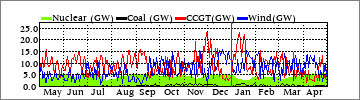
We'll all keep some generation of last resort -- right now, in the UK that's coal. It comes in as less economic than interconnects most of the time. There's a few (three or four IIRC) remaining coal plants, all of which are spending 99% of the time idling. Doing absolutely nothing but being ready for spin up. In five years all the coal will be closed, and it'll be the gas plants at the bottom of the heap. It's already uneconomic to build new gas.
I analysed the Templar website grid watch records for I think 2017 and they showed a period of five days with no wind and overall, wind generation was about 30% of the rated maximum over the year. Also don't forget that turbines close down if the winds are too strong as well as too weak.
Sure, and that's not ever in dispute. That's what the grid manage on a daily basis, and the reason we have a mix of sources, and need to always have a mix of renewables. We're also only using a tiny amount of the renewable potential. Not forgetting offshore alone is even less variable.
The only thing that matters is getting the right mix for the local conditions, and a grid capable of managing the rising amount of generating sources properly, and smartly. So far the grid's side of things is being done pretty well, and is pushing and promoting faster renewable adoption. The Westminster political part not so much.
Wind can provide the bulk of regional need, but clearly can't ever be 100%. The resulting mix also has to allow for keeping the lights on in once in a century conditions as well as normality -- an increasing challenge with changing climate.
Europe has some of the best spots on the planet for wind generation. Winds are in many places, a near constant companion, and usually within the range that turbines prefer. Any one of Britain, Ireland and the Nordics could supply a huge proportion of Europe's power needs with fully developed offshore wind. With a slim chance of ever being becalmed. Together I wouldn't be at all surprised to find generation capacity above European needs. There's plenty of suitable onshore sites too, and plenty of other European countries not yet mentioned.
Solar is never going to generate as much per panel in Scotland and UK as in California or Saudi, but it's good enough to pay well economically and in terms of emissions and overall impact too. Why wouldn't we use it in the mix? There's plenty of roof space doing nothing else.
New hydro has less scope, but there are suitable sites, and a large selection of locations suitable for pumped storage -- some of them part prepared by already having a lake in a disused quarry!
> Solar is never going to generate as much per panel in Scotland and UK as in California or Saudi, but it's good enough to pay well economically and in terms of emissions and overall impact too. Why wouldn't we use it in the mix? There's plenty of roof space doing nothing else.
Regarding this I live at 54N, and here installing roof top solar will pay for itself in less than 10 years. That's excluding government grants, and any electricity you are paid for exporting, so in reality it could be as little as 5. After that you have free energy for the life of the system - the inverter will last 15-25 years, solar panels will last the life of the building, but will produce less power over time.
>Europe has some of the best spots on the planet for wind generation. Winds are in many places, a near constant companion, and usually within the range that turbines prefer.
And how much area does that require? Sure, the countries with a long coast might be able to do it, but others might not be able to as easily. Even if they can do it, electricity and land prices would be more expensive there than elsewhere. I'm not sure how this would work politically, because business would probably just move to the other parts of the EU.
>the Nordics could supply a huge proportion of Europe's power needs with fully developed offshore wind.
The further you have to transport electricity the less efficient it becomes. And when you say "Nordics" here are you talking about just Denmark or do you include Sweden too? Because remember, Norway is not in the EU.
This kind of an energy solution is likely unthinkable politically as well. It would render some nation states vulnerable to others.
Well the regions with the most wind tend to concentrate in Western Europe, conveniently with lots of Atlantic, North Sea, and to a somewhat lesser extent Baltic coasts. Summer winds down in N Africa.
I include Norway as we're talking about Europe, and there are two interconnects coming with the UK -- one in progress, one planned, and other EU-Norway links coming. UK has about 5 others in progress to Netherlands, Ireland and elsewhere. There's loads of new interconnects in the pipeline within the EU and to surrounding. I've even seen Iceland in one interconnect proposal, which was somewhat surprising. Proposed interconnects to N Africa less so. There's lots of suitable onshore sites too, mainly in spots where other uses of the land are limited.
Politically not at all unthinkable though -- think of most nation's reliance on imported coal, oil, and gas, much of it for generation. That's more risky. Two way interconnect agreements are much less risk by comparison to import only, often from volatile oil and gas states. Reduced reliance on imported fossil energy is one of the big reasons it's heading that way and started in the first place.
So? The grids of the Nordic countries are already interconnected. There's also a 700 MW cable connecting Norway to the Netherlands, and plans for connections to Germany and the UK.
Pretty sure the UK National Grid does not have interconnects and pricing between Scotland and England in the same way as between UK and interconnect partners in the EU. It's part of the same grid. Scotland has no choice but that some of it be fossil unless and until England and Wales are fully renewable also. Northern Ireland and Orkney do have interconnects.
So they can monitor total renewable generation, and total consumption, but can't have influence on what the shortfall is made up by. I've no doubt the grid will move toward more locality as it redesigns for a smart grid suitable for 100% renewables, and Scottish independence might provoke formal interconnecting.
For now they are both in the same 'house'.
Edit: I find myself newly suspicious of that site's agenda as he links to Watts Up With That, a notorious and extreme denialist site in his blog role. His phrasing may have been carefully chosen to downplay and minimise the achievement. He seems to have a fair time in the oil industry from his about page.
I don't think it's just a question of Scotland not having a choice about where the shortfall is made up by, but of the shortfall having to be made up using fossil fuels.
For context, because Scotland is so big and empty, a disproportionate chunk of UK wind power is based there compared to their population - so much so that if I remember correctly their wind power has to curtail sometimes due to interconnect limits with the rest of the UK. It's kind of hard to get day-by-day or hour-by-hour figures for Scotland alone, but Scottish nuclear + renewables in the entire UK dropped well below Scotland's peak demand a good few times just in the last two months. That shortfall has to be made up using fossil fuels, there's no alternative - and a good chunk of that is going to be Scottish fossil fuel plants due to interconnect limits.
The Scottish government is simply using the fact that a disprortionate amount of UK wind power ended up there to spin themselves as less dependent on fossil electricity than they are. You can't measure progress towards an 100% grid using net figures like this because the last bit of demand is so much harder to satisfy renewably than the first, and countries with the ability to play silly tricks like this with net power can skip the hard part and pretend they've solved the problem. If/when renewable generation in England and Wales increases it might well even roll this figure back as less electricity is imported during peak wind generation, despite the fact that both Scotland and the rest of the UK would be getting more of their actual electricity from renewable sources.
It's the Orkney interconnect that's at capacity. They really need an extra one.
Sure it's a lot of PR, but it's not just empty PR with a grid that's controlled mainland wide, and chooses sources minute to minute depending on availability, demand and price it's the best they can do. Scotland can, and does, encourage a much healthier approach to the adoption of renewables than Westminster. With more powers to the regions outside London, including Holyrood, so much more could, and would be done.
You can make the same criticism for every use of home solar panels, of green suppliers, of the whole transition to sustainable, and even of the entire markets for gas and electric considering we can't segregate individual electrons and atoms.
It's kind of hard to get Scotland figures alone because there is no separate Scottish grid, nor interconnects as such, just the mainland National Grid encompassing the three mainland countries. It's accounting, but it's not silly, it's the market we're all forced to participate in. We could have more precise regional figures with regional grids with interconnects between. We're not really large enough to need or justify that. Scottish independence, if it ever comes, might well see a Scottish grid as separate entity.
You're right that the same criticism could and perhaps sometimes should be aimed at "net zero" homes with solar. Arguably solar is even worse than wind in the UK, because we're so far north that it has an awful capacity factor and it reliably drops off when power is needed the most. Ecohomes and net-zero homes have extra insulation that does provide a benefit in winter, but home solar alone is dubious. (The UK government also basically killed off subsidies for it.) It's a little more useful in countries closer to the equator with better capacity factors and summer aircon rather than winter heating, since output is reasonably closely correlated to demand then, but still won't get us to actual zero even there.
No it's not dubious at all. It's hilariously beneficial considering how far north we are, where I honestly thought it would be very borderline, and probably not worth it at all.
We just about eliminated the electricity component of the typical UK supply of electricity and gas for heating. That's not net zero, or creative accounting, that's actually eliminate use of grid electric for nine or ten months, with a little use in winter. That only because of switching water heating to the panels, that was previously on gas. We're in N Cumbria.
It feels that way because it has been exactly as you describe. I can only assume it's youngsters who have been doing the undeserved downvoting. If you look at the timeline, you can get a feel for why, and who:
1988/9 First ISPs and connections outside academia
1993 Eternal September, AOL let the great unwashed out on to the net. Damn annoying for six months or so, but the net recovered.
1994 First spam, and colossal in scale. Two bottom feeding US lawyers filling every usenet group with US Green Card spam.
1995 NSF end their ban on online commercial activity.
First e-commerce kicks off, and it's all a bit hobby-esque, and even large businesses are adopting netiquette habits. Like linking out, providing chatty informative pages for no other reason than "because", etc. Putting an e-commerce order somewhere might get you a lovely long chatty thank you email direct from the owner, or a hand written note in the box. The internet still feels like something remarkably different to meatspace.
By the millennium, the year AdWords was born, as the first dot com boom turned into a full on idiocy fuelled bubble, it was the birth of bait and switch. There's a whole ballooning category of "internet marketers" with gloriously scummy SEO, fraudulent sales tactics, learn to spam better courses and worse. Like all easy way to riches sales, the only way to get rich is with the easy way to riches book, subscription or course parting fools from money.
Now everyone commercial, from the largest 5 world companies down, are internet marketers of the worst possible interpretation of the term. Commerce, scam and affiliate slice forced into everything. Bait and switch all the way down.


Night raids would have cut losses markedly and achieved no worse accuracy.