Reminds me of Neil Postman's "Amusing Ourselves to Death" (1985), in which he argues that TV as a medium is fundamentally incapable of producing anything other than entertainment. So things like news, political discussion, or any other type of educational programming can only exist on TV as a nutrition-less pantomime of the real thing.
Education, real education, can be made entertaining. Mythbusters and Connections (I believe it was called) both qualify. As do some historic documentaries.
One line in the piece says "Observing the direct effects of radiation, although possible, requires extraordinary circumstances.". While this is mostly true, you can actually observe radiation directly, with your own eyeballs, without any extraordinary methods. Basically all you need is a radioactive source, scintillator and a very dark room. That's how scintillation counting was done back in the day. This sort of device is called a Spinthariscope, you can find examples of them on youtube and what you see is a lot like the map in the OP. So I'd say the author did a good job.
The author probably counts these as indirect effects, as it is the collision of the α particles with zinc sulfide, and not a direct effect of radiation like Cherenkov.
isnt cherenkov also caused by interaction with water molecules?
edit: the article goes into a little more detail and talks about how its due to the different speeds of light in water and vaccuum, and I don't know enough about semantics or physics to say what this means about my original question :)
It's kinda a complicated question. Cherenkov radiation can be produced in any medium that has index of refraction greater than 1, that's what allows the charged particle radiation to go faster than the light it produces, which ultimate is what causes the Cherenkov light. The process is not reliant on the specific molecular/chemical/whatever properties of the medium, only dependent on the index of refraction. But, the index of refraction in turn comes from polarizabilty and magnetic susceptibility of the medium. Those factors depend on both what atoms & molecules exist in the medium, but also the structure of those molecules. For example, ice and water have the some chemical composition, but slightly different indices of refraction.
To be a bit nit-picky, Cherenkov light typically has a wide spectrum. For water it spans the entire optical range, peaking around 350nm and dying off at longer wavelengths. So you could, for example, put dye in water such that it absorbed more blue light, but you'd still be able to observe some red light from the Cherenkov radiation escaping. But the signal would be much fainter.
Although, one further caveat, changing a materials absorption spectrum will also change it's refractive index as a function of wavelength, which will in turn effect how much Cherenkov light is emitted at each wavelength. So the situation is more complicated still.
Agreed the classical electrodynamic approach lets us derive this relationship in terms of electric fields (Ampere-Maxwell and Gauss given a suitable gauge), a change in permittivity /varepsilon lets us change the region of this effect
The only neutrino detector placed in a salt mine was the IMB detector. That detector was ~10kt of water observed by ~2 thousand photo-detectors, it was located ~600meters underground. The only neutrino detector that's a mile underground was the SNO detector, which was ~1kt of water, observed by ~10 thousand photo-detectors. The SNO detector is still running today as the rechristened SNO+ experiment.
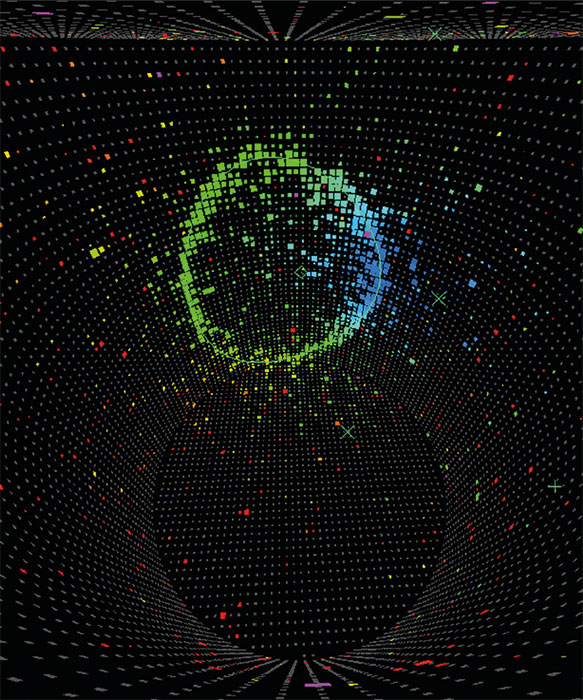
Both the IMB and SNO detectors used electron scattering to observe neutrinos, a neutrino comes in and bumps into an electron orbiting an atom, the electron & neutrino both then go flying off. The electron will usually go off in the same approximate direction that the neutrino was traveling, conservation of energy and momentum requires that. The electron, if energetic enough, emits Cherenkov radiation as it goes. Cherenkov radiation is just the light equivalent to a sonic-boom, it is emitted in a cone centered around the electrons direction of travel. The light from that cone is detected by the photo-detectors. Crucially, both the interaction process (electron-scattering) and the detection process (Cherenkov radiation) will preserve the directionality from the original neutrino (for the most part). The pattern of photo-detectors that gets hit by the Cerenkov light can be analyzed to reconstruct the Cerenkov cone and estimate the original neutrinos direction. Here's an example of an observed Cerenkov ring at the Super Kamiokande detector, although this example is very clear, the Cerenkov rings aren't always so obvious.
https://cerncourier.com/wp-content/uploads/2016/07/CCthe1_06...
The IceCube detector is somewhat different. Their photo-detectors are buried in the Antarctic ice at various depths from ~1-2km and spread out over a roughly 1-cubic km volume, which is ~1Gt of water. I'm not exactly sure how many PMTs in total they have, I reckon its probably around 5-10 thousand. Since their PMT array is so much less dense than the previously mentioned experiments, they can only observe very high energy, very bright, light flashes. So neutrino sources that are low energy, like the Sun, are invisible to them. But, they can see sources that are very high energy, and Ice Cube's extraordinary size lets them observe interactions that are rare/infrequent, such as those from very far away galaxies.
High energy neutrinos will almost always interact via "Deep Inelastic Scattering" (DIS), which is basically the neutrino hitting the protons & neutrons within an atomic nucleus. Since DIS is a scattering process, conservation of energy/momentum requires the scattered particles will preferentially travel in the same direction that the incoming neutrino was traveling in. After that Cerenkov radiation is produced from the scattered protons & neutrons, and that Cerenkov radiation still is emitted in a cone pointing in the direction of travel. So once again, the interaction (DIS) and detection (Cerenkov radiation) preserves directional information. So the pattern of which photo-detectors observe the light can be used to reconstruct that direction, and point back to the neutrinos source (approximately).
I think you're correct to say a lot of people simplify what the problem is with neutrino mass. In principle it seems like there is no problem, you just add a mass term for the neutrino just like any other particle. Just b/c at first we didn't expect that term to be there doesn't mean it's a problem to now, or that original expectation was all that meaningful. And again, as you point out, there are a couple of potential ways to add that mass term in, either the "normal" way with a right handed neutrino, or with some fancy see-saw majorana term, or some combination thereof.
The issue is though, right now the standard model is at least ambiguous in terms of the majorana mass term. If it ends up the neutrino gets its mass from only the "normal" mass term, then why doesn't it have a majorana mass term? There's no current symmetry that says there can't be a majorana mass? If the neutrino's majorana mass is zero, then you'd probably have to introduce a symmetry into the standard model that says majorana particles can't exist.
But if the neutrino does end up having a non-zero majorana mass term then that means the neutrino is a majorana particle, and can undergo lepton number violating processes (e.g. neutrinoless double beta decay). Again, that's new physics.
So no matter how you give the neutrino mass, you're gonna have to modify the standard model in some "significant" way to accommodate. Either by specifically saying majorana particles can't exist, or by allowing for lepton number violating processes.
Now you could say, well then it might the case that majorana particles don't exist b/c that would require lepton number violating processes, so I don't need to introduce a new symmetry, I can just take advantage of one that's already lying around. That might be a valid claim to make...I'm not sure. I think the issue with that comes down to the difference between lepton number a global vs accidental symmetry in the standard model.
Articles like this always remind me of Clifford's "The Ethics of Belief". I feel like no one ever sums up the the importance of thorough and independent thought as well as Clifford did 150 years ago.
For their more recent data they reported seeing ~32000 solar neutrino events over a 1600 day dataset (cite: top-right of page 13 https://arxiv.org/pdf/1606.07538.pdf). Their detector nowadays is more sensitive than it was when the OP was published so I would estimate the image comes from probably around 5000 neutrino events.
And I don't know any specific numbers but you can be sure a large amount more of neutrinos interacted with the air/rock between the Sun and Super-K than interacted in the detector volume. But that number (whatever it is) is still tiny compared to the total flux (which is ~5 million per square centimeter per second).
And that's of just the "high energy" type neutrinos that Super-K is sensitive to. The lower energy varieties are more like 10 billion per square centimeter per second.
I think what you're seeing is either a random noise fluctuations, or perhaps a result of the coordinate system they're using for that image. If you take a look at a similar, more up to date, image from Super-K that uses more data you don't see any sort of elliptical nature. http://www-sk.icrr.u-tokyo.ac.jp/sk/physics/image/image_sola...



reply